Lovato Nicole, Short Michelle A, Micic Gorica, Hiller Rachel M, Gradisar Michael
Adelaide Institute for Sleep Health: A Flinders Centre of Research Excellence, Repatriation General Hospital, Flinders University.
Centre for Sleep Research, University of South Australia.
Nat Sci Sleep. 2017 Feb 13;9:3-10. doi: 10.2147/NSS.S111521. eCollection 2017.
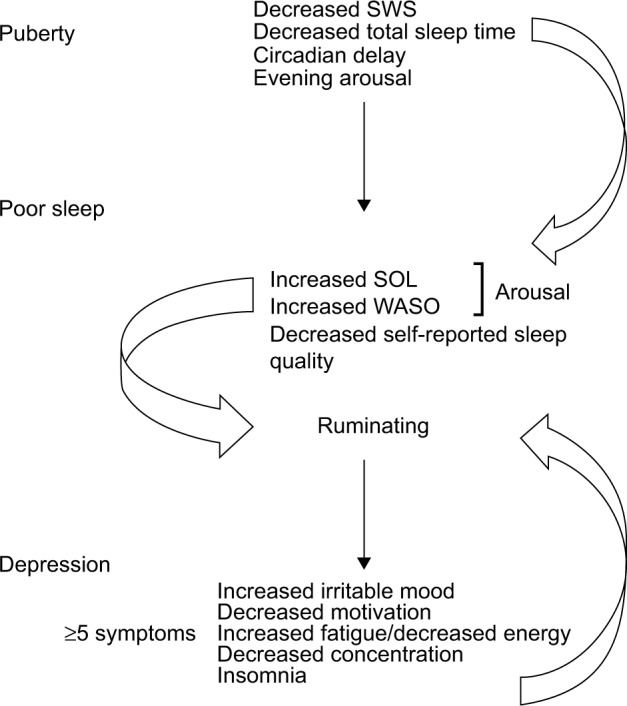
The prospective, bidirectional relationship between sleep disturbance and depressed mood was assessed in a school-based sample of adolescents.
One hundred and thirty-eight Australian adolescents (mean age time 1 =15.69, standard deviation =0.92; 64% male) completed questionnaires to assess sleep parameters and depressed mood, on two occasions over 1 year.
Cross-sectional associations were observed between depressed mood and sleep duration, as well as wakefulness in bed. Prospective analyses revealed depressed mood predicted less total sleep time on school nights and a longer latency to sleep onset on weekends 1 year later. There was no prospective support for sleep predicting later depressed mood.
Contrary to prediction, our results suggest in this case that depressed mood may act as a precursor to poor sleep rather than the converse.
在一个以学校为基础的青少年样本中评估睡眠障碍与抑郁情绪之间的前瞻性双向关系。
138名澳大利亚青少年(平均年龄时间1 = 15.69,标准差 = 0.92;64%为男性)在1年中的两个时间点完成问卷,以评估睡眠参数和抑郁情绪。
观察到抑郁情绪与睡眠时间以及卧床清醒时间之间存在横断面关联。前瞻性分析显示,抑郁情绪预示着1年后上学日晚上的总睡眠时间减少,周末入睡潜伏期延长。没有前瞻性证据支持睡眠可预测后期的抑郁情绪。
与预测相反,我们的结果表明在这种情况下,抑郁情绪可能是睡眠不佳的先兆,而非相反。