Ozansoy Kasap Berna, Marchenko Svitlana V, Soldatkin Oleksandr O, Dzyadevych Sergei V, Akata Kurc Burcu
Department of Micro and Nanotechnology, Middle East Technical University, Ankara, 0631, Turkey.
Laboratory of Biomolecular Electronics, Institute of Molecular Biology and Genetics, National Academy of Sciences of Ukraine, 150 Zabolotnogo Str., 03680, Kyiv, Ukraine.
Nanoscale Res Lett. 2017 Dec;12(1):162. doi: 10.1186/s11671-017-1943-x. Epub 2017 Mar 2.
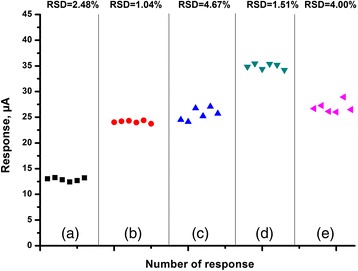
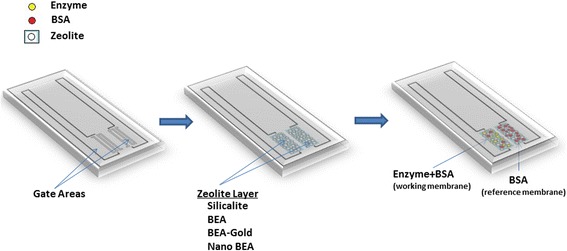
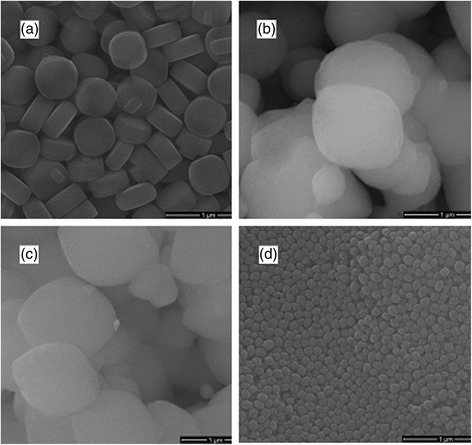
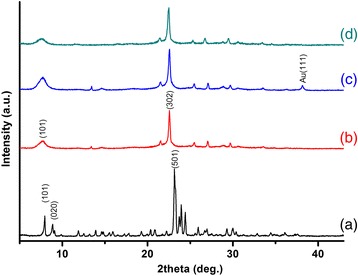
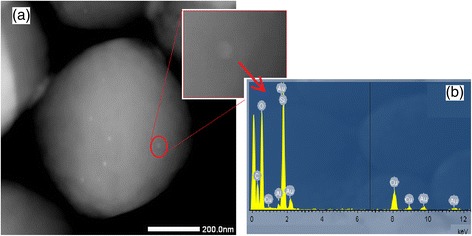
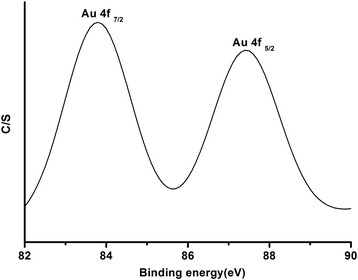
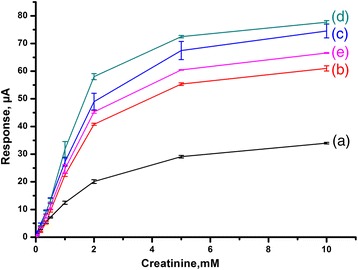
The combination of advantages of using zeolites and gold nanoparticles were aimed to be used for the first time to improve the characteristic properties of ion selective field-effect transistor (ISFET)-based creatinine biosensors. The biosensors with covalently cross-linked creatinine deiminase using glutaraldehyde (GA) were used as a control group, and the effect of different types of zeolites on biosensor responses was investigated in detail by using silicalite, zeolite beta (BEA), nano-sized zeolite beta (Nano BEA) and zeolite BEA including gold nanoparticle (BEA-Gold). The presence of gold nanoparticles was investigated by ICP, STEM-EDX and XPS analysis. The chosen zeolite types allowed investigating the effect of aluminium in the zeolite framework, particle size and the presence of gold nanoparticles in the zeolitic framework.After the synthesis of different types of zeolites in powder form, bare biosensor surfaces were modified by drop-coating of zeolites and creatinine deiminase (CD) was adsorbed on this layer. The sensitivities of the obtained biosensors to 1 mM creatinine decreased in the order of BEA-Gold > BEA > Nano BEA > Silicalite > GA. The highest sensitivity belongs to BEA-Gold, having threefold increase compared to GA, which can be attributed to the presence of gold nanoparticle causing favourable microenvironment for CD to avoid denaturation as well as increased surface area. BEA zeolites, having aluminium in their framework, regardless of particle size, gave higher responses than silicalite, which has no aluminium in its structure. These results suggest that ISFET biosensor responses to creatinine can be tailored and enhanced upon carefully controlled alteration of zeolite parameters used to modify electrode surfaces.
首次旨在利用沸石和金纳米颗粒的优势组合来改善基于离子选择性场效应晶体管(ISFET)的肌酐生物传感器的特性。使用戊二醛(GA)共价交联肌酐脱亚氨酶的生物传感器用作对照组,并通过使用硅沸石、β型沸石(BEA)、纳米级β型沸石(纳米BEA)和包含金纳米颗粒的BEA沸石(BEA-金)详细研究了不同类型沸石对生物传感器响应的影响。通过电感耦合等离子体质谱(ICP)、扫描透射电子显微镜-能谱仪(STEM-EDX)和X射线光电子能谱(XPS)分析研究了金纳米颗粒的存在情况。所选的沸石类型能够研究沸石骨架中铝的影响、粒径以及沸石骨架中金纳米颗粒的存在情况。在合成了不同类型的粉末状沸石后,通过滴涂沸石对裸生物传感器表面进行修饰,并将肌酐脱亚氨酶(CD)吸附在该层上。所获得的生物传感器对1 mM肌酐的灵敏度按BEA-金>BEA>纳米BEA>硅沸石>GA的顺序降低。最高灵敏度属于BEA-金,与GA相比提高了三倍,这可归因于金纳米颗粒的存在为CD营造了有利的微环境以避免变性以及表面积增加。其骨架中含有铝的BEA沸石,无论粒径大小,其响应均高于结构中不含铝的硅沸石。这些结果表明,通过仔细控制用于修饰电极表面的沸石参数的变化,可以调整和增强ISFET生物传感器对肌酐的响应。