Durá-Travé T, Gallinas-Victoriano F, Chueca-Guindulain M J, Berrade-Zubiri S
Department of Pediatrics, School of Medicine, University of Navarra, Navarra Hospital Complex, Pamplona, Spain.
Department of Pediatrics, Navarra Hospital Complex, Pamplona, Spain.
Nutr Diabetes. 2017 Mar 13;7(3):e248. doi: 10.1038/nutd.2016.50.
BACKGROUND/OBJECTIVES: Vitamin D deficiency may contribute to endocrine health and disease (diabetes, autoimmune thyroid diseases, polycystic ovarian syndrome, etc.). The aim of this study was to determine the prevalence and specific factors for hypovitaminosis D among children stratified by body mass index (BMI) in Northern Spain.
SUBJECTS/METHODS: A cross-sectional clinical (sex, age, season of study visit, place of residence and BMI) and blood testing (calcium, phosphorous, calcidiol and parathyroid hormone (PTH)) were accomplished in 546 Caucasian individuals (aged 3.2-15.8 years). The BMI (Z-score) allowed establishing four groups: normal, overweight, obesity and severe obesity. The criteria of the US Endocrine Society were used for the definition of hypovitaminosis D.
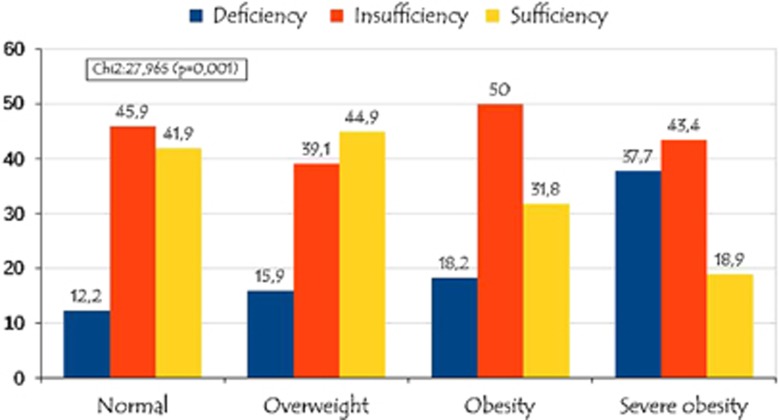
Calcidiol levels were significantly higher in normal and overweight groups (P=0.001), whereas PTH levels were significantly higher in obesity and severe obesity groups (P=0.001). Hypovitaminosis D prevalence was significantly higher in severe obesity (81.1%) and obesity (68.2%) groups, whereas was lowest in overweight (55%) and normal (58.1%) groups (P=0.001). There was a negative correlation between calcidiol and PTH levels (P<0.01). Female (90.9%), adolescent group (88,2%), winter (100%) and autumn (82.4%) time and urban residence (94.1%) imply a higher prevalence of hypovitaminosis D in subjects with severe obesity (P<0.001). Female, puberal age, autumn, winter and spring time, urban residence and severe obesity were found to be independent predictors for hypovitaminosis D.
Severe obesity could be considered as an associated factor for vitamin D deficiency, and, owing to its high prevalence, the implementation of systematic screening and hypovitaminosis treatment programs would be particularly useful.
背景/目的:维生素D缺乏可能与内分泌健康及疾病(糖尿病、自身免疫性甲状腺疾病、多囊卵巢综合征等)有关。本研究旨在确定西班牙北部按体重指数(BMI)分层的儿童维生素D缺乏症的患病率及相关具体因素。
受试者/方法:对546名白种人个体(年龄3.2 - 15.8岁)进行了横断面临床检查(性别、年龄、研究访视季节、居住地点和BMI)及血液检测(钙、磷、骨化二醇和甲状旁腺激素(PTH))。根据BMI(Z评分)分为四组:正常、超重、肥胖和重度肥胖。采用美国内分泌学会的标准定义维生素D缺乏症。
骨化二醇水平在正常和超重组显著更高(P = 0.001),而PTH水平在肥胖和重度肥胖组显著更高(P = 0.001)。维生素D缺乏症患病率在重度肥胖组(81.1%)和肥胖组(68.2%)显著更高,而在超重组(55%)和正常组(58.1%)最低(P = 0.001)。骨化二醇和PTH水平之间存在负相关(P < 0.01)。女性(90.9%)、青少年组(88.2%)、冬季(100%)和秋季(82.4%)以及城市居住(94.1%)表明重度肥胖受试者中维生素D缺乏症患病率更高(P < 0.001)。女性、青春期年龄、秋季、冬季和春季、城市居住以及重度肥胖被发现是维生素D缺乏症的独立预测因素。
重度肥胖可被视为维生素D缺乏的相关因素,鉴于其高患病率,实施系统的筛查和维生素D缺乏症治疗方案将特别有用。