JC School of Public Health and Primary Care, The Chinese University of Hong Kong, Hong Kong SAR, China.
Hong Kong Occupational and Environmental Health Academy, Hong Kong SAR, China.
Sci Rep. 2017 Mar 15;7:44610. doi: 10.1038/srep44610.
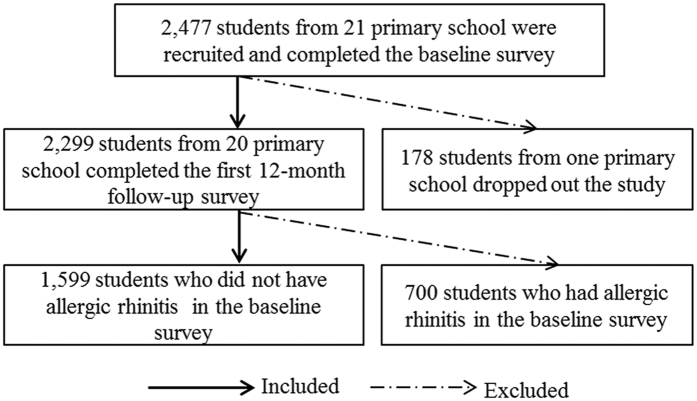
This study was to investigate the association between dietary patterns and rhinitis in primary school children. 1,599 students without rhinitis at baseline survey were selected from a primary school children cohort. Information on food consumption, respiratory symptoms, and confounders was collected using questionnaires. Dietary patterns were defined using principal component analysis. Logistic regression was performed to calculate odds ratio (OR) with 95% confidence intervals (95% CI). The incidence of rhinitis during 12 months follow-up was 21.2%. Three patterns were extracted and labeled as pattern I, II and III. Dietary pattern II which had higher factor loadings of legumes, butter, nuts and potatoes was associated with an increased risk of rhinitis (OR: 1.34, 95% CI: 1.01-1.87) when the highest tertile of pattern score was compared to the lowest tertile, after adjusted for confounders. Besides, every 1-unit increase of score of pattern II was also associated with an increased risk of rhinitis (OR: 1.19, 95% CI: 1.05-1.35). Neither pattern I nor Pattern III was observed to be associated with risk of rhinitis. A diet with higher levels of consumption of legumes, butter, nuts and potatoes may increase the risk of allergic rhinitis in primary school children.
本研究旨在探讨饮食模式与小学生变应性鼻炎的关系。从一个小学生队列中选择了 1599 名基线调查时无鼻炎的学生。使用问卷收集了关于食物摄入、呼吸道症状和混杂因素的信息。采用主成分分析法定义饮食模式。使用逻辑回归计算比值比(OR)及其 95%置信区间(95%CI)。在 12 个月的随访期间,鼻炎的发生率为 21.2%。提取了三种模式并标记为模式 I、II 和 III。饮食模式 II 具有较高的豆类、黄油、坚果和土豆的因子负荷,与鼻炎的风险增加相关(OR:1.34,95%CI:1.01-1.87),当最高 tertile 与最低 tertile 相比时,调整混杂因素后。此外,模式 II 评分每增加 1 分,也与鼻炎风险增加相关(OR:1.19,95%CI:1.05-1.35)。模式 I 和模式 III 均与鼻炎风险无关。食用更多豆类、黄油、坚果和土豆的饮食可能会增加小学生变应性鼻炎的风险。