Departments of Metabolism, Endocrinology and Molecular Medicine, Osaka City University Graduate School of Medicine, Osaka, Japan.
Premier Preventive Medicine, Osaka City University Graduate School of Medicine, Osaka, Japan.
J Diabetes Investig. 2018 Jan;9(1):55-62. doi: 10.1111/jdi.12657. Epub 2017 Apr 25.
AIMS/INTRODUCTION: A soluble form of the leptin receptor (soluble Ob-R) in the circulation regulates leptin's bioactivity, and is inversely associated with body adiposity and circulating leptin levels. However, no study has examined the clinical impact of soluble Ob-R on glucose metabolism in diabetes. The present study aimed to investigate the association of plasma soluble Ob-R levels with insulin resistance and pancreatic β-cell function in patients with type 2 diabetes.
A total of 289 Japanese patients with type 2 diabetes were included in the present study. Fasting plasma soluble Ob-R levels and plasma leptin levels were measured by enzyme-linked immunosorbent assay. Insulin resistance and pancreatic β-cell function were estimated by homeostasis model assessment of insulin resistance, homeostasis model assessment of β-cell function and fasting C-peptide index.
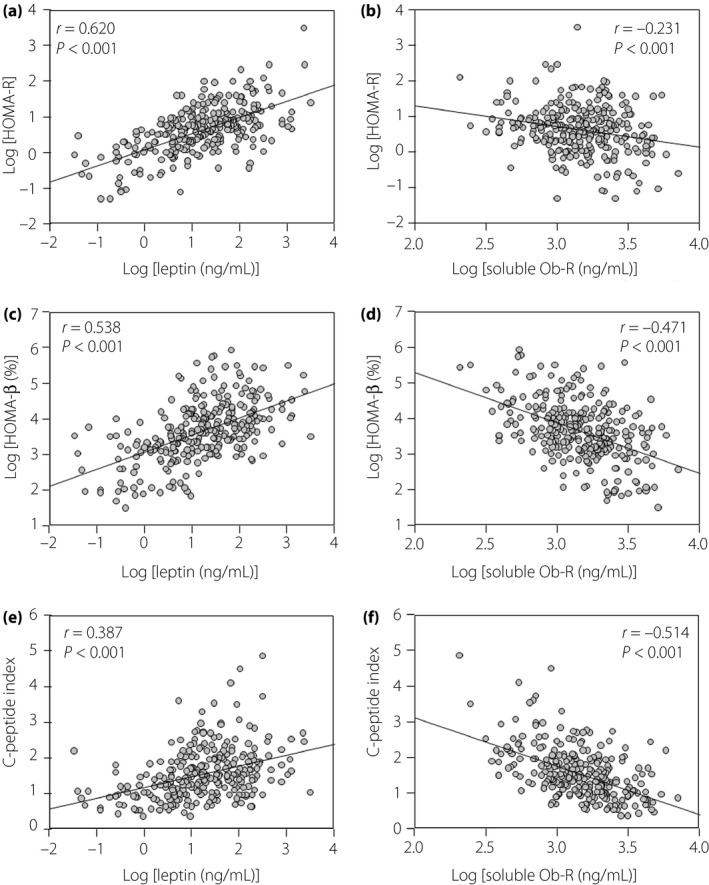
The median plasma soluble Ob-R level and plasma leptin level were 3.4 ng/mL and 23.6 ng/mL, respectively. Plasma soluble Ob-R levels were negatively correlated with homeostasis model assessment of insulin resistance, homeostasis model assessment of β-cell function and the C-peptide index, whereas plasma leptin levels were positively correlated with each index in univariate analyses. Multivariate analyses including plasma soluble Ob-R levels, plasma leptin levels and use of sulfonylureas, along with age, sex, body mass index and other covariates, showed that soluble Ob-R levels were independently and negatively associated with homeostasis model assessment of β-cell function and the C-peptide index, but not significantly associated with homeostasis model assessment of insulin resistance.
Plasma soluble Ob-R levels are independently associated with pancreatic β-cell function, but not with insulin resistance, in patients with type 2 diabetes. The present study implicates the role of soluble Ob-R in pancreatic β-cell dysfunction in type 2 diabetes.
目的/引言:循环中的瘦素受体可溶性形式(可溶性 Ob-R)调节瘦素的生物活性,与身体脂肪和循环瘦素水平呈负相关。然而,尚无研究探讨可溶性 Ob-R 对糖尿病患者葡萄糖代谢的临床影响。本研究旨在探讨 2 型糖尿病患者血浆可溶性 Ob-R 水平与胰岛素抵抗和胰岛β细胞功能的关系。
本研究共纳入 289 例日本 2 型糖尿病患者。采用酶联免疫吸附试验测定空腹血浆可溶性 Ob-R 水平和血浆瘦素水平。通过稳态模型评估胰岛素抵抗、稳态模型评估β细胞功能和空腹 C 肽指数评估胰岛素抵抗和胰岛β细胞功能。
中位血浆可溶性 Ob-R 水平和血浆瘦素水平分别为 3.4ng/ml 和 23.6ng/ml。血浆可溶性 Ob-R 水平与稳态模型评估的胰岛素抵抗、稳态模型评估的β细胞功能和 C 肽指数呈负相关,而血浆瘦素水平在单变量分析中与各指数呈正相关。包括血浆可溶性 Ob-R 水平、血浆瘦素水平和磺脲类药物使用在内的多变量分析,以及年龄、性别、体重指数和其他协变量,表明可溶性 Ob-R 水平与稳态模型评估的β细胞功能和 C 肽指数独立且呈负相关,但与稳态模型评估的胰岛素抵抗无显著相关性。
血浆可溶性 Ob-R 水平与 2 型糖尿病患者的胰岛β细胞功能独立相关,但与胰岛素抵抗无关。本研究提示可溶性 Ob-R 在 2 型糖尿病中参与了胰岛β细胞功能障碍。