Cenci Alberto, Rouard Mathieu
Bioversity InternationalMontpellier, France; CGIAR Research Programme on Roots, Tubers and BananasMontpellier, France.
Front Plant Sci. 2017 Mar 2;8:273. doi: 10.3389/fpls.2017.00273. eCollection 2017.
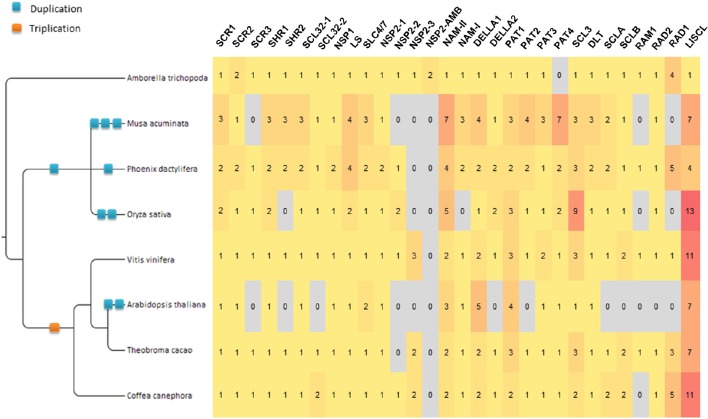
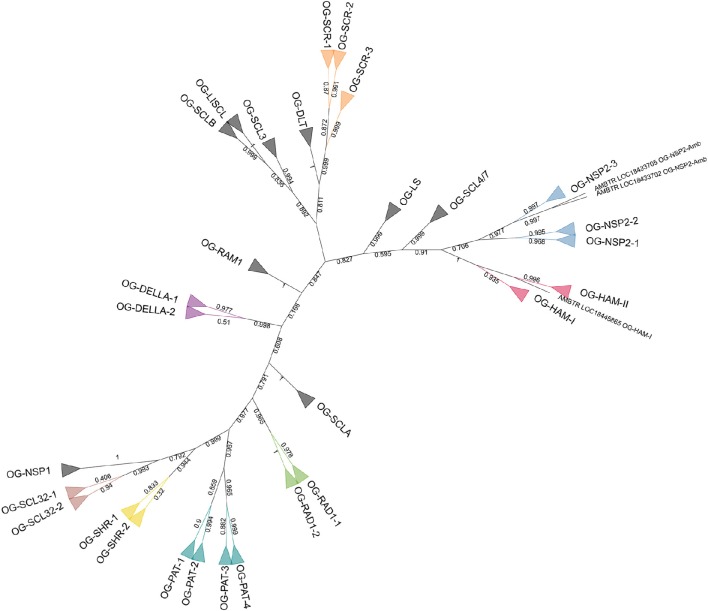
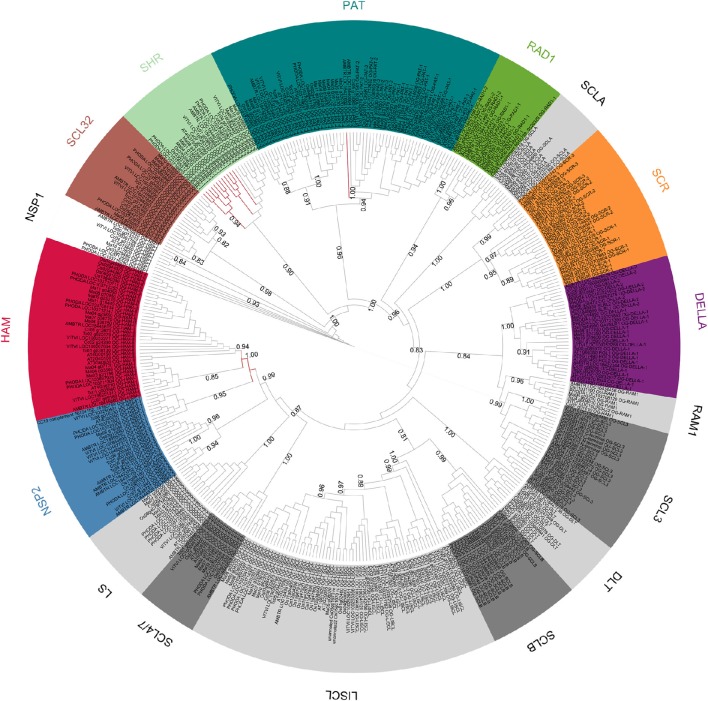
GRAS transcription factors (TFs) play critical roles in plant growth and development such as gibberellin and mycorrhizal signaling. Proteins belonging to this gene family contain a typical GRAS domain in the C-terminal sequence, whereas the -terminal region is highly variable. Although, GRAS genes have been characterized in a number of plant species, their classification is still not completely resolved. Based on a panel of eight representative species of angiosperms, we identified 29 orthologous groups or orthogroups (OGs) for the GRAS gene family, suggesting that at least 29 ancestor genes were present in the angiosperm lineage before the "Amborella" evolutionary split. Interestingly, some taxonomic groups were missing members of one or more OGs. The gene number expansion usually observed in transcription factors was not observed in GRAS while the genome triplication ancestral to the eudicots (γ hexaploidization event) was detectable in a limited number of GRAS orthogroups. We also found conserved OG-specific motifs in the variable -terminal region. Finally, we could regroup OGs in 17 subfamilies for which names were homogenized based on a literature review and described 5 new subfamilies (DLT, RAD1, RAM1, SCLA, and SCLB). This study establishes a consistent framework for the classification of GRAS members in angiosperm species, and thereby a tool to correctly establish the orthologous relationships of GRAS genes in most of the food crops in order to facilitate any subsequent functional analyses in the GRAS gene family. The multi-fasta file containing all the sequences used in our study could be used as database to perform diagnostic BLASTp to classify GRAS genes from other non-model species.
GRAS转录因子(TFs)在植物生长发育过程中发挥着关键作用,如参与赤霉素和菌根信号传导。属于该基因家族的蛋白质在C端序列中含有一个典型的GRAS结构域,而N端区域则高度可变。尽管GRAS基因已在许多植物物种中得到表征,但其分类仍未完全解决。基于一组八个代表性被子植物物种,我们为GRAS基因家族鉴定出29个直系同源组或直系同源群(OGs),这表明在“无油樟”进化分支之前,被子植物谱系中至少存在29个祖先基因。有趣的是,一些分类群缺少一个或多个OGs的成员。通常在转录因子中观察到的基因数量扩增在GRAS中未观察到,而在有限数量的GRAS直系同源组中可检测到双子叶植物祖先的基因组三倍化(γ六倍体化事件)。我们还在可变的N端区域发现了保守的OG特异性基序。最后,我们可以将OGs重新分组为17个亚家族,根据文献综述对其名称进行了统一,并描述了5个新的亚家族(DLT、RAD1、RAM1、SCLA和SCLB)。本研究为被子植物物种中GRAS成员的分类建立了一个一致的框架,从而提供了一种工具,可正确建立大多数粮食作物中GRAS基因的直系同源关系,以便于随后对GRAS基因家族进行功能分析。包含我们研究中使用的所有序列的多序列比对文件可作为数据库,用于执行诊断性BLASTp以对来自其他非模式物种的GRAS基因进行分类。