Leutgeb R, Engeser P, Berger S, Szecsenyi J, Laux G
University Hospital Heidelberg, Marsilius-Arcades, Western Tower, Im Neuenheimer Feld 130.3, 69120, Heidelberg, Germany.
BMC Fam Pract. 2017 Mar 21;18(1):42. doi: 10.1186/s12875-017-0609-1.
Family practitioners (FPs) who work in Out-Of-Hours Care (OOHC) - especially in rural areas - complain about high workload related to low urgency and potentially unnecessary patient presentations with minor ailments. The aim of this study was to describe Reasons for Encounter (RFEs) in primary OOHC taken into account the doctor's perspective in the context of high workload without knowing patients' motives for visiting an OOHC-centre.
Within this descriptive study, OOHC data from 2012 were evaluated from a German statutory health insurance company in the federal state of Baden-Wuerttemberg. 1.53 Million of the 10.5 Million inhabitants of Baden-Wuerttemberg were covered. The frequency of the ICD-10 diagnoses was determined at the three- and four-digit-level. The rate of hospitalizations was used to estimate the severity of the evaluated cases.
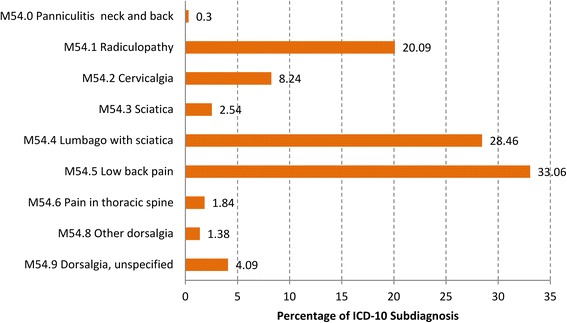
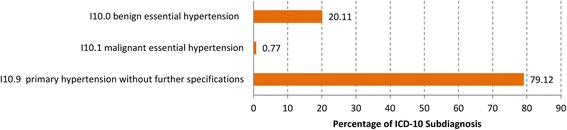
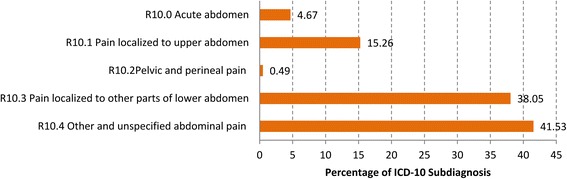
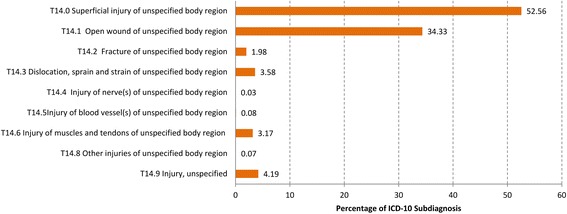
Taken as a whole, 163,711 reasons for encounter with 1,174 ICD-10 single diagnoses were documented, of these 62.2% were on weekends. Less than 5.0% of the examined patients were hospitalized. Low back pain-dorsalgia (M54) was the most common diagnosis in OOHC, with 10,843 cases. Injuries were found twelve times in the list of the 30 most frequent diagnoses. The most frequent infectious disease was acute upper respiratory infection of multiple and unspecified sites (J06). By analysing the ICD codes to four-digits and looking at the rate of hospitalizations, it can be assumed that many RFEs were of less urgency in terms of the prompt need for medical treatment.
While it is acknowledged that it can be difficult to make an exact diagnosis in an OOHC setting, after analysing the ICD-10 diagnoses, the majority of reasons for encounter in OOHC were determined to be of low urgency, meaning that patients could have waited until regular consultation hours. In the OOHC setting, it is important to understand RFEs from both the patient perspective and the family practitioner perspective. Additionally, results like these can be used in staff education especially improving triage methods and medical recommendations and in developing specific guidelines for OOHC in Germany. Analysis of routine data, such as in this study, contributes to this understanding and contributes to resolving problems of coding.
在非工作时间护理(OOHC)工作的家庭医生(尤其是在农村地区)抱怨工作量大,这与低紧急程度以及患有小病的患者可能不必要的就诊有关。本研究的目的是在工作量大的情况下,从医生的角度描述初级OOHC中的就诊原因(RFEs),而不了解患者前往OOHC中心就诊的动机。
在这项描述性研究中,对来自巴登-符腾堡州一家德国法定健康保险公司的2012年OOHC数据进行了评估。巴登-符腾堡州1050万居民中有153万参保。在三位数和四位数级别确定了ICD-10诊断的频率。住院率用于估计所评估病例的严重程度。
总体而言,记录了163711条就诊原因,涉及1174个ICD-10单一诊断,其中62.2%发生在周末。接受检查的患者中不到5.0%住院。下背痛-背痛(M54)是OOHC中最常见的诊断,有10843例。在30个最常见诊断列表中,损伤出现了12次。最常见的传染病是多个未指定部位的急性上呼吸道感染(J06)。通过分析四位数的ICD编码并查看住院率,可以假设许多就诊原因在急需医疗治疗方面的紧迫性较低。
虽然人们承认在OOHC环境中可能难以做出准确诊断,但在分析ICD-10诊断后,确定OOHC中的大多数就诊原因紧迫性较低,这意味着患者可以等到正常会诊时间。在OOHC环境中,从患者角度和家庭医生角度理解就诊原因都很重要。此外,这样的结果可用于员工教育,特别是改进分诊方法和医疗建议,以及制定德国OOHC的具体指南。像本研究中这样的常规数据分析有助于这种理解,并有助于解决编码问题。