Research Center for Environmental Trace Toxic Substances, National Cheng Kung University, Tainan, Taiwan.
Department of Environmental and Occupational Health, College of Medicine, National Cheng Kung University, Tainan, Taiwan.
Sci Rep. 2017 Mar 22;7:45009. doi: 10.1038/srep45009.
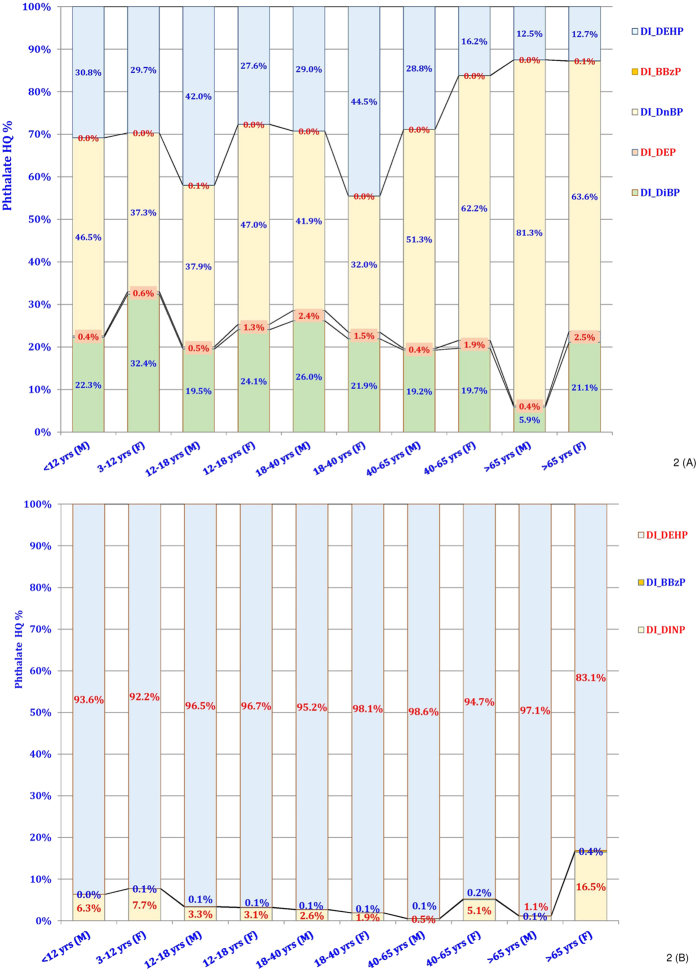
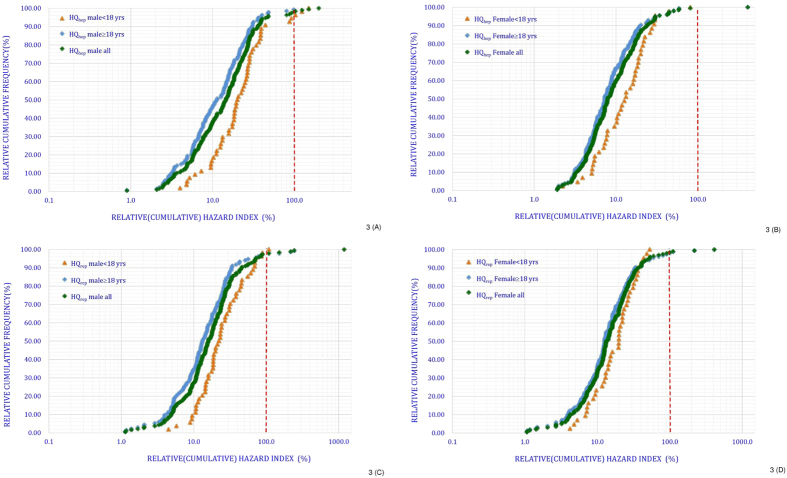
A food scandal occurred in Taiwan in 2011 because the DEHP (di-2-ethylhexyl phthalate) had been intentionally used in food products. We assessed the daily intakes (DIs) and cumulative risk of phthalates in Taiwan's general population after the scandal. The DIs of 6 phthalates, including di-n-butyl phthalate (DnBP), di-iso-butyl phthalate (DiBP), and DEHP, were evaluated using urinary phthalate metabolites. Hazard quotients of phthalates classified as affecting the reproductive (HQ) and hepatic (HQ) systems were assessed using cumulative approach. The creatinine-based model showed that the highest DI values in children 7-to 12- years-old were for DEHP (males: median: 4.79 μg/kg bw/d; females: median: 2.62 μg/kg bw/d). The 95 percentile (P95) of HQ values were all >1 in the 7- to 12-year-old and 18- to 40-year-old male groups. The P95 of HQ values were all >1 in the 7- to 18- year-old male groups. Most of the HQ was attributable to the HQs of DnBP and DiBP (53.9-84.7%), and DEHP contributed most to HQ (83.1-98.6%), which reveals that DnBP, DiBP and DEHP were the main risk of phthalate exposure for Taiwanese. Taiwan's general population is widely exposed to DnBP, DiBP and DEHP, especially for young children.
2011 年台湾发生了一起食品丑闻,因为邻苯二甲酸二(2-乙基)己酯(DEHP)被故意用于食品中。我们评估了该丑闻后台湾一般人群中邻苯二甲酸酯的日摄入量(DI)和累积风险。使用尿邻苯二甲酸酯代谢物评估了包括邻苯二甲酸二正丁酯(DnBP)、邻苯二甲酸二异丁酯(DiBP)和 DEHP 在内的 6 种邻苯二甲酸酯的 DI。采用累积法评估了生殖系统(HQ)和肝脏系统(HQ)受影响的邻苯二甲酸酯的危害系数(HQ)。基于肌酐的模型表明,7-12 岁儿童的 DEHP 最高 DI 值(男性:中位数:4.79μg/kg bw/d;女性:中位数:2.62μg/kg bw/d)。7-12 岁和 18-40 岁男性组的 HQ95 均>1。7-18 岁男性组的 HQ95 均>1。大多数 HQ 归因于 DnBP 和 DiBP 的 HQ(53.9-84.7%),DEHP 对 HQ 的贡献最大(83.1-98.6%),这表明 DnBP、DiBP 和 DEHP 是台湾人接触邻苯二甲酸酯的主要风险因素。台湾一般人群广泛接触 DnBP、DiBP 和 DEHP,尤其是幼儿。