Garg Pankaj, Ha My Trinh, Eastwood John, Harvey Susan, Woolfenden Sue, Murphy Elisabeth, Dissanayake Cheryl, Jalaludin Bin, Williams Katrina, McKenzie Anne, Einfeld Stewart, Silove Natalie, Short Kate, Eapen Valsamma
Department of Community Paediatrics, Liverpool Hospital, Liverpool, Australia.
School of Women's and Children's Health, UNSW, Liverpool, Australia.
BMC Health Serv Res. 2017 Mar 22;17(1):228. doi: 10.1186/s12913-017-2143-1.
Regular health visits for parents with young children provide an opportunity for developmental surveillance and anticipatory guidance regarding common childhood problems and help to achieve optimal developmental progress prior to school entry. However, there are few published reports from Australian culturally and linguistically diverse (CALD) communities exploring parents' experiences for accessing child health surveillance programs. This paper aims to describe and explain parental experiences for accessing developmental surveillance and anticipatory guidance for children.
Qualitative data was obtained from 6 focus groups (33 parents) and seven in-depth interviews of CALD parents recruited from an area of relative disadvantage in Sydney. Thematic analysis of data was conducted using an ecological framework.
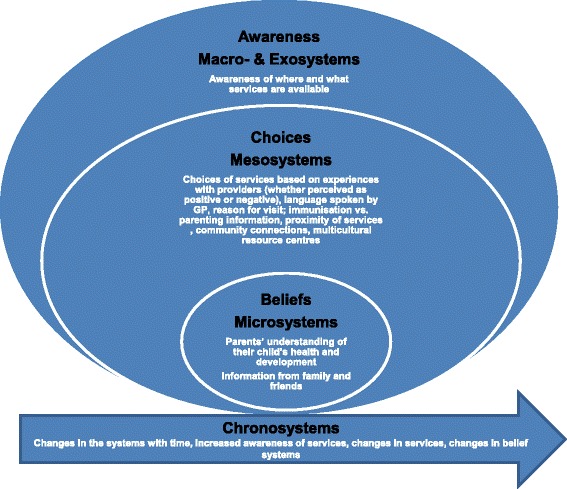
An overarching theme of "awareness-beliefs-choices" was found to explain parents' experiences of accessing primary health care services for children. "Awareness" situated within the meso-and macro-systems explained parents knowledge of where and what primary health services were available to access for their children. Opportunities for families to obtain this information existed at the time of birth in Australian hospitals, but for newly arrived immigrants with young children, community linkages with family and friends, and general practitioner (GPs) were most important. "Beliefs" situated within the microsystems included parents' understanding of their children's development, in particular what they considered to be "normal" or "abnormal". Parental "choices", situated within meso-systems and chronosystems, related to their choices of service providers, which were based on the proximity, continuity, purpose of visit, language spoken by the provider and past experience of a service.
CALD parents have diverse experiences with primary health care providers which are influenced by their awareness of available services in the context of their duration of stay in Australia. The role of the general practitioner, with language concordance, suggests the importance of diversity within the primary care health workforce in this region. There is a need for ongoing cultural competence training of health professionals and provisions need to be made to support frequent use of interpreters at general practices in Australia.
为幼儿家长安排定期健康检查,可为发育监测及针对常见儿童问题的预期指导提供契机,有助于儿童在入学前实现最佳发育进程。然而,关于澳大利亚文化和语言多样化(CALD)社区的家长获取儿童健康监测项目体验的公开报告较少。本文旨在描述并解释家长获取儿童发育监测及预期指导的体验。
定性数据来自6个焦点小组(33名家长)以及对从悉尼一个相对贫困地区招募的CALD家长进行的7次深度访谈。采用生态框架对数据进行主题分析。
发现一个总体主题“认知-信念-选择”可解释家长为孩子获取初级卫生保健服务的体验。中观和宏观系统中的“认知”解释了家长对于何处可获取以及有哪些针对其子女的初级卫生服务的了解。在澳大利亚医院出生时,家庭有机会获取此信息,但对于有幼儿的新移民而言,与家人、朋友及全科医生(GP)的社区联系最为重要。微观系统中的“信念”包括家长对子女发育的理解,尤其是他们所认为的“正常”或“异常”情况。中观系统和时间系统中的家长“选择”与其对服务提供者的选择有关,这些选择基于距离、连续性、就诊目的、提供者所讲语言以及过往的服务体验。
CALD家长在与初级卫生保健提供者打交道时有着多样的体验,这受到他们在澳大利亚停留时间背景下对现有服务的认知的影响。全科医生在语言一致性方面的作用表明该地区初级保健卫生人力多样化的重要性。有必要对卫生专业人员持续开展文化能力培训,并且需要做出安排以支持在澳大利亚全科诊所频繁使用口译员。