Barbosa Alexandre Naime, Boyer Leslie, Chippaux Jean-Philippe, Medolago Natalia Bronzatto, Caramori Carlos Antonio, Paixão Ariane Gomes, Poli João Paulo Vasconcelos, Mendes Mônica Bannwart, Dos Santos Lucilene Delazari, Ferreira Rui Seabra, Barraviera Benedito
Department of Tropical Diseases, Botucatu Medical School, São Paulo State University (UNESP - Univ Estadual Paulista), Botucatu, SP Brazil.
VIPER Institute, University of Arizona College of Medicine, Tucson, AZ USA.
J Venom Anim Toxins Incl Trop Dis. 2017 Mar 16;23:14. doi: 10.1186/s40409-017-0106-y. eCollection 2017.
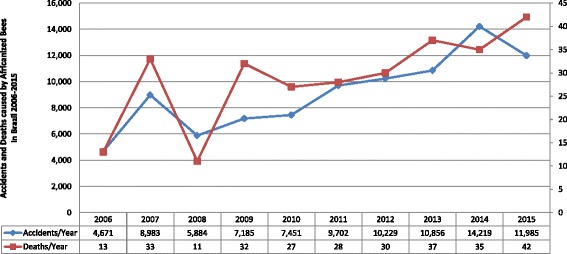
Envenomation caused by multiple stings from Africanized honeybees constitutes a public health problem in the Americas. In 2015, the Brazilian Ministry of Health reported 13,597 accidents (incidence of seven cases per 100,000 inhabitants) with 39 deaths (lethality of 0.25%). The toxins present in the venom, which include melittin and phospholipase A, cause lesions in diverse organs and systems that may be fatal. As there has been no specific treatment to date, management has been symptomatic and supportive only.
In order to evaluate the safety and neutralizing capacity of a new apilic antivenom, as well as to confirm its lowest effective dose, a clinical protocol was developed to be applied in a multicenter, non-randomized and open phase I/II clinical trial. Twenty participants with more than five stings, aged more than 18 years, of both sexes, who have not previously received the heterologous serum against bee stings, will be included for 24 months. The proposed dose was based on the antivenom neutralizing capacity and the number of stings. Treatment will be administered only in a hospital environment and the participants will be evaluated for a period up to 30 days after discharge for clinical and laboratory follow-up.
This protocol, approved by the Brazilian regulatory agencies for ethics (National Commission for Ethics on Research - CONEP) and sanitation (National Health Surveillance Agency - ANVISA), is a guideline constituted by specific, adjuvant, symptomatic and complementary treatments, in addition to basic orientations for conducting a clinical trial involving heterologous sera.
This is the first clinical trial protocol designed specifically to evaluate the preliminary efficacy and safety of a new antivenom against stings from the Africanized honeybee . The results will support future studies to confirm a new treatment for massive bee attack that has a large impact on public health in the Americas.
非洲化蜜蜂多次蜇刺导致的中毒事件在美洲构成了一个公共卫生问题。2015年,巴西卫生部报告了13597起事故(每10万居民中有7例发病),其中39人死亡(致死率为0.25%)。毒液中存在的毒素,包括蜂毒肽和磷脂酶A,会对多个器官和系统造成损害,可能致命。由于迄今为止尚无特效治疗方法,目前的治疗仅为对症和支持治疗。
为了评估一种新型蜂毒抗毒素的安全性和中和能力,并确定其最低有效剂量,制定了一项临床方案,用于多中心、非随机、开放的I/II期临床试验。将纳入20名年龄超过18岁、男女不限、此前未接受过抗蜂蜇异源血清治疗且蜇刺次数超过5次的参与者,为期24个月。建议剂量基于抗毒素的中和能力和蜇刺次数。治疗仅在医院环境中进行,参与者出院后将接受长达30天的临床和实验室随访评估。
该方案已获得巴西伦理监管机构(国家研究伦理委员会 - CONEP)和卫生监管机构(国家卫生监督局 - ANVISA)的批准,是一份由特定、辅助、对症和补充治疗组成的指南,此外还包括进行涉及异源血清的临床试验的基本指导原则。
这是首个专门设计用于评估一种新型抗非洲化蜜蜂蜇刺抗毒素的初步疗效和安全性的临床试验方案。研究结果将为未来的研究提供支持,以确认一种对美洲公共卫生有重大影响的大规模蜜蜂攻击的新治疗方法。