Saeb Sohrab, Lattie Emily G, Schueller Stephen M, Kording Konrad P, Mohr David C
Department of Preventive Medicine, Northwestern University, Chicago, IL, United States; Rehabilitation Institute of Chicago, Department of Physical Medicine and Rehabilitation, Northwestern University, Chicago, IL, United States.
Department of Preventive Medicine, Northwestern University , Chicago , IL , United States.
PeerJ. 2016 Sep 29;4:e2537. doi: 10.7717/peerj.2537. eCollection 2016.
Smartphones offer the hope that depression can be detected using passively collected data from the phone sensors. The aim of this study was to replicate and extend previous work using geographic location (GPS) sensors to identify depressive symptom severity.
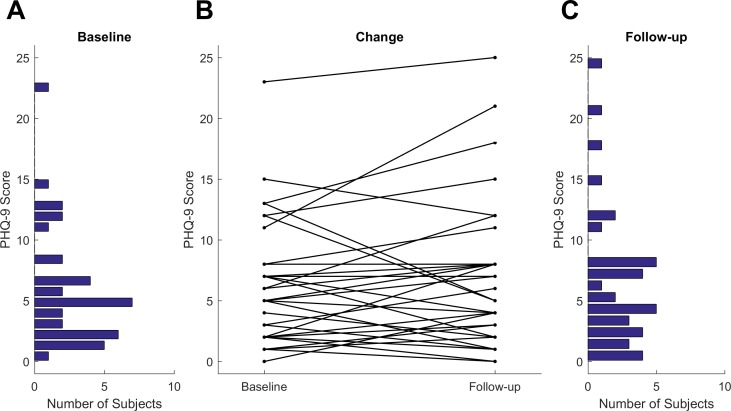
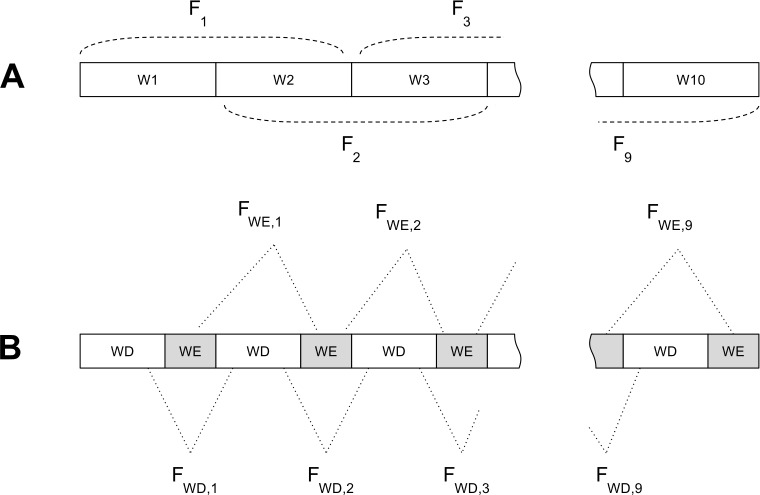
We used a dataset collected from 48 college students over a 10-week period, which included GPS phone sensor data and the Patient Health Questionnaire 9-item (PHQ-9) to evaluate depressive symptom severity at baseline and end-of-study. GPS features were calculated over the entire study, for weekdays and weekends, and in 2-week blocks.
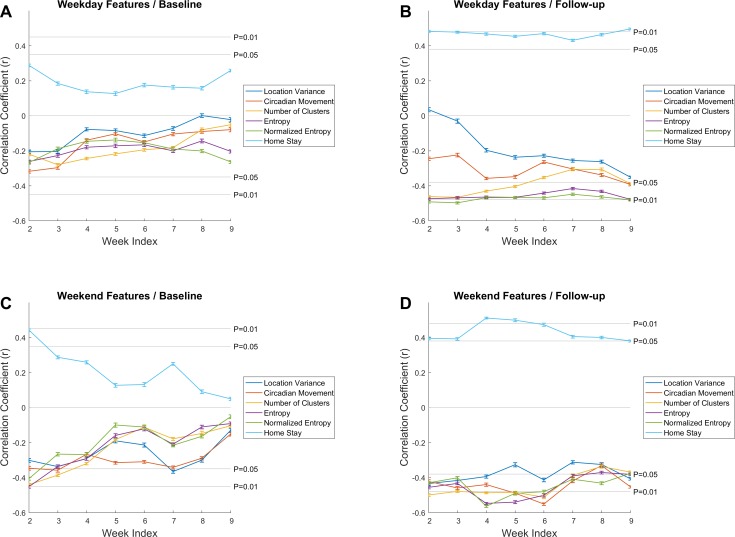
The results of this study replicated our previous findings that a number of GPS features, including location variance, entropy, and circadian movement, were significantly correlated with PHQ-9 scores ('s ranging from -0.43 to -0.46, -values < .05). We also found that these relationships were stronger when GPS features were calculated from weekend, compared to weekday, data. Although the correlation between baseline PHQ-9 scores with 2-week GPS features diminished as we moved further from baseline, correlations with the end-of-study scores remained significant regardless of the time point used to calculate the features.
Our findings were consistent with past research demonstrating that GPS features may be an important and reliable predictor of depressive symptom severity. The varying strength of these relationships on weekends and weekdays suggests the role of weekend/weekday as a moderating variable. The finding that GPS features predict depressive symptom severity up to 10 weeks prior to assessment suggests that GPS features may have the potential as early warning signals of depression.
智能手机带来了一种希望,即可以利用从手机传感器被动收集的数据来检测抑郁症。本研究的目的是重复并扩展先前使用地理位置(GPS)传感器来识别抑郁症状严重程度的工作。
我们使用了在10周内从48名大学生收集的数据集,其中包括GPS手机传感器数据和患者健康问卷9项(PHQ-9),以评估基线和研究结束时的抑郁症状严重程度。在整个研究期间、工作日和周末以及以2周为间隔计算GPS特征。
本研究的结果重复了我们之前的发现,即包括位置方差、熵和昼夜活动在内的一些GPS特征与PHQ-9得分显著相关(相关系数范围为-0.43至-0.46,P值<0.05)。我们还发现,与工作日数据相比,从周末数据计算GPS特征时,这些关系更强。尽管随着我们离基线时间越来越远,基线PHQ-9得分与2周GPS特征之间的相关性减弱,但无论用于计算特征的时间点如何,与研究结束时得分的相关性仍然显著。
我们的研究结果与过去的研究一致,表明GPS特征可能是抑郁症状严重程度的重要且可靠的预测指标。这些关系在周末和工作日的强度不同,表明周末/工作日作为一个调节变量的作用。GPS特征在评估前长达10周就能预测抑郁症状严重程度,这一发现表明GPS特征可能有潜力作为抑郁症的早期预警信号。