Chung Ill-Min, Rahuman Abdul Abdul, Marimuthu Sampath, Kirthi Arivarasan Vishnu, Anbarasan Karunanithi, Rajakumar Govindasamy
Department of Applied Bioscience, College of Life and Environmental Science, Konkuk University, Seoul 05029, Korea.
Unit of Nanotechnology and Bioactive Natural Products, Post Graduate and Research Department of Zoology, C. Abdul Hakeem College, Melvisharam 632509, Vellore District, Tamil Nadu, India.
Nanomaterials (Basel). 2015 Aug 12;5(3):1317-1330. doi: 10.3390/nano5031317.
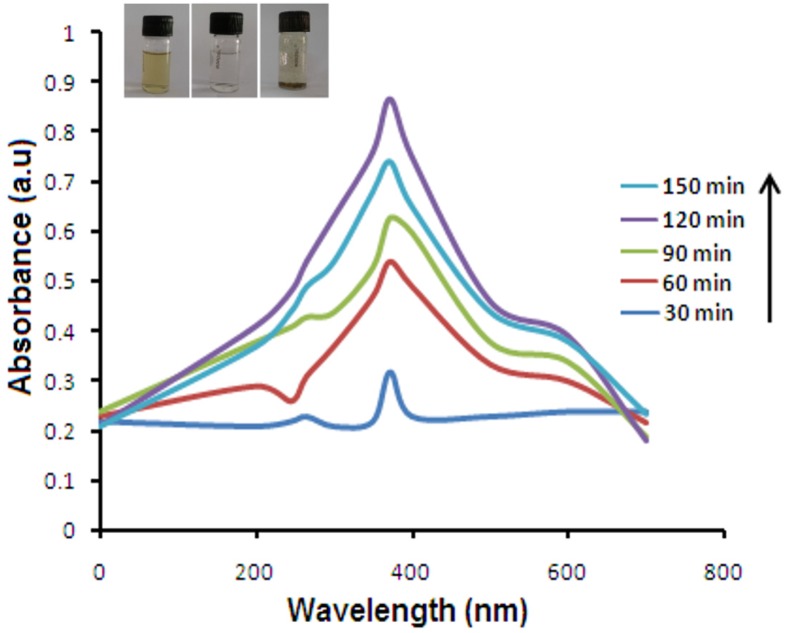
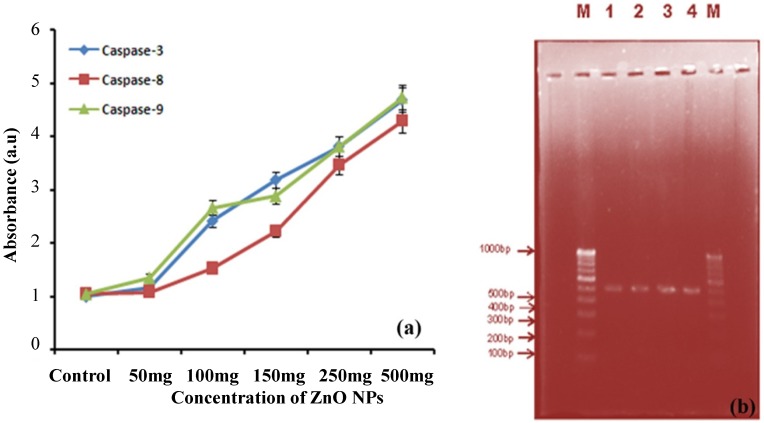
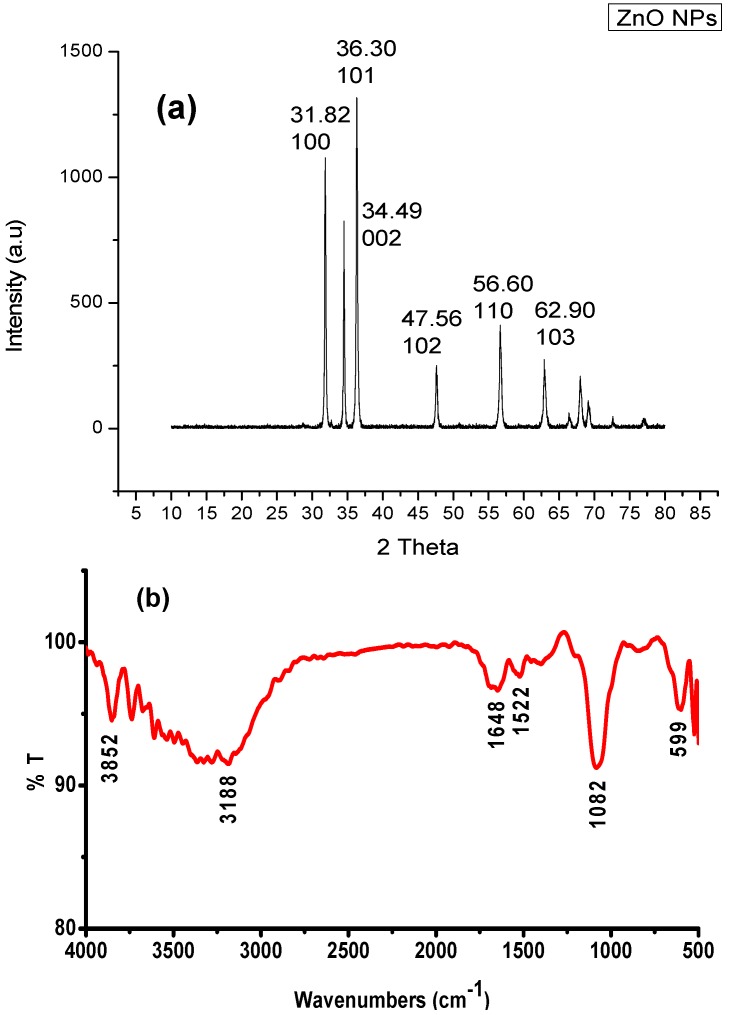
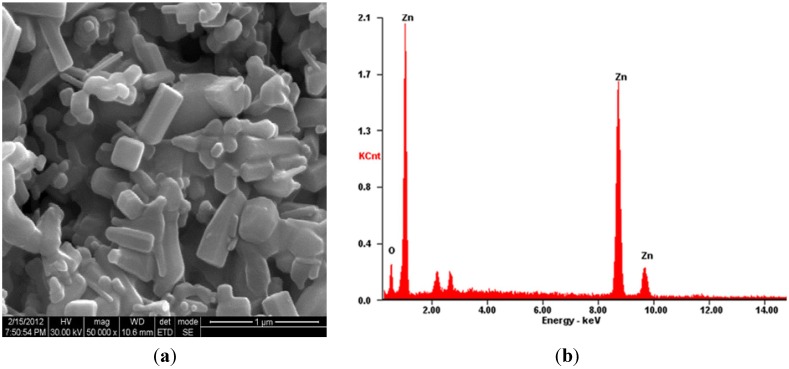
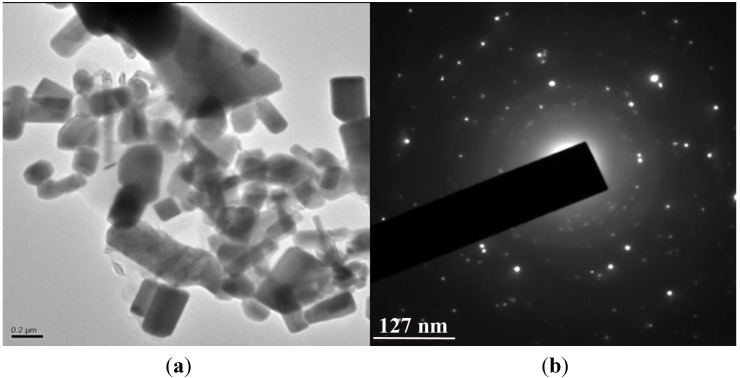
Cancer is a leading cause of death worldwide and sustained focus is on the discovery and development of newer and better tolerated anticancer drugs, especially from plants. In the present study, a simple, eco-friendly, and inexpensive approach was followed for the synthesis of zinc oxide nanoparticles (ZnO NPs) using the aqueous leaf extract of . The synthesized ZnO NPs were characterized by UV-visible absorption spectroscopy, X-ray diffraction (XRD), Fourier transform infrared spectroscopy (FTIR), Scanning electron microscopy with energy dispersive X-ray spectroscopy (SEM-EDX), High-resolution transmission electron microscopy (HRTEM), and Selected area (electron) diffraction (SAED). The HRTEM images confirmed the presence of triangle, radial, hexagonal, rod, and rectangle, shaped with an average size of 29 ± 1.3 nm. The functional groups for synthesized ZnO NPs were 3852 cm for H-H weak peak, 3138 cm for aromatic C-H extend, and 1648 cm for Aromatic ring stretch. The 3-(4,5-Dimethylthiazol-2-yl)-2,5-Diphenyltetrazolium Bromide (MTT), caspase and DNA fragmentation assays were carried out using various concentrations of ZnO NPs ranging from 1 to 100 mg/mL. The synthesized ZnO NPs showed dose dependent cytopathic effects in the Hep-G2 cell line. At 100 mg/mL concentration, the synthesized ZnO NPs exhibited significant cytotoxic effects and the apoptotic features were confirmed through caspase-3 activation and DNA fragmentation assays.
癌症是全球主要的死亡原因之一,人们持续关注新型且耐受性更好的抗癌药物的发现与开发,尤其是来自植物的药物。在本研究中,采用了一种简单、环保且廉价的方法,利用[植物名称]的水叶提取物合成氧化锌纳米颗粒(ZnO NPs)。通过紫外可见吸收光谱、X射线衍射(XRD)、傅里叶变换红外光谱(FTIR)、带能谱仪的扫描电子显微镜(SEM-EDX)、高分辨率透射电子显微镜(HRTEM)和选区(电子)衍射(SAED)对合成的ZnO NPs进行了表征。HRTEM图像证实存在三角形、放射状、六边形、棒状和矩形,平均尺寸为29±1.3纳米。合成的ZnO NPs的官能团,H-H弱峰为3852厘米,芳香族C-H伸展为3138厘米,芳香环伸展为1648厘米。使用浓度范围为1至100毫克/毫升的各种ZnO NPs进行了3-(4,5-二甲基噻唑-2-基)-2,5-二苯基四氮唑溴盐(MTT)、半胱天冬酶和DNA片段化测定。合成的ZnO NPs在Hep-G2细胞系中显示出剂量依赖性细胞病变效应。在100毫克/毫升浓度下,合成的ZnO NPs表现出显著的细胞毒性作用,并且通过半胱天冬酶-3激活和DNA片段化测定证实了凋亡特征。