Adamu Aishatu L, Crampin Amelia, Kayuni Ndoliwe, Amberbir Alemayehu, Koole Olivier, Phiri Amos, Nyirenda Moffat, Fine Paul
Bayero University Kano, Community Medicine, Kano, Nigeria.
London School of Hygiene and Tropical Medicine, London, United Kingdom.
Popul Health Metr. 2017 Mar 29;15(1):12. doi: 10.1186/s12963-017-0128-2.
The global burden of anemia is large especially in sub-Saharan Africa, where HIV is common and lifestyles are changing rapidly with urbanization. The effects of these changes are unknown. Studies of anemia usually focus on pregnant women or children, among whom the burden is greatest. We describe prevalence and risk factors for anemia among rural and urban men and women of all ages in Malawi.
We analyzed data from a population-wide cross-sectional survey of adults conducted in two sites, Karonga (rural) and Lilongwe (urban), commencing in May 2013. We used multinomial logistic regression models, stratified by sex to identify risk factors for mild and moderate-to-severe anemia.
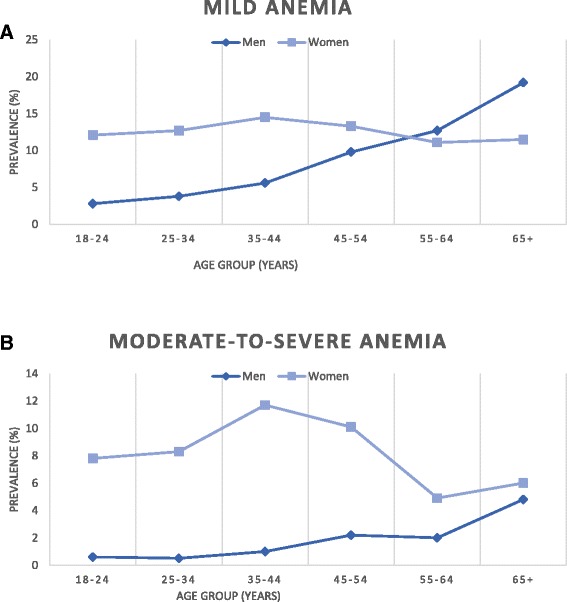
Anemia prevalence was assessed among 8,926 men (age range 18-100 years) and 14,978 women (age range: 18-103 years). Weighted prevalence levels for all, mild, and moderate-to-severe anemia were 8.2, 6.7 and 1.2% in rural men; 19.4, 12.0 and 7.4% in rural women; 5.9, 5.1 and 0.8% in urban men; and 23.4, 13.6 and 10.1% in urban women. Among women, the odds of anemia were higher among urban residents and those with higher socioeconomic status. Increasing age was associated with higher anemia prevalence in men. Among both men and women, HIV infection was a consistent risk factor for severity of anemia, though its relative effect was stronger on moderate-to-severe anemia.
The drivers of anemia in this population are complex, include both socioeconomic and biological factors and are affecting men and women differently. The associations with urban lifestyle and HIV indicate opportunities for targeted intervention.
贫血的全球负担巨大,尤其是在撒哈拉以南非洲地区,那里艾滋病病毒感染很常见,且随着城市化进程生活方式正在迅速改变。这些变化的影响尚不清楚。贫血研究通常集中在孕妇或儿童身上,他们当中贫血负担最为沉重。我们描述了马拉维所有年龄段城乡男女贫血的患病率及危险因素。
我们分析了2013年5月开始在卡龙加(农村)和利隆圭(城市)两个地点对成年人进行的一项全人群横断面调查的数据。我们使用按性别分层的多项逻辑回归模型来确定轻度和中度至重度贫血的危险因素。
对8926名男性(年龄范围18 - 100岁)和14978名女性(年龄范围18 - 103岁)进行了贫血患病率评估。农村男性中所有贫血、轻度贫血以及中度至重度贫血的加权患病率分别为8.2%、6.7%和1.2%;农村女性分别为19.4%、12.0%和7.4%;城市男性分别为5.9%、5.1%和0.8%;城市女性分别为23.4%、13.6%和10.1%。在女性中,城市居民以及社会经济地位较高者患贫血的几率更高。男性中,年龄增长与贫血患病率升高相关。在男性和女性中,艾滋病毒感染都是贫血严重程度的一个持续危险因素,不过其对中度至重度贫血的相对影响更强。
该人群中贫血的驱动因素很复杂,包括社会经济和生物学因素,且对男性和女性的影响不同。与城市生活方式和艾滋病毒的关联表明有进行针对性干预的机会。