Zakham Fathiah, Al-Habal Mohammed, Taher Rola, Alaoui Altaf, El Mzibri Mohammed
Department of Laboratory Medicine, Faculty of Medicine and Health Sciences, Hodeidah University, Hodeidah, Yemen.
Epidemiological Surveillance Administration, Office of Public Health and Population, Hodeidah, Yemen.
PLoS Negl Trop Dis. 2017 Apr 6;11(4):e0005322. doi: 10.1371/journal.pntd.0005322. eCollection 2017 Apr.
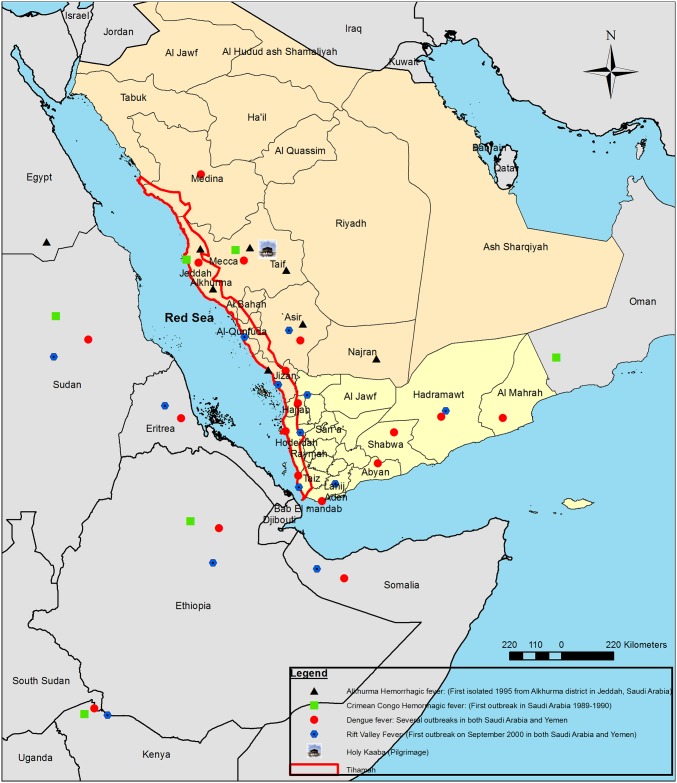
Viral hemorrhagic fever (VHF) refers to a group of diseases characterized by an acute febrile syndrome with hemorrhagic manifestations and high mortality rates caused by several families of viruses that affect humans and animals. These diseases are typically endemic in certain geographical regions and sometimes cause major outbreaks. The history of hemorrhagic fever in the Arabian Peninsula refers to the 19th century and most outbreaks were reported in the Tihamah region-the Red Sea coastal plain of the Arabian Peninsula in the west and southwest of Saudi Arabia and Yemen. Herein, we describe the agents that cause VHFs and their epidemiology in Tihamah, the history of the diseases, transmission, species affected, and clinical signs. Finally, we address challenges in the diagnosis and control of VHFs in this region.
病毒性出血热(VHF)是指由几类影响人类和动物的病毒引起的一组疾病,其特征为伴有出血表现的急性发热综合征以及高死亡率。这些疾病通常在某些地理区域呈地方性流行,有时会引发大规模疫情。阿拉伯半岛的出血热历史可追溯到19世纪,多数疫情报告发生在提哈迈地区——位于沙特阿拉伯西部和西南部以及也门的阿拉伯半岛红海沿岸平原。在此,我们描述了导致病毒性出血热的病原体及其在提哈迈地区的流行病学情况、疾病史、传播途径、受影响的物种以及临床症状。最后,我们探讨了该地区病毒性出血热诊断和控制方面的挑战。