Kim Young-Min, Kim Jihyun, Han Youngshin, Jeon Byoung-Hak, Cheong Hae-Kwan, Ahn Kangmo
Environmental Health Center for Atopic Diseases, Samsung Medical Center, Seoul, Korea.
Department of Pediatrics, Samsung Medical Center, Sungkyunkwan University School of Medicine, Seoul, Korea.
PLoS One. 2017 Apr 6;12(4):e0175229. doi: 10.1371/journal.pone.0175229. eCollection 2017.
The effects of weather and air pollution on the severity and persistence of atopic dermatitis (AD) are important issues that have not been investigated in detail. The objective of our study was to determine the short-term effects of meteorological variables and air pollution on AD symptoms in children.
We enrolled 177 AD patients with 5 years or younger from the Seoul Metropolitan Area, Korea, and followed for 17 months between August 2013 and December 2014. Symptoms records of 35,158 person-days, including itching, sleep disturbance, erythema, dry skin, oozing, and edema, were obtained. We estimated the effect of meteorological variables including daily mean temperature, relative humidity (RH), diurnal temperature range (DTR), rainfall and air pollutants including particulate matter with an aerodynamic diameter ≤10 μm (PM10), nitrogen dioxide (NO2), and tropospheric ozone (O3) on AD symptoms using a generalized linear mixed model with adjustment for related confounding factors.
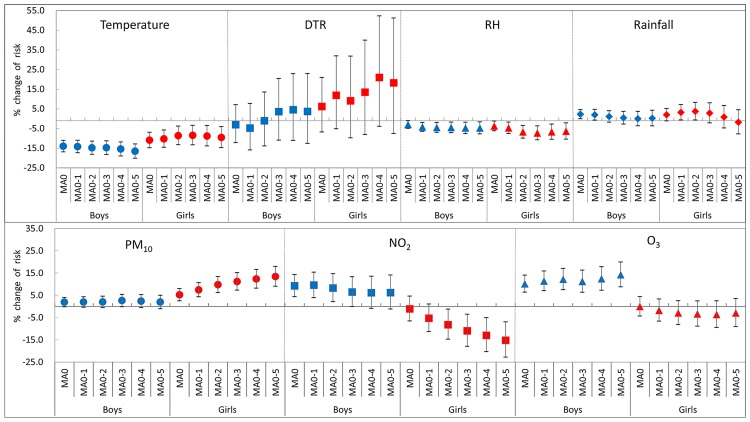
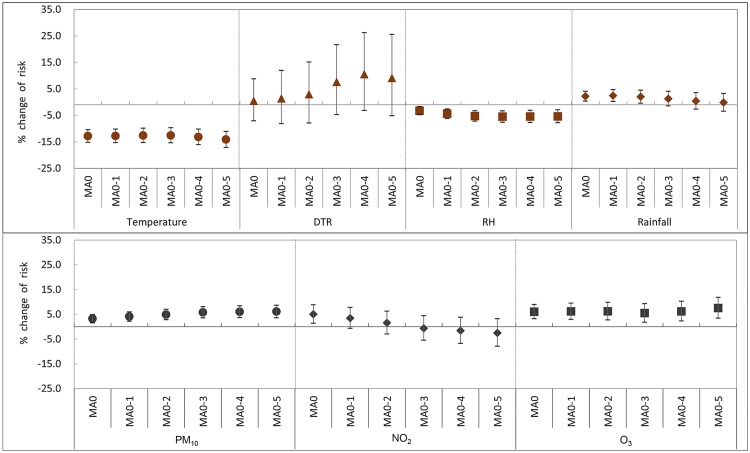
A 5°C increase in outdoor temperature and a 5% increase in outdoor RH was associated with 12.8% (95% confidence intervals (CI): 10.5, 15.2) and 3.3% (95% CI: 1.7, 4.7) decrease in AD symptoms, respectively, on the same day. An increase of rainfall by 5 mm increased AD symptoms by 7.3% (95% CI: 3.6, 11.1) for the days with <40 mm rainfall. The risk of AD symptoms increased by 284.9% (95% CI: 67.6, 784.2) according to a 5°C increase in DTR when it was >14°C. An increase in PM10, NO2, and O3 by 10 units increased the risk of AD symptoms on the same day by 3.2% (95% CI: 1.5, 4.9), 5.0% (95% CI: 1.4, 8.8), and 6.1% (95% CI: 3.2, 9.0), respectively.
Exposure to meteorological variables and air pollutants are associated with AD symptoms in young children.
天气和空气污染对特应性皮炎(AD)的严重程度和持续时间的影响是尚未详细研究的重要问题。我们研究的目的是确定气象变量和空气污染对儿童AD症状的短期影响。
我们招募了来自韩国首尔大都市区的177名5岁及以下的AD患者,并在2013年8月至2014年12月期间进行了17个月的随访。获得了35158人日的症状记录,包括瘙痒、睡眠障碍、红斑、皮肤干燥、渗出和水肿。我们使用广义线性混合模型,并对相关混杂因素进行调整,估计了气象变量(包括日平均温度、相对湿度(RH)、昼夜温差(DTR)、降雨量)和空气污染物(包括空气动力学直径≤10μm的颗粒物(PM10)、二氧化氮(NO2)和对流层臭氧(O3))对AD症状的影响。
室外温度升高5°C和室外RH升高5%分别与当日AD症状减少12.8%(95%置信区间(CI):10.5,15.2)和3.3%(95%CI:1.7,4.7)相关。在降雨量<40mm的日子里,降雨量增加5mm会使AD症状增加7.3%(95%CI:3.6,11.1)。当DTR>14°C时,DTR升高5°C会使AD症状风险增加284.9%(95%CI:67.6,784.2)。PM10、NO2和O3分别增加10个单位会使当日AD症状风险分别增加3.2%(95%CI:1.5,4.9)、5.0%(95%CI:1.4,8.8)和6.1%(95%CI:3.2,9.0)。
暴露于气象变量和空气污染物与幼儿的AD症状相关。