Nguyen Hung, Lebel Karina, Boissy Patrick, Bogard Sarah, Goubault Etienne, Duval Christian
Département des Sciences de l'activité Physique, Université du Québec àMontréal, 141 Avenue du Président -Kennedy, Montréal, Québec, Canada.
Centre de Recherche de l'Institut Universitaire de Gériatrie de Montréal, Montréal, Québec, Canada.
J Neuroeng Rehabil. 2017 Apr 7;14(1):26. doi: 10.1186/s12984-017-0241-2.
Wearable sensors have the potential to provide clinicians with access to motor performance of people with movement disorder as they undergo intervention. However, sensor data often have to be manually classified and segmented before they can be processed into clinical metrics. This process can be time consuming. We recently proposed detection and segmentation algorithms based on peak detection using Inertial Measurement Units (IMUs) to automatically identify and isolate common activities during daily living such as standing up, walking, turning, and sitting down. These algorithms were developed using a homogenous population of healthy older adults. The aim of this study was to investigate the transferability of these algorithms in people with Parkinson's disease (PD).
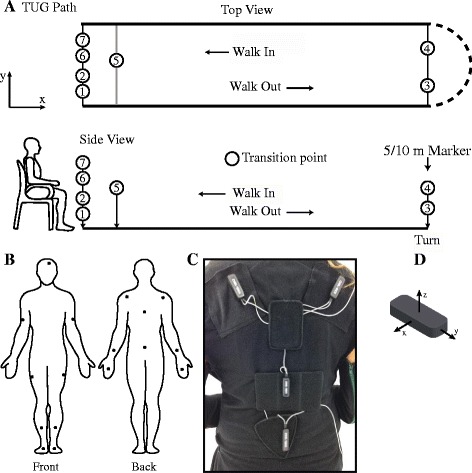
A modified Timed Up And Go task was used since it is comprised of these activities, all performed in a continuous fashion. Twelve older adults diagnosed with early PD (Hoehn & Yahr ≤ 2) were recruited for the study and performed three trials of a 10 and 5-m TUG during OFF state. They were outfitted with 17 IMUs covering each body segment. Raw data from IMUs were detrended, normalized and filtered to reveal kinematics peaks that corresponded to different activities. Segmentation was accomplished by identifying the first minimum or maximum to the right and the left of these peaks. Segmentation times were compared to results from two examiners who visually segmented the activities. Specificity and sensitivity were used to evaluate the accuracy of the detection algorithms.
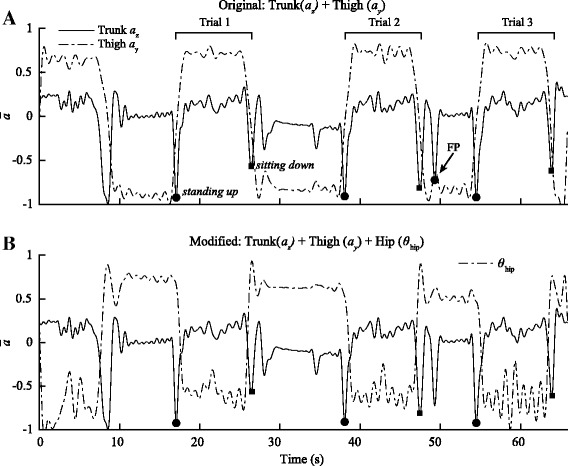
Using the same IMUs and algorithms developed in the previous study, we were able to detect these activities with 97.6% sensitivity and 92.7% specificity (n = 432) in PD population. However, with modifications to the IMUs selection, we were able to detect these activities with 100% accuracy. Similarly, applying the same segmentation to PD population, we were able to isolate these activities within ~500 ms of the visual segmentation. Re-optimizing the filtering frequencies, we were able to reduce this difference to ~400 ms.
This study demonstrates the agility and transferability of using a system of IMUs to accurately detect and segment activities in daily living in people with movement disorders.
可穿戴传感器有潜力在运动障碍患者接受干预时,为临床医生提供其运动表现的相关信息。然而,在将传感器数据处理为临床指标之前,通常必须对其进行手动分类和分段。这个过程可能很耗时。我们最近提出了基于使用惯性测量单元(IMU)进行峰值检测的检测和分段算法,以自动识别和分离日常生活中的常见活动,如站立、行走、转身和坐下。这些算法是使用健康老年人的同质群体开发的。本研究的目的是调查这些算法在帕金森病(PD)患者中的可转移性。
采用改良的定时起立行走任务,因为它包含这些以连续方式进行的活动。招募了12名被诊断为早期PD(Hoehn & Yahr≤2)的老年人参与研究,并在关期进行了三次10米和5米定时起立行走试验。他们配备了覆盖每个身体部位的17个IMU。来自IMU的原始数据进行了去趋势化、归一化和滤波,以揭示与不同活动相对应的运动学峰值。通过识别这些峰值左右两侧的第一个最小值或最大值来完成分段。将分段时间与两名通过视觉对活动进行分段的检查人员的结果进行比较。使用特异性和敏感性来评估检测算法的准确性。
使用与先前研究中相同的IMU和算法,我们在PD人群中能够以97.6%的敏感性和92.7%的特异性检测到这些活动(n = 432)。然而,通过对IMU选择进行修改,我们能够以100%的准确率检测到这些活动。同样,将相同的分段方法应用于PD人群,我们能够在视觉分段的约500毫秒内分离出这些活动。重新优化滤波频率后,我们能够将这种差异减少到约400毫秒。
本研究证明了使用IMU系统在运动障碍患者中准确检测和分段日常生活活动的灵活性和可转移性。