University of Maryland Energy Research Center, University of Maryland, College Park, MD 20742, USA.
Department of Materials Science and Engineering, University of Maryland, College Park, MD 20742, USA.
Sci Adv. 2017 Apr 7;3(4):e1601659. doi: 10.1126/sciadv.1601659. eCollection 2017 Apr.
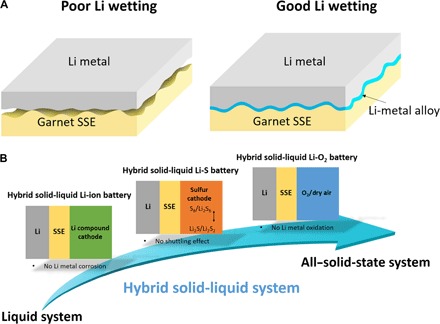
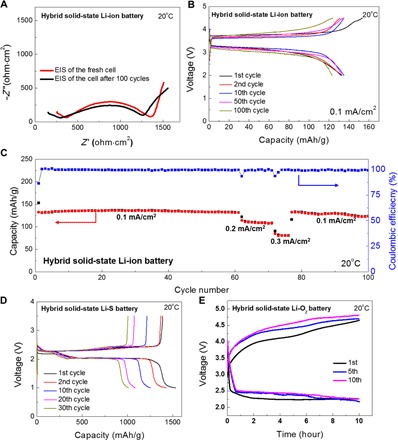
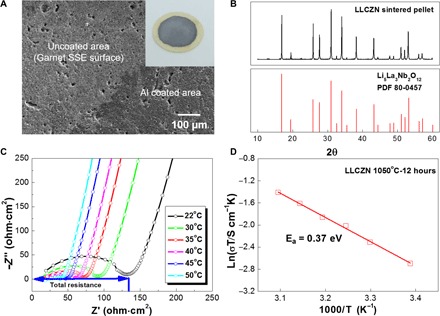
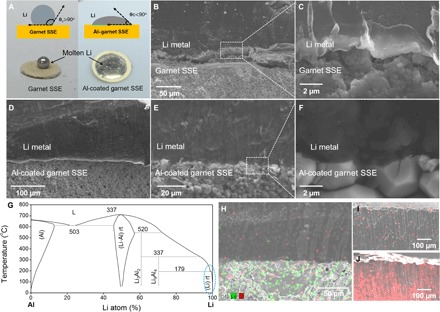
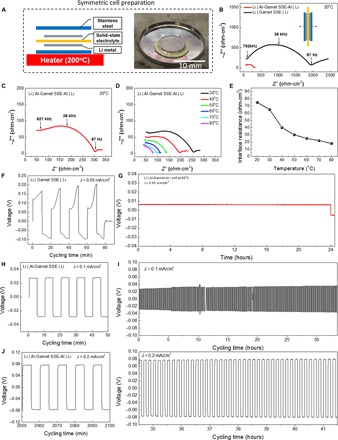
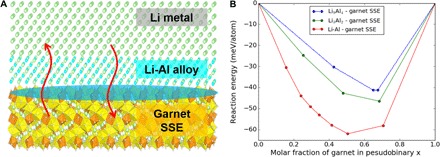
Solid-state batteries are a promising option toward high energy and power densities due to the use of lithium (Li) metal as an anode. Among all solid electrolyte materials ranging from sulfides to oxides and oxynitrides, cubic garnet-type LiLaZrO (LLZO) ceramic electrolytes are superior candidates because of their high ionic conductivity (10 to 10 S/cm) and good stability against Li metal. However, garnet solid electrolytes generally have poor contact with Li metal, which causes high resistance and uneven current distribution at the interface. To address this challenge, we demonstrate a strategy to engineer the garnet solid electrolyte and the Li metal interface by forming an intermediary Li-metal alloy, which changes the wettability of the garnet surface (lithiophobic to lithiophilic) and reduces the interface resistance by more than an order of magnitude: 950 ohm·cm for the pristine garnet/Li and 75 ohm·cm for the surface-engineered garnet/Li. LiLaCaZrNbO (LLCZN) was selected as the solid-state electrolyte (SSE) in this work because of its low sintering temperature, stabilized cubic garnet phase, and high ionic conductivity. This low area-specific resistance enables a solid-state garnet SSE/Li metal configuration and promotes the development of a hybrid electrolyte system. The hybrid system uses the improved solid-state garnet SSE Li metal anode and a thin liquid electrolyte cathode interfacial layer. This work provides new ways to address the garnet SSE wetting issue against Li and get more stable cell performances based on the hybrid electrolyte system for Li-ion, Li-sulfur, and Li-oxygen batteries toward the next generation of Li metal batteries.
固态电池由于使用锂(Li)金属作为阳极,因此是实现高能量和高功率密度的有前途的选择。在所有固态电解质材料中,从硫化物到氧化物和氮氧化物,立方石榴石型 LiLaZrO(LLZO)陶瓷电解质因其高离子电导率(10 到 10 S/cm)和对 Li 金属的良好稳定性而成为首选。然而,石榴石固体电解质通常与 Li 金属接触不良,这会导致界面处的电阻高且电流分布不均匀。为了解决这一挑战,我们通过形成中间 Li 金属合金来设计石榴石固体电解质和 Li 金属界面的策略,从而改变了石榴石表面的润湿性(疏锂性变为亲锂性),并将界面电阻降低了一个数量级以上:原始石榴石/Li 的电阻为 950 欧姆·厘米,而经过表面处理的石榴石/Li 的电阻为 75 欧姆·厘米。在这项工作中,选择 LiLaCaZrNbO(LLCZN)作为固态电解质(SSE),因为它具有较低的烧结温度、稳定的立方石榴石相和较高的离子电导率。这种低的比面积电阻可实现固态石榴石 SSE/Li 金属配置,并促进混合电解质系统的发展。混合系统使用改进的固态石榴石 SSE Li 金属阳极和薄的液体电解质阴极界面层。这项工作为解决石榴石 SSE 对 Li 的润湿性问题提供了新途径,并基于混合电解质系统为锂离子、硫离子和氧离子电池提供了更稳定的电池性能,朝着下一代 Li 金属电池迈进。