Department of Genetics, Stanford University, Stanford, California 94305, USA.
Department of Computer Science, Stanford University, Stanford, California 94305, USA.
Nat Commun. 2017 May 5;8:15178. doi: 10.1038/ncomms15178.
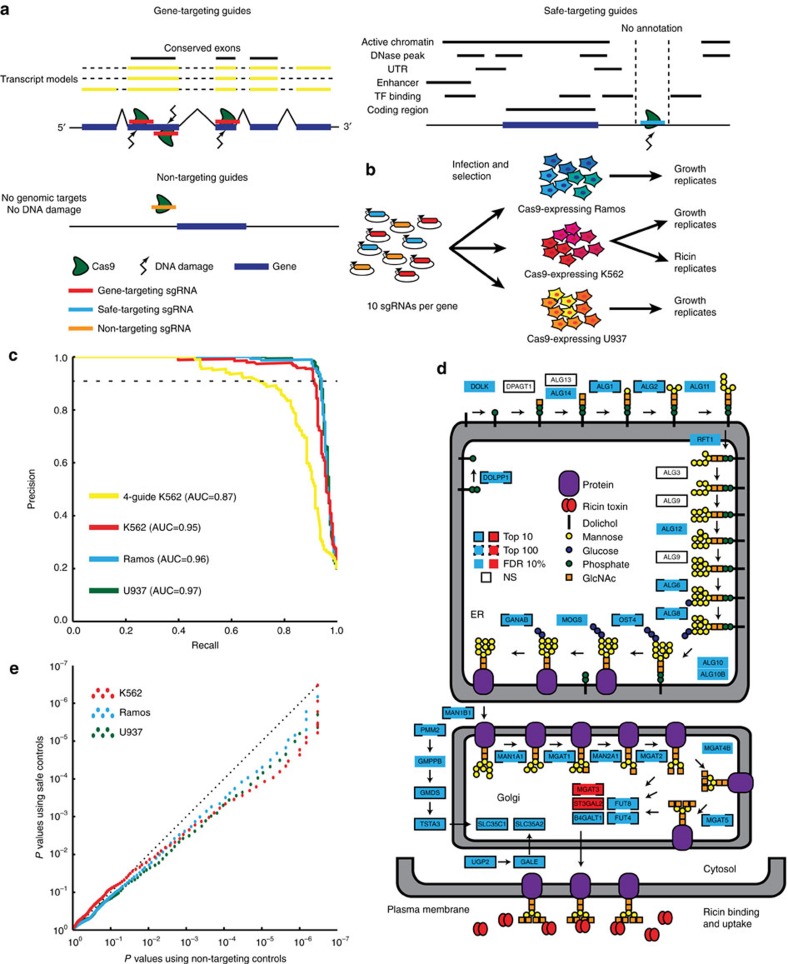
CRISPR-Cas9 screens are powerful tools for high-throughput interrogation of genome function, but can be confounded by nuclease-induced toxicity at both on- and off-target sites, likely due to DNA damage. Here, to test potential solutions to this issue, we design and analyse a CRISPR-Cas9 library with 10 variable-length guides per gene and thousands of negative controls targeting non-functional, non-genic regions (termed safe-targeting guides), in addition to non-targeting controls. We find this library has excellent performance in identifying genes affecting growth and sensitivity to the ricin toxin. The safe-targeting guides allow for proper control of toxicity from on-target DNA damage. Using this toxicity as a proxy to measure off-target cutting, we demonstrate with tens of thousands of guides both the nucleotide position-dependent sensitivity to single mismatches and the reduction of off-target cutting using truncated guides. Our results demonstrate a simple strategy for high-throughput evaluation of target specificity and nuclease toxicity in Cas9 screens.
CRISPR-Cas9 筛选是高通量研究基因组功能的强大工具,但在靶和脱靶位点都会因核酸酶诱导的毒性而变得复杂,这可能是由于 DNA 损伤。在这里,为了测试这个问题的潜在解决方案,我们设计并分析了一个 CRISPR-Cas9 文库,每个基因有 10 个可变长度的向导,还有数千个针对非功能、非基因区域的阴性对照(称为安全靶向向导),以及非靶向对照。我们发现,这个文库在识别影响生长和对蓖麻毒素敏感性的基因方面表现出色。安全靶向向导可以适当控制靶标 DNA 损伤引起的毒性。我们利用这种毒性作为衡量脱靶切割的替代指标,使用数万种向导展示了单碱基错配的核苷酸位置依赖性敏感性,以及使用截断向导减少脱靶切割。我们的结果表明,这是一种用于 Cas9 筛选中靶特异性和核酸酶毒性的高通量评估的简单策略。