Mai Stefania, Walker Gillian E, Vietti Roberta, Cattaldo Stefania, Mele Chiara, Priano Lorenzo, Mauro Alessandro, Bona Gianni, Aimaretti Gianluca, Scacchi Massimo, Marzullo Paolo
Laboratory of Metabolic Research, Ospedale S. Giuseppe, I.R.C.S.S. Istituto Auxologico Italiano, 28921 Piancavallo-Verbania, Italy.
Laboratory of Paediatrics, Department of Health Sciences, Università del Piemonte Orientale, 28100 Novara, Italy.
Nutrients. 2017 May 5;9(5):459. doi: 10.3390/nu9050459.
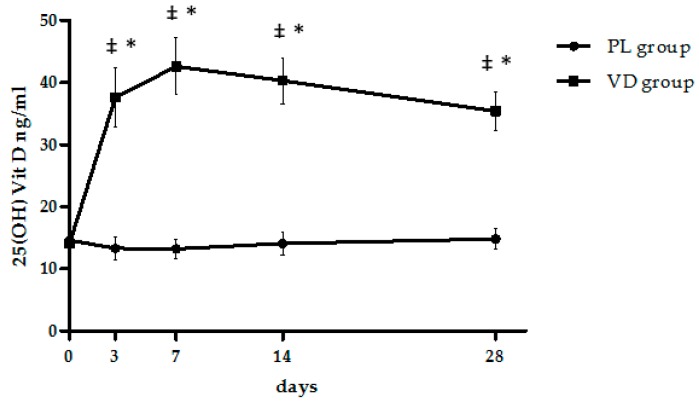
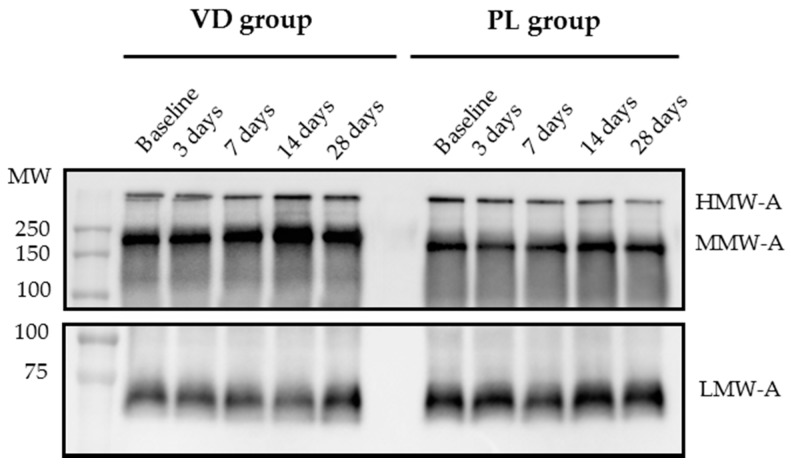
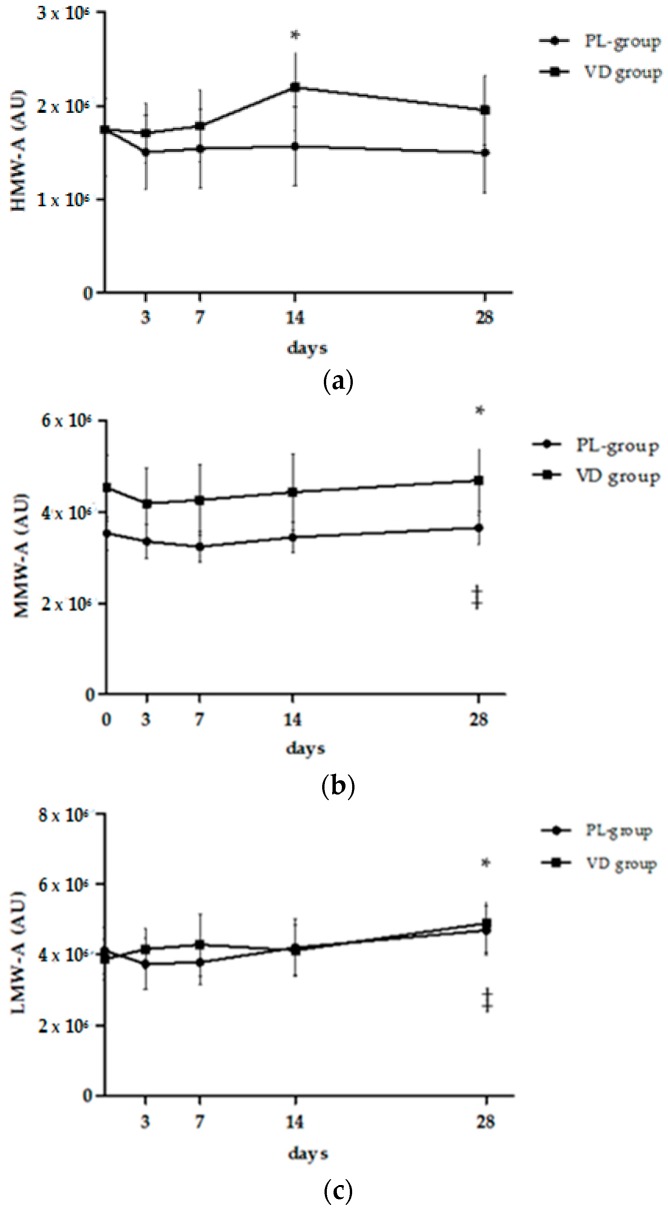
Obesity predisposes to vitamin D deficiency (VDD) and glucose abnormalities. It is currently debated if vitamin D administration may improve glucose homeostasis by interacting with modulators of insulin sensitivity, such as adiponectin and its oligomers. In a 4-week inpatient study on a metabolic rehabilitation program, consisting of individualized caloric restriction and aerobic physical exercise in obese subjects with VDD, we assessed the acute effects of 600,000 IU cholecalciferol given per os VD group, 12 subjects; body mass index (BMI) 42.7 ± 1.3 kg/m²) or placebo per os (PL group, 12 subjects, BMI 39.8 ± 0.9 kg/m²) on high (HWM-A), medium (MMW-A), and low molecular weight adiponectin (LMW-A), as quantified by western immunoblot (WIB) and ELISA. During the 4-week study, dieting promoted a similar magnitude of weight loss in VD and PL groups. Compared to the PL group, cholecalciferol administration increased 25(OH)Vit D levels ( < 0.001) and promoted a significant increase of HMW-A expression analyzed by WIB ( = 0.02). In parallel, a significant decrease of leptin/HMW-A ratio ( < 0.05), a biomarker of metabolic homeostasis, was observed. During the study, changes of MMW-A and LMW-A occurred independently of cholecalciferol administration, and were likely explained by weight loss. At odds with these findings, the ELISA assessment of adiponectin oligomers showed no modifications in the VD group or PL group. Current findings suggest that acute cholecalciferol administration selectively modifies HMW-A and the leptin/HMW-A ratio.
肥胖易导致维生素D缺乏(VDD)和葡萄糖异常。目前存在争议的是,补充维生素D是否可通过与胰岛素敏感性调节因子(如脂联素及其寡聚体)相互作用来改善葡萄糖稳态。在一项针对代谢康复项目的为期4周的住院研究中,该项目包括对患有VDD的肥胖受试者进行个体化热量限制和有氧运动,我们评估了口服60万国际单位胆钙化醇(VD组,12名受试者;体重指数[BMI]为42.7±1.3kg/m²)或口服安慰剂(PL组,12名受试者,BMI为39.8±0.9kg/m²)对高(HWM-A)、中(MMW-A)和低分子量脂联素(LMW-A)的急性影响,通过western免疫印迹法(WIB)和酶联免疫吸附测定(ELISA)进行定量分析。在为期4周的研究中,节食使VD组和PL组的体重减轻幅度相似。与PL组相比,补充胆钙化醇可提高25(OH)维生素D水平(<0.001),并通过WIB分析促进HMW-A表达显著增加(=0.02)。同时,观察到代谢稳态生物标志物瘦素/HMW-A比值显著降低(<0.05)。在研究期间,MMW-A和LMW-A的变化与胆钙化醇的补充无关,可能是由体重减轻所解释。与这些发现不一致地是,ELISA对脂联素寡聚体的评估显示VD组或PL组没有变化。目前的研究结果表明,急性补充胆钙化醇可选择性地改变HMW-A和瘦素/HMW-A比值。