Laboratory of Clinical Pediatrics, Department of Health Sciences, Università del Piemonte Orientale "Amedeo Avogadro", Novara, Italy.
Division of Pediatrics, Department of Health Sciences, Università del Piemonte Orientale "Amedeo Avogadro", Novara, Italy.
PLoS One. 2014 Jan 3;9(1):e83685. doi: 10.1371/journal.pone.0083685. eCollection 2014.
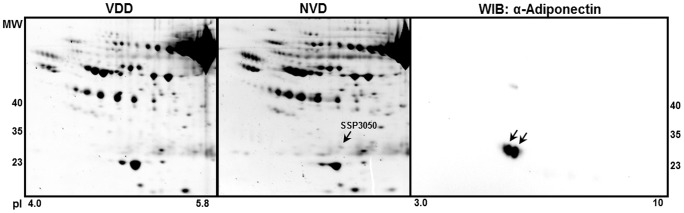
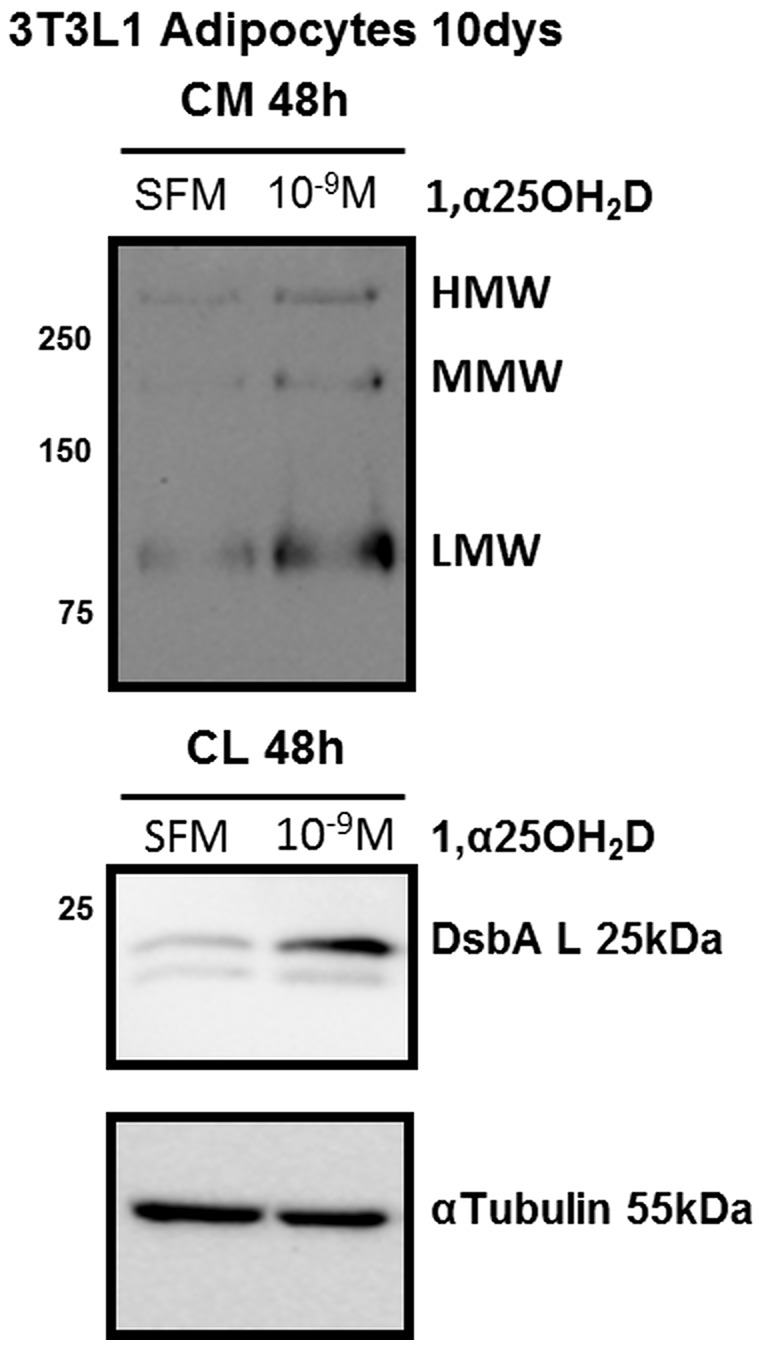
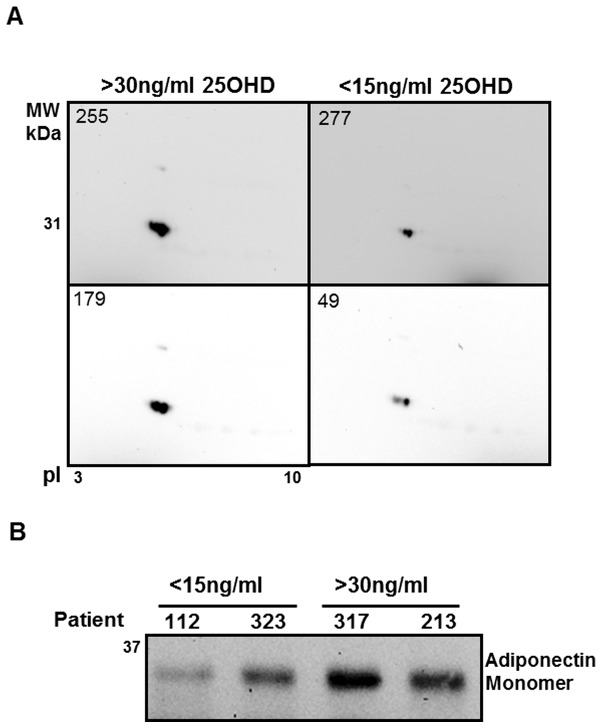
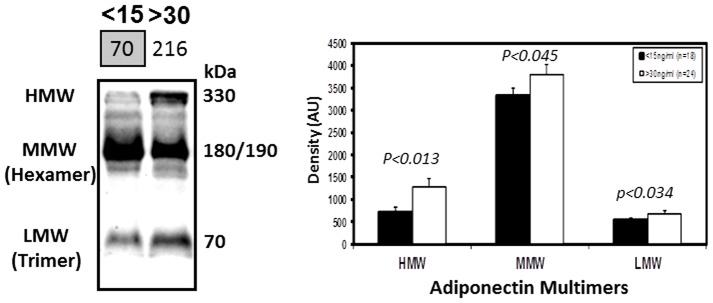
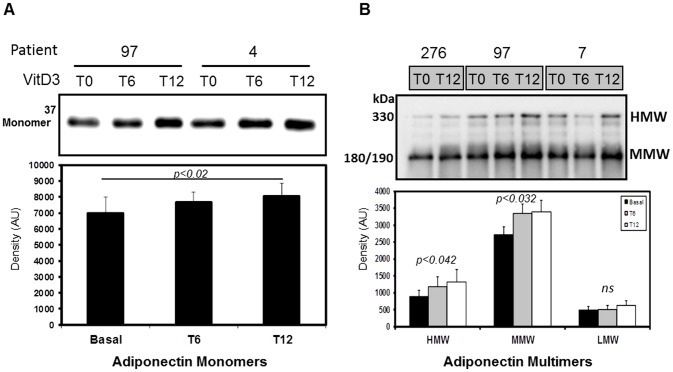
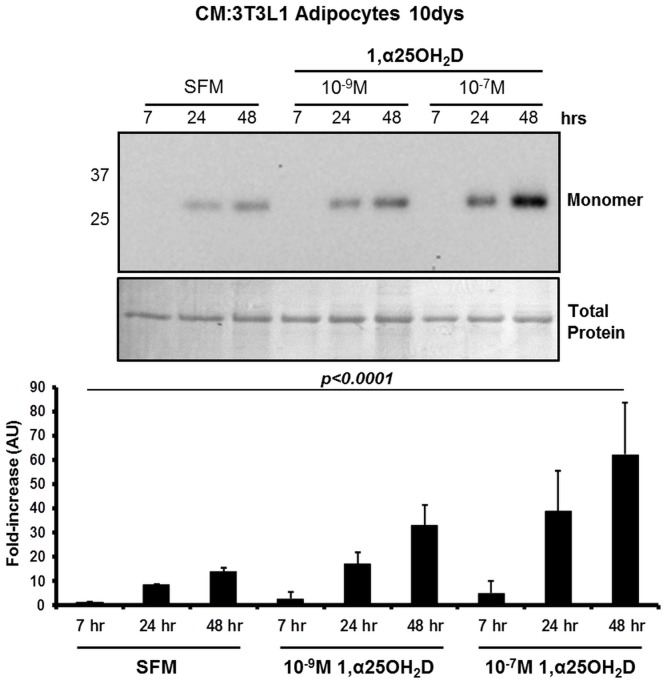
Key circulating molecules that link vitamin D (VD) to pediatric obesity and its co-morbidities remain unclear. Using a proteomic approach, our objective was to identify key molecules in obese children dichotomized according to 25OH-vitamin D (25OHD) levels. A total of 42 obese children (M/F = 18/24) were divided according to their 25OHD3 levels into 25OHD3 deficient (VDD; n = 18; 25OHD<15 ng/ml) or normal subjects (NVD; n = 24; >30 ng/ml). Plasma proteomic analyses by two dimensional (2D)-electrophoresis were performed at baseline in all subjects. VDD subjects underwent a 12mo treatment with 3000 IU vitamin D3 once a week to confirm the proteomic analyses. The proteomic analyses identified 53 "spots" that differed between VDD and NVD (p<0.05), amongst which adiponectin was identified. Adiponectin was selected for confirmational studies due to its tight association with obesity and diabetes mellitus. Western Immunoblot (WIB) analyses of 2D-gels demonstrated a downregulation of adiponectin in VDD subjects, which was confirmed in the plasma from VDD with respect to NVD subjects (p<0.035) and increased following 12mo vitamin D3 supplementation in VDD subjects (p<0.02). High molecular weight (HMW) adiponectin, a surrogate indicator of insulin sensitivity, was significantly lower in VDD subjects (p<0.02) and improved with vitamin D3 supplementation (p<0.042). A direct effect in vitro of 1α,25-(OH)2D3 on adipocyte adiponectin synthesis was demonstrated, with adiponectin and its multimeric forms upregulated, even at low pharmacological doses (10(-9) M) of 1α,25-(OH)2D3. This upregulation was paralleled by the adiponectin interactive protein, DsbA-L, suggesting that the VD regulation of adiponectin involves post-transciptional events. Using a proteomic approach, multimeric adiponectin has been identified as a key plasma protein that links VDD to pediatric obesity.
目前仍不清楚将维生素 D(VD)与儿科肥胖及其合并症联系起来的关键循环分子。本研究采用蛋白质组学方法,旨在根据 25-羟维生素 D(25OHD)水平,确定肥胖儿童中关键分子。总共 42 名肥胖儿童(M/F=18/24)根据 25OHD3 水平分为 25OHD3 缺乏(VDD;n=18;25OHD<15ng/ml)或正常组(NVD;n=24;>30ng/ml)。所有受试者均在基线时进行二维(2D)电泳血浆蛋白质组学分析。VDD 组接受每周一次 3000IU 维生素 D3 治疗 12 个月,以确认蛋白质组学分析。蛋白质组学分析确定了 53 个在 VDD 和 NVD 之间存在差异的“斑点”(p<0.05),其中包括脂联素。由于脂联素与肥胖和糖尿病密切相关,因此选择脂联素进行确证研究。2D 凝胶的 Western 免疫印迹(WIB)分析表明 VDD 受试者的脂联素下调,在 VDD 受试者的血浆中得到证实(与 NVD 受试者相比,p<0.035),并在 VDD 受试者接受 12 个月维生素 D3 补充后增加(p<0.02)。高相对分子质量(HMW)脂联素是胰岛素敏感性的替代指标,在 VDD 受试者中显著降低(p<0.02),并随着维生素 D3 补充而改善(p<0.042)。体外研究表明,1α,25-(OH)2D3 对脂肪细胞脂联素合成有直接作用,即使在低药理剂量(10-9M)1α,25-(OH)2D3 下,脂联素及其多聚体形式也被上调。这种上调与脂联素相互作用蛋白 DsbA-L 平行,表明 VD 对脂联素的调节涉及转录后事件。本研究采用蛋白质组学方法,确定多聚体脂联素为将 VDD 与儿科肥胖联系起来的关键血浆蛋白。