Pisanic Nora, Rahman Atiqur, Saha Samir K, Labrique Alain B, Nelson Kenrad E, Granger Douglas A, Granger Steve W, Detrick Barbara, Heaney Christopher D
Department of Environmental Health and Engineering, Johns Hopkins Bloomberg School of Public Health, Baltimore, MD, USA.
Department of Microbiology, Dhaka Shishu (Children's) Hospital, Dhaka 1207, Bangladesh.
J Immunol Methods. 2017 Sep;448:1-8. doi: 10.1016/j.jim.2017.04.012. Epub 2017 May 3.
Hepatitis E virus (HEV) infection causes significant morbidity and mortality worldwide, particularly among pregnant women. In clinical settings blood-based testing protocols are commonly used to diagnose HEV infection, but in community settings such invasive sampling can hinder study participation and limit discovery of the ecology and natural history of HEV infection. Oral fluid is a non-invasive biospecimen that can harbor pathogen-specific antibodies and has the potential to replace blood-based testing protocols.
To develop an immunoassay to assess past and recent HEV infection that uses oral fluid instead of serum or plasma.
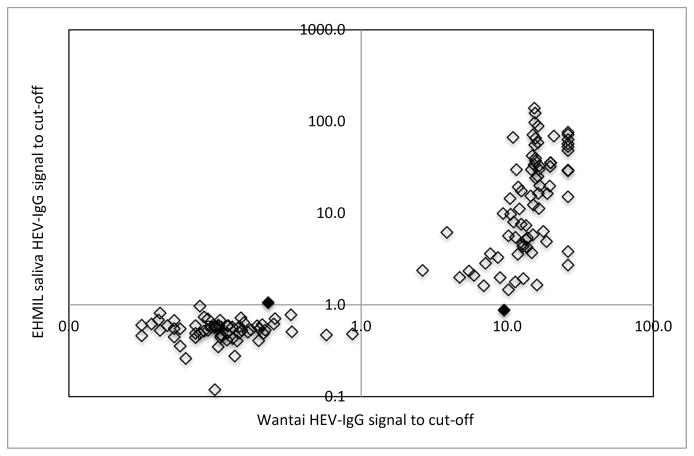
The assay was validated using paired oral fluid and serum samples collected from 141 patients who presented either with (n=76) or without (n=65) symptoms of acute viral hepatitis at a clinical diagnostics center in Dhaka, Bangladesh. The sensitivity and specificity of the oral fluid-based immunoassay for HEV IgG (past HEV infection) and HEV IgA (recent HEV infection) antibodies was calculated in reference to Wantai's (Beijing Wantai) serum-based HEV enzyme-linked immunosorbent assay (ELISA) kits for IgG and IgM antibodies, respectively.
The sensitivity and specificity of the oral fluid-based immunoassay for HEV-IgG antibodies were 98.7% and 98.4%, respectively. The sensitivity and specificity of the oral fluid-based immunoassay for HEV IgA were 89.5% and 98.3%, respectively.
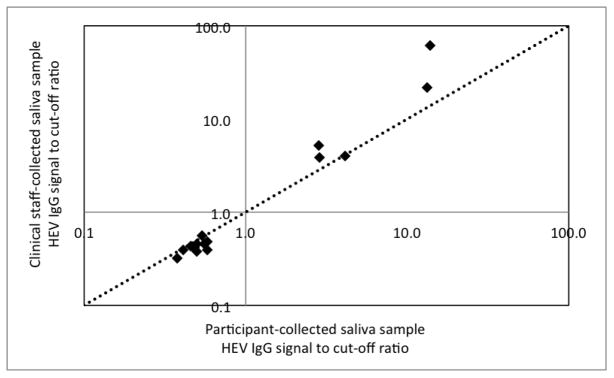
The high concordance of our non-invasive oral fluid-based immunoassays (HEV IgG and HEV IgA) with commercial high-performance serum HEV ELISA kits (IgG and IgM) means that population-based surveillance of past and recent HEV infection could be expanded to improve understanding of its ecology and natural history.
戊型肝炎病毒(HEV)感染在全球范围内导致了显著的发病率和死亡率,尤其是在孕妇中。在临床环境中,基于血液的检测方案常用于诊断HEV感染,但在社区环境中,这种侵入性采样可能会阻碍研究参与,并限制对HEV感染的生态学和自然史的发现。口腔液是一种非侵入性生物样本,可携带病原体特异性抗体,有潜力取代基于血液的检测方案。
开发一种免疫测定法,以使用口腔液而非血清或血浆来评估既往和近期的HEV感染。
该测定法使用从孟加拉国达卡一家临床诊断中心的141名患者收集的配对口腔液和血清样本进行验证,这些患者中有(n = 76)或没有(n = 65)急性病毒性肝炎症状。基于口腔液的HEV IgG(既往HEV感染)和HEV IgA(近期HEV感染)抗体免疫测定法的敏感性和特异性,分别参照万泰(北京万泰)基于血清的HEV IgG和IgM抗体酶联免疫吸附测定(ELISA)试剂盒进行计算。
基于口腔液的HEV-IgG抗体免疫测定法的敏感性和特异性分别为98.7%和98.4%。基于口腔液的HEV IgA免疫测定法的敏感性和特异性分别为89.5%和98.3%。
我们基于非侵入性口腔液的免疫测定法(HEV IgG和HEV IgA)与商业化高性能血清HEV ELISA试剂盒(IgG和IgM)的高度一致性意味着,对既往和近期HEV感染的人群监测可以扩大,以增进对其生态学和自然史的了解。