Qiu Shanhu, Cai Xue, Sun Zilin, Li Ling, Zuegel Martina, Steinacker Juergen Michael, Schumann Uwe
Department of Endocrinology, Zhongda Hospital, Institute of Diabetes, School of Medicine, Southeast University, Nanjing, China.
Department of Endocrinology, Zhongda Hospital, Institute of Diabetes, School of Medicine, Southeast University, Nanjing, China
J Am Heart Assoc. 2017 May 9;6(5):e005505. doi: 10.1161/JAHA.117.005505.
Heart rate recovery (HRR) is a noninvasive assessment of autonomic dysfunction and has been implicated with risk of cardiovascular events and all-cause mortality. However, evidence has not been systematically assessed. We performed a meta-analysis of prospective cohort studies to quantify these associations in the general population.
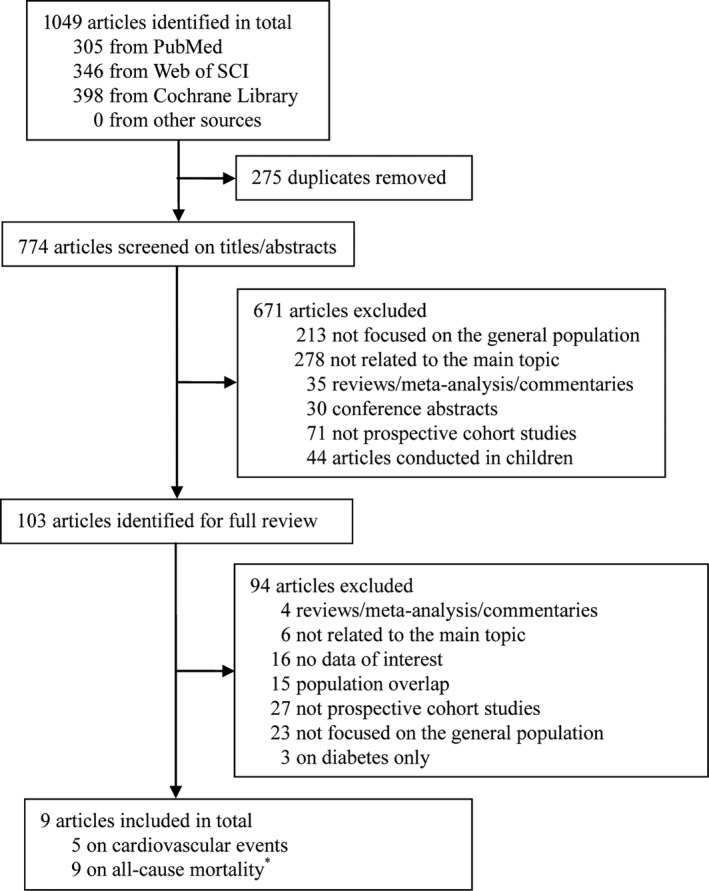
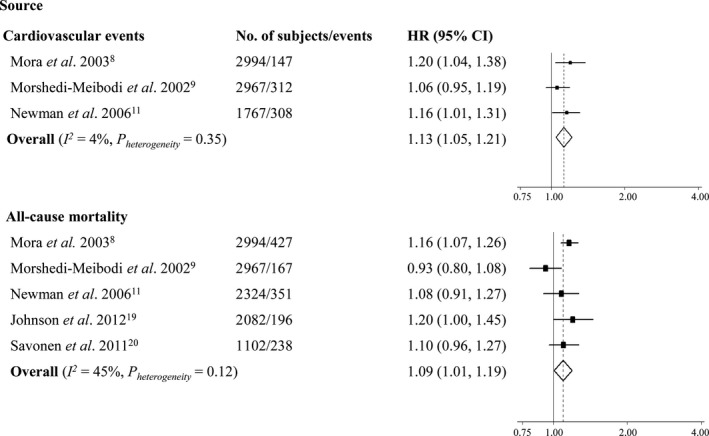
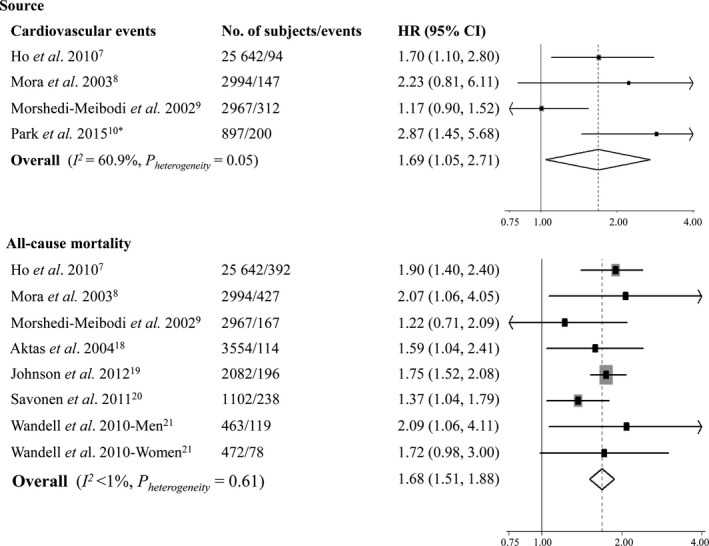
A literature search using 3 databases up to August 2016 was conducted for studies that reported hazard ratios with 95% CIs for the association between baseline HRR and outcomes of interest. The overall hazard ratios were calculated using a random-effects model. There were 9 eligible studies in total, with 5 for cardiovascular events enrolling 1061 cases from 34 267 participants, and 9 for all-cause mortality enrolling 2082 cases from 41 600 participants. The pooled hazard ratios associated with attenuated HRR versus fast HRR that served as the referent were 1.69 (95% CI 1.05-2.71) for cardiovascular events and 1.68 (95% CI 1.51-1.88) for all-cause mortality. For every 10 beats per minute decrements in HRR, the hazard ratios were 1.13 (95% CI 1.05-1.21) and 1.09 (95% CI 1.01-1.19), respectively. Further analyses suggested that the associations observed between attenuated HRR and risk of fatal cardiovascular events and all-cause mortality were independent of traditional metabolic factors for cardiovascular disease (all <0.05).
Attenuated HRR is associated with increased risk of cardiovascular events and all-cause mortality, which supports the recommendation of recording HRR for risk assessment in clinical practice as a routine.
心率恢复(HRR)是自主神经功能障碍的一种非侵入性评估方法,与心血管事件风险和全因死亡率相关。然而,相关证据尚未得到系统评估。我们进行了一项前瞻性队列研究的荟萃分析,以量化一般人群中的这些关联。
利用3个数据库检索截至2016年8月的研究,这些研究报告了基线HRR与感兴趣结局之间关联的风险比及95%可信区间。采用随机效应模型计算总体风险比。共有9项符合条件的研究,其中5项关于心血管事件,纳入了34267名参与者中的1061例;9项关于全因死亡率,纳入了41600名参与者中的2082例。与作为参照的快速心率恢复相比,心率恢复减弱的合并风险比在心血管事件中为1.69(95%可信区间1.05 - 2.71),在全因死亡率中为1.68(95%可信区间1.51 - 1.88)。心率恢复每降低10次/分钟,风险比分别为1.13(95%可信区间1.05 - 1.21)和1.09(95%可信区间1.01 - 1.19)。进一步分析表明,心率恢复减弱与致命心血管事件风险和全因死亡率之间的关联独立于传统心血管疾病代谢因素(所有P<0.05)。
心率恢复减弱与心血管事件风险和全因死亡率增加相关,这支持了在临床实践中常规记录心率恢复以进行风险评估的建议。