Ben Khedher Soumaya, Neri Monica, Guida Florence, Matrat Mireille, Cenée Sylvie, Sanchez Marie, Menvielle Gwenn, Molinié Florence, Luce Danièle, Stücker Isabelle
Centre de recherche en Epidemiologie et Sante des Populations, Universite Paris-Sud, illejuif, France.
Department of Epidemiology and Biostatistics, Imperial College London, MRC-PHE Centre for Environment and Health, School of Public Health, London, UK.
Occup Environ Med. 2017 Sep;74(9):667-679. doi: 10.1136/oemed-2016-104117. Epub 2017 May 10.
To investigate the role of occupational exposure to endotoxins in lung cancer in a French population-based case-control study (ICARE (Investigation of occupational and environmental causes of respiratory cancers)).
Detailed information was collected on the occupational history and smoking habits from 2926 patients with histologically confirmed lung cancer and 3555 matched controls. We evaluated each subject's endotoxin exposure after cross referencing International Standard Classification of Occupations (ISCO) codes (for job tasks) and Nomenclature d'Activités Françaises (NAF) codes (for activity sectors). Endotoxin exposure levels were attributed to each work environment based on literature reports. ORs and 95% CIs were estimated using unconditional logistic regression models and controlled for main confounding factors.
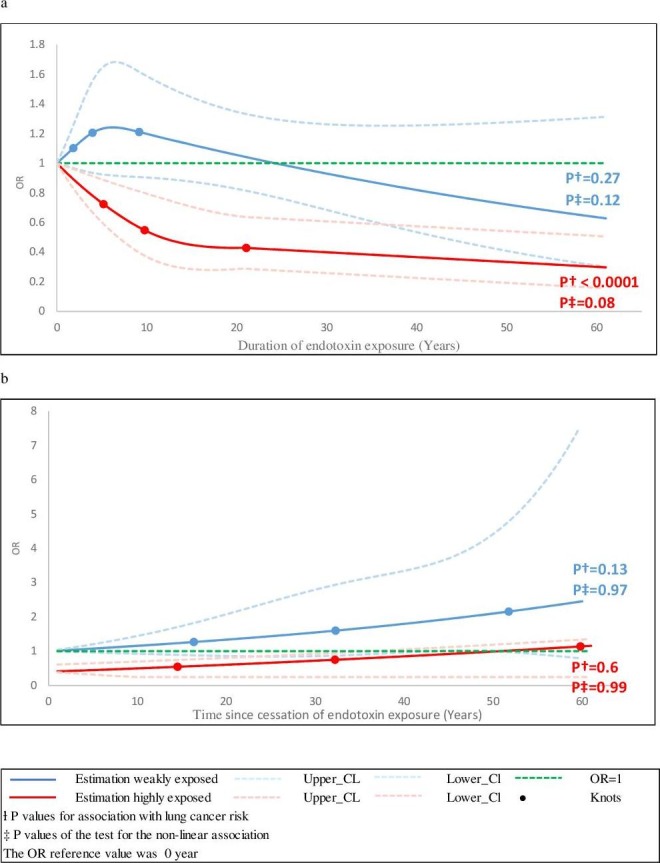
An inverse association between exposure to endotoxins and lung cancer was found (OR=0.80, 95% CI 0.66 to 0.95). Negative trends were shown with duration and cumulative exposure, and the risk was decreased decades after exposure cessation (all statistically significant). Lung cancer risk was particularly reduced among workers highly exposed (eg, in dairy, cattle, poultry, pig farms), but also in those weakly exposed (eg, in waste treatment). Statistically significant interactions were shown with smoking, and never/light smokers were more sensitive to an endotoxin effect than heavy smokers (eg, OR=0.14, 95% CI 0.06 to 0.32 and OR=0.80, 95% CI 0.45 to 1.40, respectively, for the quartiles with the highest cumulative exposure, compared with those never exposed). Pronounced inverse associations were shown with adenocarcinoma histological subtype (OR=0.37, 95% CI 0.25 to 0.55 in the highly exposed).
Our findings suggest that exposure to endotoxins, even at a low level, reduces the risk of lung cancer.
在一项基于法国人群的病例对照研究(ICARE(呼吸道癌症的职业和环境病因调查))中,调查职业接触内毒素在肺癌发病中的作用。
收集了2926例经组织学确诊的肺癌患者和3555例匹配对照的职业史和吸烟习惯的详细信息。在交叉参考国际职业标准分类(ISCO)代码(用于工作任务)和法国活动分类法(NAF)代码(用于活动部门)后,我们评估了每个受试者的内毒素暴露情况。根据文献报告,将内毒素暴露水平归因于每个工作环境。使用无条件逻辑回归模型估计比值比(OR)和95%可信区间(CI),并对主要混杂因素进行控制。
发现内毒素暴露与肺癌之间存在负相关(OR=0.80,95%CI 0.66至0.95)。暴露持续时间和累积暴露呈现负趋势,且在接触停止数十年后风险降低(均具有统计学意义)。肺癌风险在高暴露工人(如在乳制品、牛、家禽、养猪场工作的工人)中尤其降低,但在低暴露工人(如在废物处理行业工作的工人)中也降低。与吸烟存在统计学显著的交互作用,从不吸烟/轻度吸烟者比重度吸烟者对内毒素效应更敏感(例如,对于累积暴露最高的四分位数,与从未暴露者相比,OR分别为0.14,95%CI 0.06至0.32和OR=0.80,95%CI 0.45至1.40)。腺癌组织学亚型呈现明显的负相关(高暴露组中OR=0.37,95%CI 0.25至0.55)。
我们的研究结果表明,即使是低水平的内毒素暴露也会降低肺癌风险。