Yaripour Saeid, Delnavazi Mohammad-Reza, Asgharian Parina, Valiyari Samira, Tavakoli Saeed, Nazemiyeh Hossein
Department of Drug and Food Control, Faculty of Pharmacy, Tehran University of Medical Sciences, Tehran, Iran.
Department of Pharmaceutical and Food Control, Faculty of Pharmacy, Urmia University of Medical Sciences, Urmia, Iran.
Adv Pharm Bull. 2017 Apr;7(1):109-114. doi: 10.15171/apb.2017.014. Epub 2017 Apr 13.
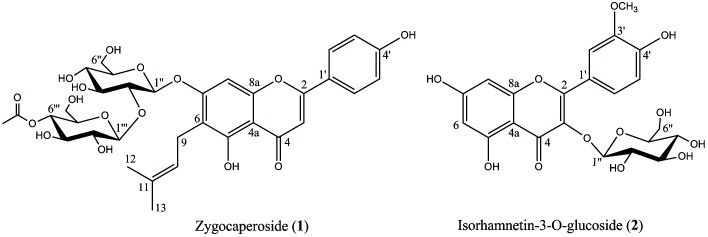
Zygophyllum fabago L. (Z. fabago) is a widespread perennial herb which is used as a medicinal plant in traditional medicine of Iran, Turkey and China. The present study was a survey on phytochemical constituents and biological activities of this plant. Methanolic extract of the roots was fractionated over a C-18 pre-packed cartridge (Sep-pak) and chromatographic separation was performed on a reversed-phase preparative HPLC. Structural elucidation of the isolated compounds was carried out using UV, H-NMR and 13C-NMR spectral analyses. Furthermore, the chemical compositions of the essential oil of the aerial parts were identified by GC-MS analysis. Antiproliferative and antioxidant activities of all extracts from aerials were determined by MTT and DPPH assays, respectively. Phytochemical investigation on the plant roots led to the isolation and identification of two the 60% methanol-water Sep-pak fraction, a prenylated flavone glycoside, 6-C-prenyl-7-O-[ β -D-4'''-O-acetyl-glucopyranosyl-(1'''→2'')-β-D-glucopyranosyl] apigenin, which was named as a Zygocaperoside and also, other flavonoid, was named as the Isorhamnetin -3-O glucoside. None of the extracts showed antiproliferative effect against cancerous cells. However, among the extracts, methanolic extract indicated antioxidant activity. Moreover, essential oils of flowers and leaves of plant have high amounts of sesquiterpene hydrocarbons and diterpenoides. The results of present study introduce Z. fabago roots as a new source of flavonoid glycosides and suggest it as an appropriate candidate for further pharmacological studies.
骆驼蓬(Zygophyllum fabago L.)是一种分布广泛的多年生草本植物,在伊朗、土耳其和中国的传统医学中被用作药用植物。本研究是对该植物的植物化学成分和生物活性的调查。将根的甲醇提取物通过C-18预填充柱(Sep-pak)进行分离,并在反相制备型高效液相色谱上进行色谱分离。使用紫外光谱、氢核磁共振光谱和碳-13核磁共振光谱分析对分离出的化合物进行结构解析。此外,通过气相色谱-质谱联用分析鉴定地上部分精油的化学成分。分别通过MTT和DPPH试验测定地上部分所有提取物的抗增殖和抗氧化活性。对该植物根的植物化学研究导致从60%甲醇-水Sep-pak馏分中分离并鉴定出两种化合物,一种是异戊烯基黄酮苷,6-C-异戊烯基-7-O-[β-D-4'''-O-乙酰基-吡喃葡萄糖基-(1'''→2'')-β-D-吡喃葡萄糖基]芹菜素,命名为骆驼蓬苷,还有另一种黄酮类化合物,命名为异鼠李素-3-O葡萄糖苷。没有一种提取物对癌细胞显示出抗增殖作用。然而,在这些提取物中,甲醇提取物表现出抗氧化活性。此外,该植物花和叶的精油含有大量的倍半萜烃和二萜类化合物。本研究结果将骆驼蓬根作为黄酮苷的新来源,并表明它是进一步药理研究的合适候选物。