Hardefeldt L Y, Holloway S, Trott D J, Shipstone M, Barrs V R, Malik R, Burrows M, Armstrong S, Browning G F, Stevenson M
Faculty of Veterinary and Agricultural Sciences, Asia-Pacific Centre for Animal Health, University of Melbourne, Melbourne, Vic., Australia.
Advanced Vetcare, Kensington, Vic., Australia.
J Vet Intern Med. 2017 Jul;31(4):1100-1107. doi: 10.1111/jvim.14733. Epub 2017 May 17.
Investigations of antimicrobial use in companion animals are limited. With the growing recognition of the need for improved antimicrobial stewardship, there is urgent need for more detailed understanding of the patterns of antimicrobial use in this sector.
To investigate antimicrobial use for medical and surgical conditions in dogs and cats by Australian veterinarians.
A cross-sectional study was performed over 4 months in 2011. Respondents were asked about their choices of antimicrobials for empirical therapy of diseases in dogs and cats, duration of therapy, and selection based on culture and susceptibility testing, for common conditions framed as case scenarios: 11 medical, 2 surgical, and 8 dermatological.
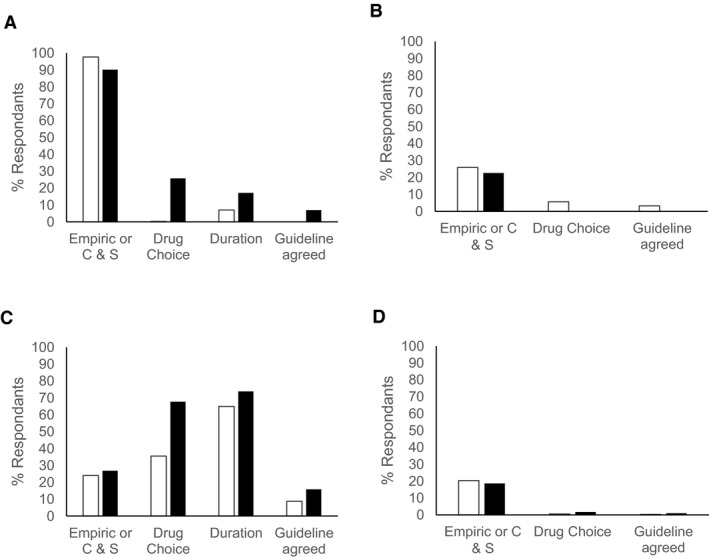
A total of 892 of the 1,029 members of the Australian veterinary profession that completed the survey satisfied the selection criteria. Empirical antimicrobial therapy was more common for acute conditions (76%) than chronic conditions (24%). Overall, the most common antimicrobial classes were potentiated aminopenicillins (36%), fluoroquinolones (15%), first- and second-generation cephalosporins (14%), and tetracyclines (11%). Third-generation cephalosporins were more frequently used in cats (16%) compared to dogs (2%). Agreement with Australasian Infectious Disease Advisory Panel (AIDAP) guidelines (generated subsequently) was variable ranging from 0 to 69% between conditions.
Choice of antimicrobials by Australian veterinary practitioners was generally appropriate, with relatively low use of drugs of high importance, except for the empirical use of fluoroquinolones in dogs, particularly for otitis externa and 3rd-generation cephalosporins in cats. Future surveys will determine whether introduction of the 2013 AIDAP therapeutic guidelines has influenced prescribing habits.
关于伴侣动物抗菌药物使用情况的调查有限。随着人们越来越认识到改善抗菌药物管理的必要性,迫切需要更详细地了解该领域抗菌药物的使用模式。
调查澳大利亚兽医针对犬猫医疗和外科疾病使用抗菌药物的情况。
2011年进行了一项为期4个月的横断面研究。向受访者询问了他们针对犬猫疾病经验性治疗时对抗菌药物的选择、治疗持续时间,以及针对以病例场景呈现的常见病症(11种内科病症、2种外科病症和8种皮肤病病症)基于培养和药敏试验的选择。
完成调查的1029名澳大利亚兽医专业人员中,共有892人符合选择标准。经验性抗菌治疗在急性病症(76%)中比慢性病症(24%)中更常见。总体而言,最常用的抗菌药物类别是加酶氨基青霉素(36%)、氟喹诺酮类(15%)、第一代和第二代头孢菌素(14%)以及四环素类(11%)。与犬相比,第三代头孢菌素在猫中的使用频率更高(16%对2%)。与澳大利亚和新西兰传染病咨询小组(AIDAP)随后制定的指南的符合率在不同病症间差异较大,从0%到69%不等。
澳大利亚兽医从业者对抗菌药物的选择总体上是合适的,高重要性药物的使用相对较少,但犬中氟喹诺酮类的经验性使用除外,尤其是用于外耳炎,以及猫中第三代头孢菌素的使用。未来的调查将确定2013年AIDAP治疗指南的引入是否影响了处方习惯。