Sun Yuan-Chao, Sun Xiao-Feng, Dyce Paul W, Shen Wei, Chen Hong
College of Animal Science and Technology, Northwest A&F University, Shaanxi Key Laboratory of Molecular Biology for Agriculture, Yangling Shaanxi 712100, China.
Institute of Reproductive Sciences, College of Animal Science and Technology, Qingdao Agricultural University, Qingdao 266109, China.
Int J Biol Sci. 2017 Mar 11;13(4):449-457. doi: 10.7150/ijbs.18836. eCollection 2017.
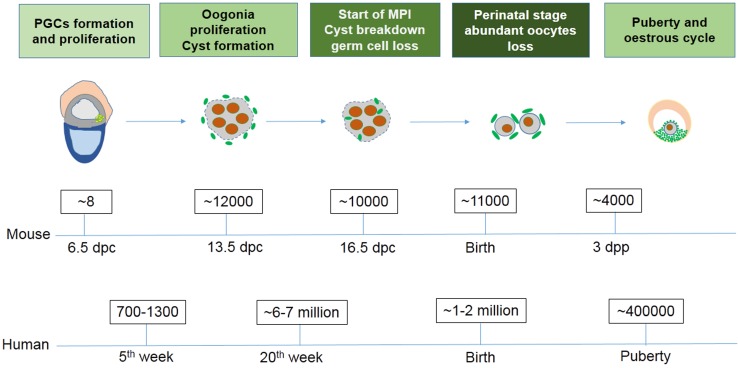
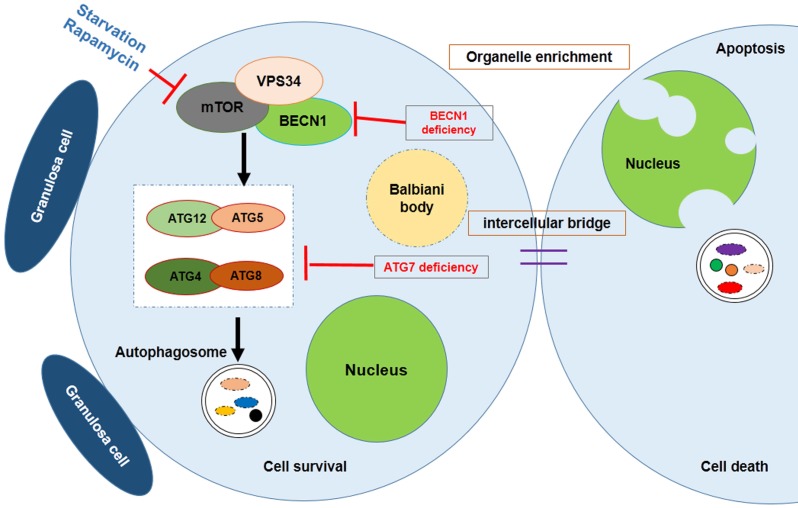
In most female mammals, early germline development begins with the appearance of primordial germ cells (PGCs), and develops to form mature oocytes following several vital processes. It remains well accepted that significant germ cell apoptosis and oocyte loss takes place around the time of birth. The transition of the ovarian environment from fetal to neonatal, coincides with the loss of germ cells and the timing of follicle formation. All told it is common to lose approximately two thirds of germ cells during this transition period. The current consensus is that germ cell loss can be attributed, at least in part, to programmed cell death (PCD). Recently, autophagy has been implicated as playing a part in germ cell loss during the time of parturition. In this review, we discuss the major opinions and mechanisms of mammalian ovarian PCD during the process of germ cell loss. We also pay close attention to the function of autophagy in germ cell loss, and speculate that autophagy may also serve as a critical and necessary process during the establishment of primordial follicle pool.
在大多数雌性哺乳动物中,早期生殖系发育始于原始生殖细胞(PGCs)的出现,并经过几个重要过程发育形成成熟的卵母细胞。人们普遍认为,在出生前后会发生大量生殖细胞凋亡和卵母细胞丢失。卵巢环境从胎儿期向新生儿期的转变,与生殖细胞的丢失以及卵泡形成的时间相吻合。总体而言,在这个过渡时期大约三分之二的生殖细胞会丢失,这是很常见的。目前的共识是,生殖细胞的丢失至少部分可归因于程序性细胞死亡(PCD)。最近,自噬被认为在分娩时生殖细胞丢失过程中发挥作用。在这篇综述中,我们讨论了哺乳动物卵巢在生殖细胞丢失过程中程序性细胞死亡的主要观点和机制。我们还密切关注自噬在生殖细胞丢失中的作用,并推测自噬在原始卵泡库建立过程中可能也是一个关键且必要的过程。