MRC Cognition and Brain Sciences Unit.
Psychol Bull. 2017 Sep;143(9):992-1009. doi: 10.1037/bul0000108. Epub 2017 May 22.
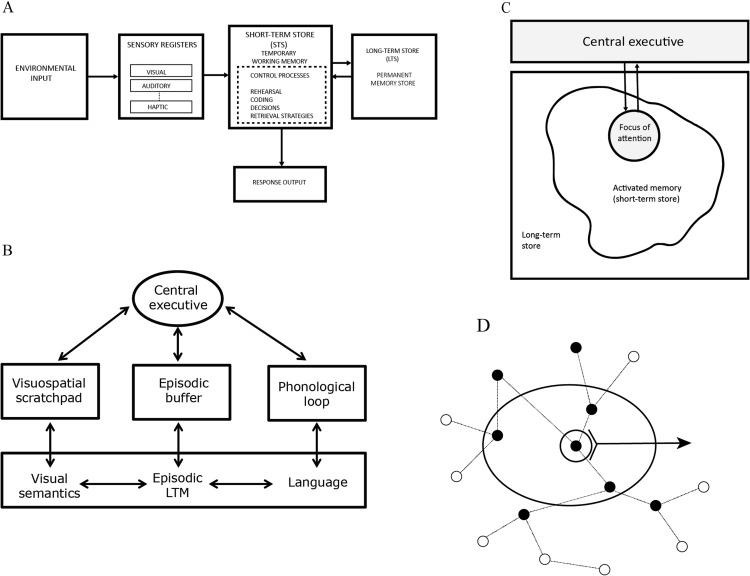
A commonly expressed view is that short-term memory (STM) is nothing more than activated long-term memory. If true, this would overturn a central tenet of cognitive psychology-the idea that there are functionally and neurobiologically distinct short- and long-term stores. Here I present an updated case for a separation between short- and long-term stores, focusing on the computational demands placed on any STM system. STM must support memory for previously unencountered information, the storage of multiple tokens of the same type, and variable binding. None of these can be achieved simply by activating long-term memory. For example, even a simple sequence of digits such as "1, 3, 1" where there are 2 tokens of the digit "1" cannot be stored in the correct order simply by activating the representations of the digits "1" and "3" in LTM. I also review recent neuroimaging data that has been presented as evidence that STM is activated LTM and show that these data are exactly what one would expect to see based on a conventional 2-store view. (PsycINFO Database Record
一种普遍的观点认为,短期记忆(STM)只不过是被激活的长期记忆。如果这是真的,这将推翻认知心理学的一个核心原则——即存在功能上和神经生物学上不同的短期和长期存储的观点。在这里,我提出了一个更新的案例,证明短期存储和长期存储是可以分离的,重点是任何 STM 系统所面临的计算需求。STM 必须支持对以前从未遇到过的信息的记忆,存储相同类型的多个标记,以及变量绑定。这些都不能简单地通过激活长期记忆来实现。例如,即使是一个简单的数字序列,如“1,3,1”,其中有 2 个数字“1”,也不能简单地通过激活长期记忆中数字“1”和“3”的表示来按正确的顺序存储。我还回顾了最近的神经影像学数据,这些数据被认为是 STM 是被激活的 LTM 的证据,并表明这些数据正是基于传统的 2 存储观点所预期看到的。