Haidar Mansour, Timmerman Vincent
Peripheral Neuropathy Research Group, Institute Born Bunge, University of AntwerpAntwerpen, Belgium.
Front Mol Neurosci. 2017 May 11;10:143. doi: 10.3389/fnmol.2017.00143. eCollection 2017.
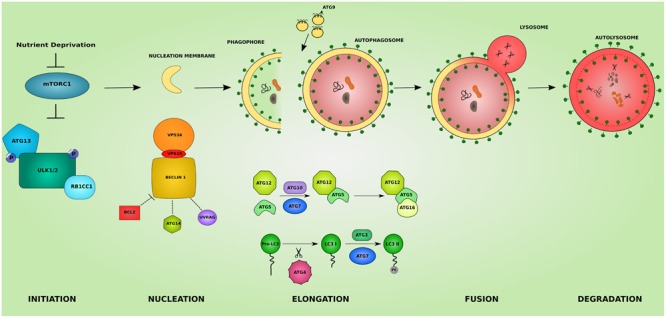
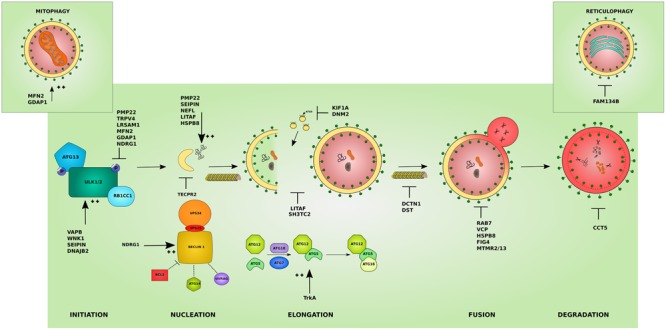
The inherited peripheral neuropathies (IPNs) comprise a growing list of genetically heterogeneous diseases. With mutations in more than 80 genes being reported to cause IPNs, a wide spectrum of functional consequences is expected to follow this genotypic diversity. Hence, the search for a common pathomechanism among the different phenotypes has become the holy grail of functional research into IPNs. During the last decade, studies on several affected genes have shown a direct and/or indirect correlation with autophagy. Autophagy, a cellular homeostatic process, is required for the removal of cell aggregates, long-lived proteins and dead organelles from the cell in double-membraned vesicles destined for the lysosomes. As an evolutionarily highly conserved process, autophagy is essential for the survival and proper functioning of the cell. Recently, neuronal cells have been shown to be particularly vulnerable to disruption of the autophagic pathway. Furthermore, autophagy has been shown to be affected in various common neurodegenerative diseases of both the central and the peripheral nervous system including Alzheimer's, Parkinson's, and Huntington's diseases. In this review we provide an overview of the genes involved in hereditary neuropathies which are linked to autophagy and we propose the disruption of the autophagic flux as an emerging common pathomechanism. We also shed light on the different steps of the autophagy pathway linked to these genes. Finally, we review the concept of autophagy being a therapeutic target in IPNs, and the possibilities and challenges of this pathway-specific targeting.
遗传性周围神经病(IPNs)包括越来越多基因异质性疾病。据报道,80多个基因的突变可导致IPNs,预计这种基因型多样性会带来广泛的功能后果。因此,寻找不同表型之间的共同发病机制已成为IPNs功能研究的圣杯。在过去十年中,对几个受影响基因的研究表明,它们与自噬存在直接和/或间接关联。自噬是一种细胞稳态过程,通过双膜囊泡将细胞聚集体、长寿蛋白和死亡细胞器从细胞中清除并运往溶酶体,这一过程是必需的。作为一个在进化上高度保守的过程,自噬对细胞的存活和正常功能至关重要。最近的研究表明,神经元细胞特别容易受到自噬途径破坏的影响。此外,在中枢和周围神经系统的各种常见神经退行性疾病(包括阿尔茨海默病、帕金森病和亨廷顿病)中,自噬也受到影响。在这篇综述中,我们概述了与自噬相关的遗传性神经病所涉及的基因,并提出自噬流的破坏是一种新出现的共同发病机制。我们还阐明了与这些基因相关的自噬途径的不同步骤。最后,我们回顾了自噬作为IPNs治疗靶点的概念,以及这种途径特异性靶向的可能性和挑战。