Faculty of Health Studies, School of Dementia Studies, University of Bradford, Bradford, UK.
Division of Health Research, Lancaster University, Lancaster, UK.
J Clin Nurs. 2018 Jan;27(1-2):317-327. doi: 10.1111/jocn.13906. Epub 2017 Dec 6.
To explore family perspectives on their involvement in the timely detection of changes in their relatives' health in UK nursing homes.
Increasingly, policy attention is being paid to the need to reduce hospitalisations for conditions that, if detected and treated in time, could be managed in the community. We know that family continue to be involved in the care of their family members once they have moved into a nursing home. Little is known, however, about family involvement in the timely detection of changes in health in nursing home residents.
Qualitative exploratory study with thematic analysis.
A purposive sampling strategy was applied. Fourteen semi-structured one-to-one interviews with family members of people living in 13 different UK nursing homes. Data were collected from November 2015-March 2016.
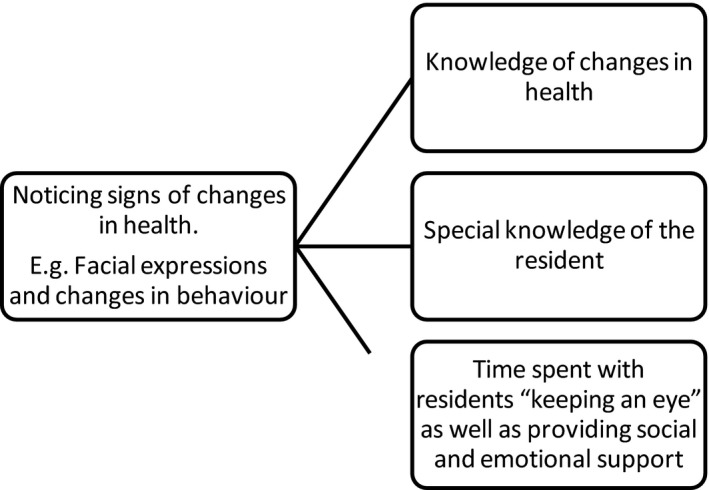
Families were involved in the timely detection of changes in health in three key ways: noticing signs of changes in health, informing care staff about what they noticed and educating care staff about their family members' changes in health. Families suggested they could be supported to detect timely changes in health by developing effective working practices with care staff.
Families can provide a special contribution to the process of timely detection in nursing homes. Their involvement needs to be negotiated, better supported, as well as given more legitimacy and structure within the nursing home.
Families could provide much needed support to nursing home nurses, care assistants and managers in timely detection of changes in health. This may be achieved through communication about their preferred involvement on a case-by-case basis as well as providing appropriate support or services.
探索英国家庭对其参与及时发现亲属在养老院健康状况变化的看法。
越来越多的政策关注到减少因病情未及时发现和治疗而需要住院的情况,这些病情如果能及时发现并在社区进行治疗是可以得到控制的。我们知道,一旦家庭成员搬入养老院,他们仍会继续参与到对其的护理中。然而,我们对家庭在养老院居民健康状况及时发现方面的参与程度知之甚少。
定性探索性研究,采用主题分析方法。
采用了目的抽样策略。对居住在 13 家不同英国养老院的 14 名家庭成员进行了 14 次半结构化的一对一访谈。数据收集于 2015 年 11 月至 2016 年 3 月期间。
家庭主要通过以下三种方式参与及时发现健康状况的变化:注意到健康状况变化的迹象,向护理人员报告他们所注意到的情况,以及教育护理人员了解其家庭成员健康状况的变化。家庭认为,通过与护理人员建立有效的工作实践,可以为他们提供支持,以发现及时的健康变化。
家庭可以为养老院的及时发现过程做出特殊贡献。需要对其参与进行协商、更好地支持,并在养老院中赋予其更多的合法性和结构性。
家庭可以为养老院护士、护理助理和管理人员在及时发现健康变化方面提供急需的支持。这可以通过就其个案的偏好参与进行沟通,并提供适当的支持或服务来实现。