Richard Caroline, Lewis Erin D, Goruk Susan, Wadge Emily, Curtis Jonathan M, Jacobs René L, Field Catherine J
Department of Agricultural, Food and Nutritional Science, University of Alberta, Edmonton, AB T6G 2E1, Canada.
Jean Mayer United States Department of Agriculture, Human Nutrition Center on Aging, Tufts University, Boston, MA 02111, USA.
Nutrients. 2017 Jun 2;9(6):567. doi: 10.3390/nu9060567.
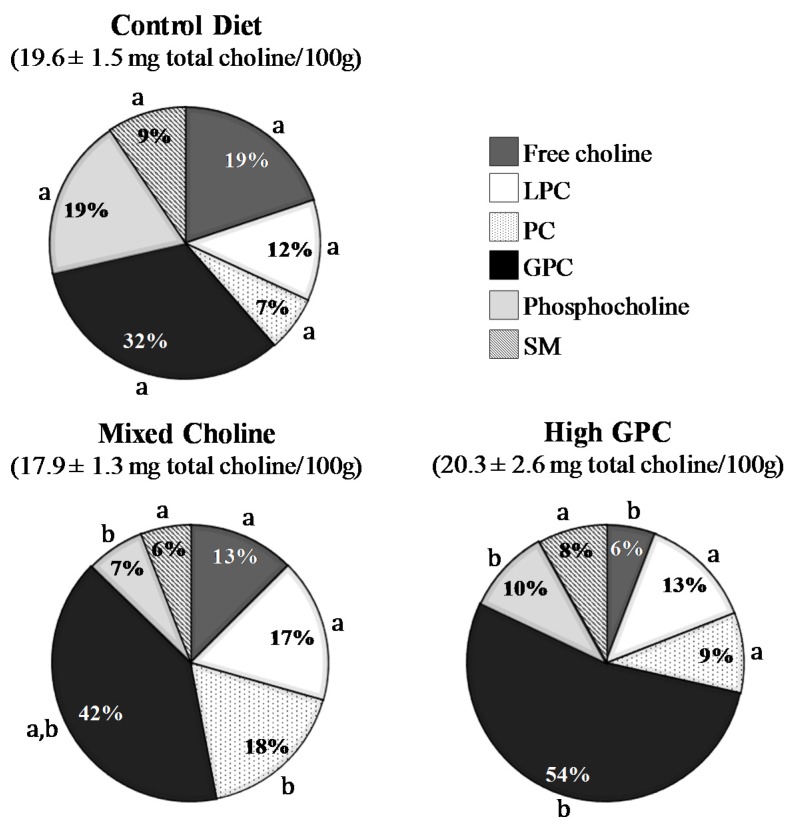
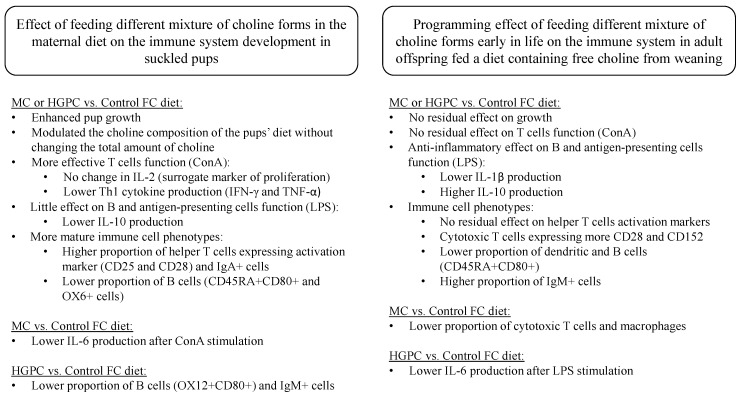
Dietary choline is essential during lactation, but few studies have examined the implications of feeding a mixture of choline forms on immune function. This study investigates the impact of feeding lactating dams different mixtures of choline forms, similar to those in human diets, on the development and later immune function of suckled offspring. Sprague-Dawley lactating dams ( = 6/diet) were randomized to consume one of three diets, containing 1 g/kg choline: Control (100% free choline (FC)), Mixed Choline (MC: 50% phosphatidylcholine (PC), 25% FC, 25% glycerophosphocholine (GPC)), or High GPC (HGPC: 75% GPC, 12.5% PC, 12.5% FC). At weaning, female pups ( = 2/dam) were fed the Control diet until 10 weeks. At 3 weeks, MC and HGPC pups were heavier and their splenocytes had a higher proportion of helper T cells expressing CD25 and CD28 and produced less interferon gamma (IFN-γ) and tumor-necrosis factor-α (TNF-α) after Concanavalin A stimulation vs. Control pups ( < 0.05). At 10 weeks, MC and HGPC offspring had a lower proportion of macrophages and dendritic cells and produced less interleukin (IL)-1β but more IL-10 after lipopolysaccharide stimulation vs. Control pups ( < 0.05). In summary, feeding mixed choline diets during lactation improved T cell phenotype/function at the end of suckling and programmed a less inflammatory response later in life.
哺乳期膳食胆碱至关重要,但很少有研究探讨喂食胆碱形式混合物对免疫功能的影响。本研究调查了给哺乳母鼠喂食不同胆碱形式混合物(类似于人类饮食中的混合物)对哺乳后代发育及后期免疫功能的影响。将Sprague-Dawley哺乳期母鼠(每组6只)随机分为三组,分别喂食含1 g/kg胆碱的三种日粮之一:对照组(100%游离胆碱(FC))、混合胆碱组(MC:50%磷脂酰胆碱(PC)、25% FC、25%甘油磷酸胆碱(GPC))或高GPC组(HGPC:75% GPC、12.5% PC、12.5% FC)。断奶时,雌性幼崽(每只母鼠2只)喂食对照组日粮直至10周龄。3周龄时,与对照组幼崽相比,MC组和HGPC组幼崽体重更重,其脾细胞中表达CD25和CD28的辅助性T细胞比例更高,在伴刀豆球蛋白A刺激后产生的干扰素γ(IFN-γ)和肿瘤坏死因子-α(TNF-α)更少(P<0.05)。10周龄时,与对照组幼崽相比,MC组和HGPC组后代的巨噬细胞和树突状细胞比例更低,在脂多糖刺激后产生的白细胞介素(IL)-1β更少,但IL-10更多(P<0.05)。总之,哺乳期喂食混合胆碱日粮可改善哺乳期末T细胞表型/功能,并使后期生活中的炎症反应减轻。