Mu Qinghui, Kirby Jay, Reilly Christopher M, Luo Xin M
Department of Biomedical Sciences and Pathobiology, Virginia-Maryland College of Veterinary Medicine, Virginia Tech, Blacksburg, VA, USA.
Edward Via College of Osteopathic Medicine, Blacksburg, VA, USA.
Front Immunol. 2017 May 23;8:598. doi: 10.3389/fimmu.2017.00598. eCollection 2017.
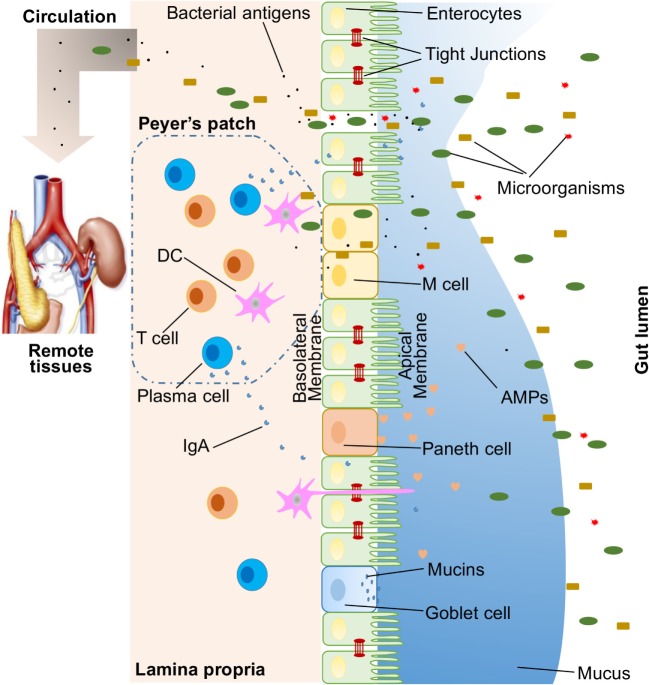
The intestinal epithelial lining, together with factors secreted from it, forms a barrier that separates the host from the environment. In pathologic conditions, the permeability of the epithelial lining may be compromised allowing the passage of toxins, antigens, and bacteria in the lumen to enter the blood stream creating a "leaky gut." In individuals with a genetic predisposition, a leaky gut may allow environmental factors to enter the body and trigger the initiation and development of autoimmune disease. Growing evidence shows that the gut microbiota is important in supporting the epithelial barrier and therefore plays a key role in the regulation of environmental factors that enter the body. Several recent reports have shown that probiotics can reverse the leaky gut by enhancing the production of tight junction proteins; however, additional and longer term studies are still required. Conversely, pathogenic bacteria that can facilitate a leaky gut and induce autoimmune symptoms can be ameliorated with the use of antibiotic treatment. Therefore, it is hypothesized that modulating the gut microbiota can serve as a potential method for regulating intestinal permeability and may help to alter the course of autoimmune diseases in susceptible individuals.
肠道上皮内衬及其分泌的因子共同形成了一道将宿主与外界环境分隔开来的屏障。在病理状态下,上皮内衬的通透性可能会受损,使得肠腔内的毒素、抗原和细菌得以进入血流,从而形成“肠漏”。对于有遗传易感性的个体,肠漏可能会使环境因素进入体内,引发自身免疫性疾病的起始和发展。越来越多的证据表明,肠道微生物群对于维持上皮屏障很重要,因此在调节进入体内的环境因素方面起着关键作用。最近的几份报告显示,益生菌可以通过增强紧密连接蛋白的产生来逆转肠漏;然而,仍需要更多的长期研究。相反,使用抗生素治疗可以改善那些能够导致肠漏并诱发自身免疫症状的病原菌。因此,据推测,调节肠道微生物群可能是调节肠道通透性的一种潜在方法,并且可能有助于改变易感个体自身免疫性疾病的病程。