State Key Laboratory of Metal Matrix Composites, School of Materials Science and Engineering, Shanghai Jiao Tong University, Shanghai 200240, China.
Photovoltaic Materials Unit, National Institute for Materials Science, Tsukuba, Ibaraki 305-0047, Japan.
Nat Commun. 2017 Jun 12;8:15330. doi: 10.1038/ncomms15330.
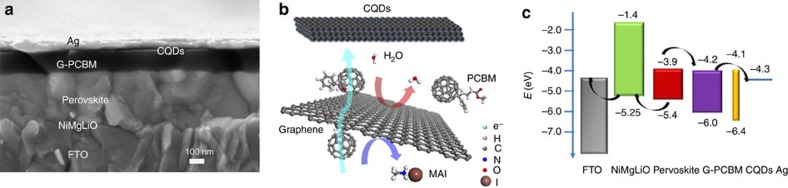
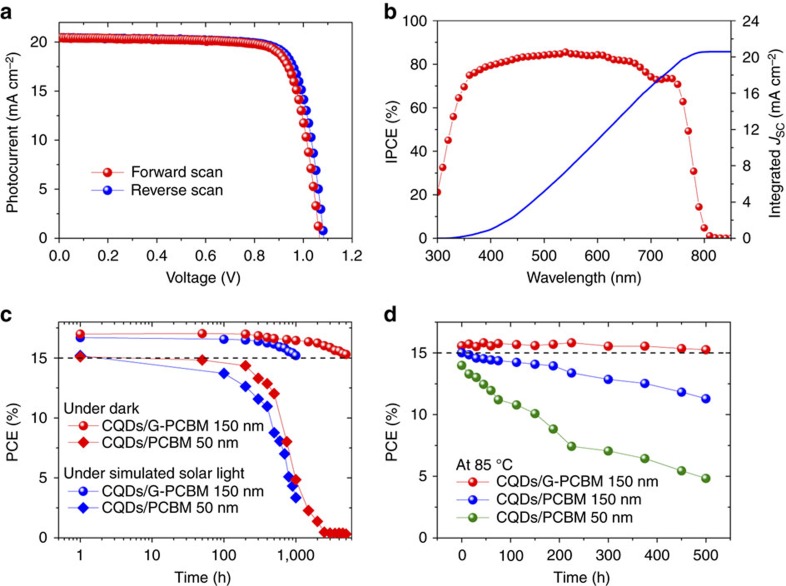
Long-term stability is crucial for the future application of perovskite solar cells, a promising low-cost photovoltaic technology that has rapidly advanced in the recent years. Here, we designed a nanostructured carbon layer to suppress the diffusion of ions/molecules within perovskite solar cells, an important degradation process in the device. Furthermore, this nanocarbon layer benefited the diffusion of electron charge carriers to enable a high-energy conversion efficiency. Finally, the efficiency on a perovskite solar cell with an aperture area of 1.02 cm, after a thermal aging test at 85 °C for over 500 h, or light soaking for 1,000 h, was stable of over 15% during the entire test. The present diffusion engineering of ions/molecules and photo generated charges paves a way to realizing long-term stable and highly efficient perovskite solar cells.
长期稳定性对于钙钛矿太阳能电池的未来应用至关重要,钙钛矿太阳能电池是一种很有前途的低成本光伏技术,近年来发展迅速。在这里,我们设计了一种纳米结构的碳层来抑制钙钛矿太阳能电池内部离子/分子的扩散,这是器件中一个重要的降解过程。此外,这种纳米碳层有利于电子电荷载流子的扩散,从而实现高能转换效率。最后,在 85°C 的热老化测试超过 500 小时或 1000 小时的光浸泡后,对于具有 1.02 平方厘米有效面积的钙钛矿太阳能电池,其效率在整个测试过程中稳定在 15%以上。本研究通过对离子/分子和光生电荷的扩散工程,为实现长期稳定和高效的钙钛矿太阳能电池铺平了道路。