Kanzaki Hiroyuki, Wada Satoshi, Narimiya Tsuyoshi, Yamaguchi Yuuki, Katsumata Yuta, Itohiya Kanako, Fukaya Sari, Miyamoto Yutaka, Nakamura Yoshiki
Maxillo-Oral Disorders, Tohoku University HospitalSendai, Japan.
Department of Orthodontics, School of Dental Medicine, Tsurumi UniversityYokohama, Japan.
Front Physiol. 2017 May 30;8:351. doi: 10.3389/fphys.2017.00351. eCollection 2017.
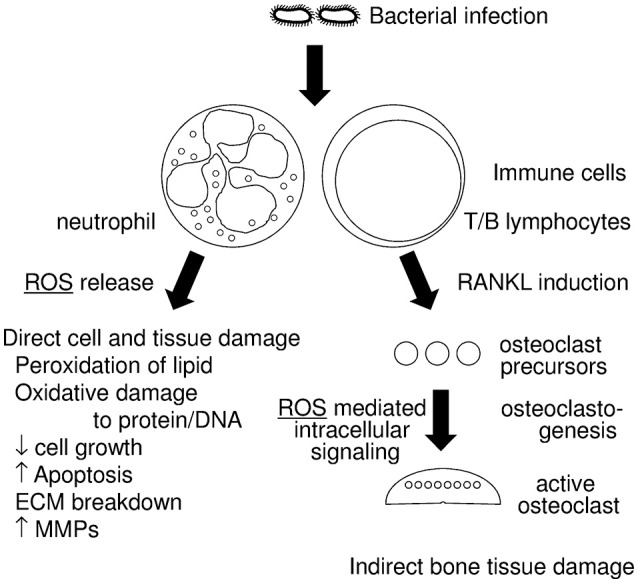
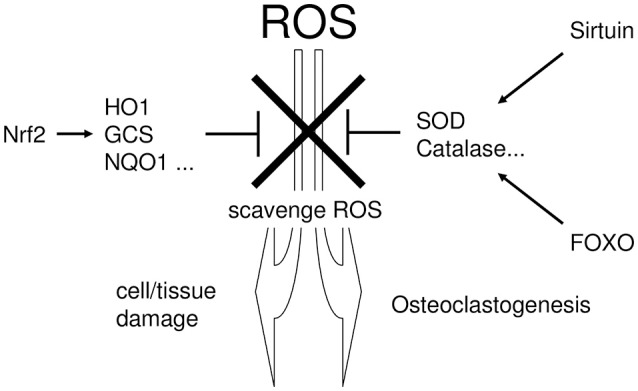
Periodontitis, an inflammatory disease that affects the tissues surrounding the teeth, is a common disease worldwide. It is caused by a dysregulation of the host inflammatory response to bacterial infection, which leads to soft and hard tissue destruction. In particular, it is the excessive inflammation in response to bacterial plaque that leads to the release of reactive oxygen species (ROS) from neutrophils, which, then play a critical role in the destruction of periodontal tissue. Generally, ROS produced from immune cells exhibit an anti-bacterial effect and play a role in host defense and immune regulation. Excessive ROS, however, can exert cytotoxic effects, cause oxidative damage to proteins, and DNA, can interfere with cell growth and cell cycle progression, and induce apoptosis of gingival fibroblasts. Collectively, these effects enable ROS to directly induce periodontal tissue damage. Some ROS also act as intracellular signaling molecules during osteoclastogenesis, and can thus also play an indirect role in bone destruction. Cells have several protective mechanisms to manage such oxidative stress, most of which involve production of cytoprotective enzymes that scavenge ROS. These enzymes are transcriptionally regulated via NRF2, Sirtuin, and FOXO. Some reports indicate an association between periodontitis and these cytoprotective enzymes' regulatory axes, with superoxide dismutase (SOD) the most extensively investigated. In this review article, we discuss the role of oxidative stress in the tissue destruction manifest in periodontitis, and the mechanisms that protect against this oxidative stress.
牙周炎是一种影响牙齿周围组织的炎症性疾病,在全球范围内都很常见。它是由宿主对细菌感染的炎症反应失调引起的,会导致软硬组织破坏。特别是,对细菌菌斑的过度炎症反应会导致中性粒细胞释放活性氧(ROS),而ROS随后在牙周组织破坏中起关键作用。一般来说,免疫细胞产生的ROS具有抗菌作用,并在宿主防御和免疫调节中发挥作用。然而,过量的ROS会产生细胞毒性作用,对蛋白质和DNA造成氧化损伤,干扰细胞生长和细胞周期进程,并诱导牙龈成纤维细胞凋亡。总的来说,这些作用使ROS能够直接诱导牙周组织损伤。一些ROS在破骨细胞形成过程中还充当细胞内信号分子,因此也能在骨破坏中发挥间接作用。细胞有几种保护机制来应对这种氧化应激,其中大多数涉及产生清除ROS的细胞保护酶。这些酶通过NRF2、Sirtuin和FOXO进行转录调控。一些报告表明牙周炎与这些细胞保护酶的调节轴之间存在关联,其中超氧化物歧化酶(SOD)是研究最广泛的。在这篇综述文章中,我们讨论了氧化应激在牙周炎中组织破坏表现中的作用,以及抵御这种氧化应激的机制。