Lebov J, Grieger K, Womack D, Zaccaro D, Whitehead N, Kowalcyk B, MacDonald P D M
RTI International, Research Triangle Park, NC, 27709, United States.
One Health. 2017 Mar 24;3:44-50. doi: 10.1016/j.onehlt.2017.03.004. eCollection 2017 Jun.
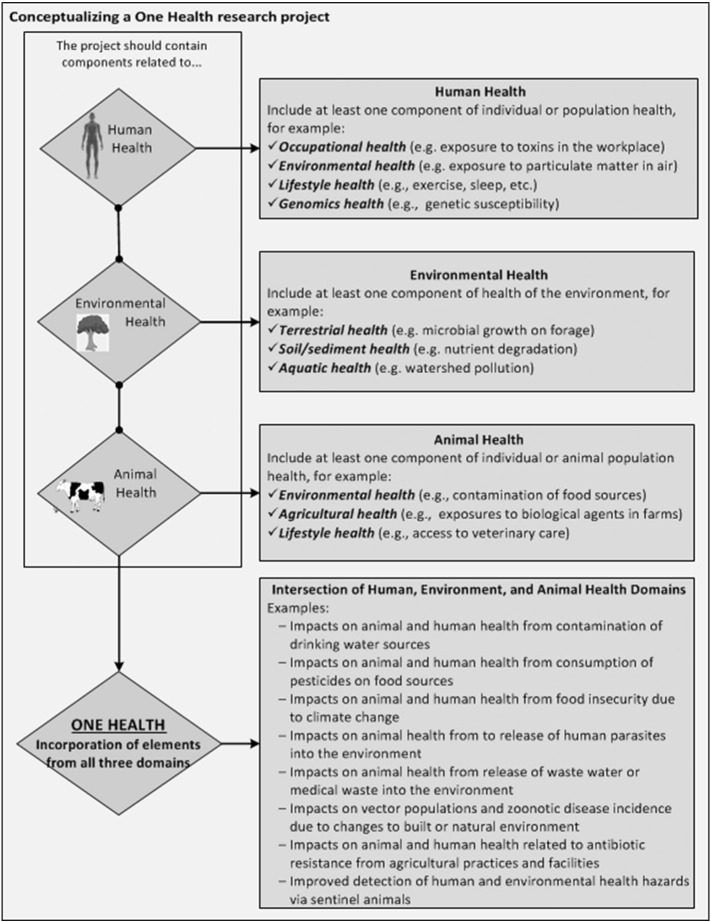
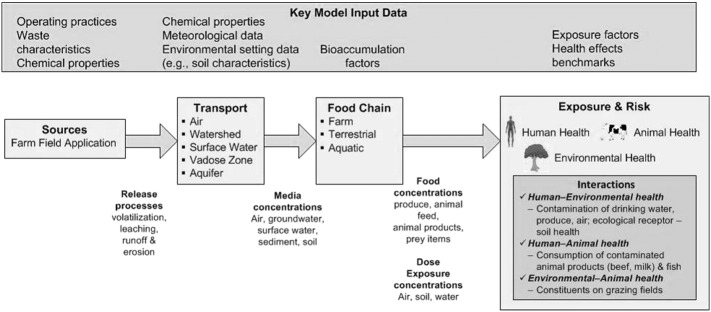
The need for multidisciplinary research to address today's complex health and environmental challenges has never been greater. The One Health (OH) approach to research ensures that human, animal, and environmental health questions are evaluated in an integrated and holistic manner to provide a more comprehensive understanding of the problem and potential solutions than would be possible with siloed approaches. However, the OH approach is complex, and there is limited guidance available for investigators regarding the practical design and implementation of OH research. In this paper we provide a framework to guide researchers through conceptualizing and planning an OH study. We discuss key steps in designing an OH study, including conceptualization of hypotheses and study aims, identification of collaborators for a multi-disciplinary research team, study design options, data sources and collection methods, and analytical methods. We illustrate these concepts through the presentation of a case study of health impacts associated with land application of biosolids. Finally, we discuss opportunities for applying an OH approach to identify solutions to current global health issues, and the need for cross-disciplinary funding sources to foster an OH approach to research.
开展多学科研究以应对当今复杂的健康和环境挑战,其需求从未如此迫切。“同一健康”(OH)研究方法确保以综合、全面的方式评估人类、动物和环境健康问题,相较于孤立的研究方法,能更全面地理解问题及潜在解决方案。然而,OH方法很复杂,对于研究人员在OH研究的实际设计和实施方面,可提供的指导有限。在本文中,我们提供一个框架,以指导研究人员构思和规划OH研究。我们讨论设计OH研究中的关键步骤,包括假设和研究目标的概念化、多学科研究团队合作者的确定、研究设计选项、数据来源和收集方法以及分析方法。我们通过展示一个与生物固体土地施用相关的健康影响案例研究来说明这些概念。最后我们讨论应用OH方法来确定当前全球健康问题解决方案的机会,以及跨学科资金来源对推动OH研究方法的必要性。