Yan Chao-Qun, Zhang Shuai, Li Qian-Qian, Zhang Li-Wen, Wang Xue-Rui, Fu Qing-Nan, Shi Guang-Xia, Liu Cun-Zhi
The Department of Acupuncture and Moxibustion, Beijing Hospital of Traditional Chinese Medicine affiliated to Capital Medical University; Beijing Key Laboratory of Acupuncture Neuromodulation, Beijing, China.
BMJ Open. 2017 Jun 15;7(6):e014438. doi: 10.1136/bmjopen-2016-014438.
To investigate the pattern of experimental pain responses at acupoints in patients with unilateral shoulder pain.
A cross-sectional matched study.
Acupuncture and Moxibustion Department, Beijing Hospital of Traditional Chinese Medicine Affiliated to Capital Medical University.
Volunteer samples of 60 participants (30 patients with unilateral shoulder pain, 30 healthy controls).
Not applicable.
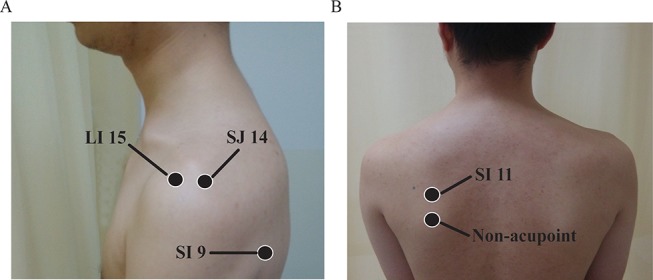
Pressure pain thresholds (PPTs) were measured at four acupoints-namely, (SI 11), (SJ 14), (LI 15) and (SI 9), on the painful/non-painful side in patients with unilateral shoulder pain or healthy controls, respectively. The correlations between the Peripheral Sensitisation Index (PSI) and Central Sensitisation Index (CSI) were compared.
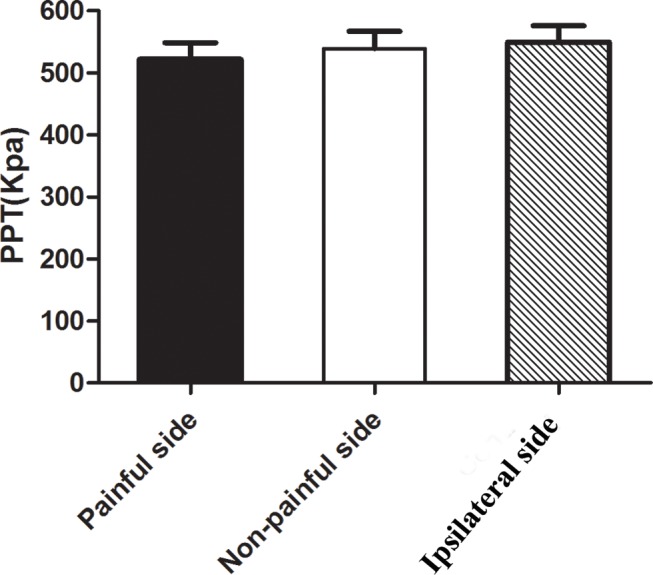
Analysis showed significantly lower PPT values at acupoints on the painful side compared with the non-painful side in patients with shoulder pain (p<0.025). Meanwhile, PPTs on the non-painful side of these patients were lower than those on the ipsilateral side of healthy controls (p<0.025). No significant differences in PPT values were found between the non-acupoint of the painful/non-painful side in patients with shoulder pain and the ipsilateral side of healthy controls (p>0.05). Additionally, it was observed that the pressure pain assessment acupoints have a strong association with PSI and CSI; three acupoints, in particular, SJ 14, LI 15 and SI 9, showed a correlation with PSI and CSI.
The results suggest the presence of peripheral and central sensitisation at acupoints in participants with unilateral shoulder pain. There exists an obvious relationship among the three acupoints SJ 14, LI 15 and SI 9, which are usually chosen to treat shoulder pain. The results provide evidence for the selection of acupoints to treat shoulder pain by acupuncture.
探讨单侧肩部疼痛患者穴位的实验性疼痛反应模式。
横断面匹配研究。
首都医科大学附属北京中医医院针灸科。
60名参与者的志愿者样本(30名单侧肩部疼痛患者,30名健康对照者)。
不适用。
分别在单侧肩部疼痛患者的患侧/非患侧或健康对照者的相应部位,测量四个穴位即肩贞(SI 11)、肩髎(SJ 14)、臂臑(LI 15)和臑俞(SI 9)的压痛阈值(PPTs)。比较外周敏化指数(PSI)和中枢敏化指数(CSI)之间的相关性。
分析显示,肩部疼痛患者患侧穴位的PPT值显著低于非患侧(p<0.025)。同时,这些患者非患侧的PPT值低于健康对照者同侧的PPT值(p<0.025)。肩部疼痛患者患侧/非患侧的非穴位部位与健康对照者同侧的PPT值之间未发现显著差异(p>0.05)。此外,观察到压痛评估穴位与PSI和CSI有很强的相关性;特别是三个穴位,即肩髎(SJ 14)、臂臑(LI 15)和臑俞(SI 9),与PSI和CSI相关。
结果表明单侧肩部疼痛参与者的穴位存在外周和中枢敏化。常用于治疗肩部疼痛的三个穴位肩髎(SJ 14)、臂臑(LI 15)和臑俞(SI 9)之间存在明显关系。该结果为针灸治疗肩部疼痛的穴位选择提供了依据。