Rauba Jason, Tahir Ammar, Milford Brett, Toll Ashley, Benedict Valerie, Wang Chi, Chehab Lynn, Sanborn Timothy
Evanston Hospital, NorthShore University HealthSystem, Evanston, IL, USA.
The University of Chicago Medical Center, Chicago, IL, USA.
Glob Pediatr Health. 2017 Jun 6;4:2333794X17711778. doi: 10.1177/2333794X17711778. eCollection 2017.
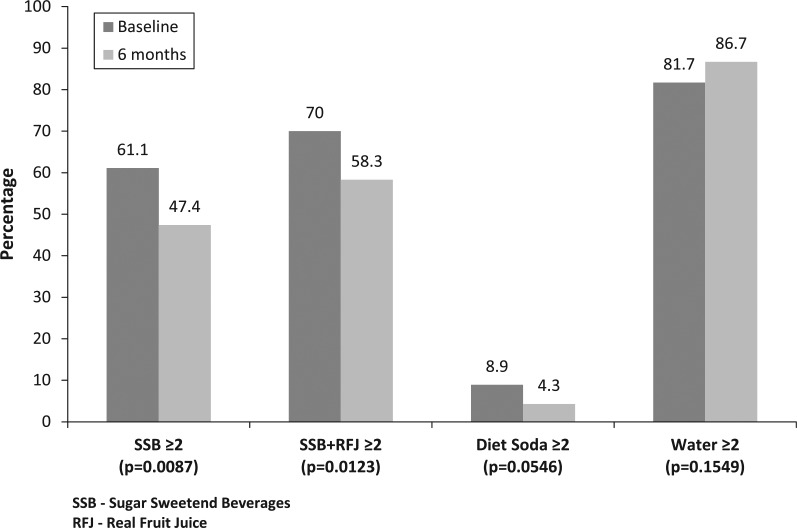
Given the known association between sugar-sweetened beverage (SSB) intake and poorer health, we instituted an educational curriculum to reduce student consumption of SSBs. The program included third- to fifth-grade students. A simple demonstration using teaspoons of sugar or small candies showed students the quantity of added sugar in common beverages. This amount of sugar was compared to the daily limit recommended by the American Heart Association. Key principles were reinforced over a 4-month period. Anonymous beverage recall surveys were distributed to 213 students at baseline and 211 students 6 months after exposure to the curriculum. Primary endpoints included evaluation of SSB, real fruit juice (RFJ), diet soda, and water servings in the last 24 hours. The proportion of children consuming 2 or more beverages daily decreased from 8.9% to 4.3% ( = .0546) for diet soda, from 70.0% to 58.3% ( = .0123) for SSB + RFJ, and from 60.1% to 47.4% ( = .0087) for SSB. At baseline, students reported an average consumption of 3.5 SSB, 4.5 SSB + RFJ, 0.4 diet soda, and 3.3 water servings per day. At 6 months after exposure, the average daily beverage consumption decreased to 2.7 servings per day for SSB ( = .014), 3.8 for SSB + RFJ ( = .039), and 0.2 for diet soda ( = .027). Water consumption increased from 3.3 to 3.6 servings per day ( = .075). Our data suggest grade school students are receptive to information about the adverse effects of SSBs on health. Adding similar educational programs to elementary school curriculum may help reduce long-term SSB consumption.
鉴于已知含糖饮料(SSB)摄入量与健康状况较差之间存在关联,我们制定了一项教育课程,以减少学生对SSB的消费。该项目涵盖三年级至五年级的学生。通过用茶匙量糖或使用小糖果进行简单演示,向学生展示常见饮料中添加糖的量。将此糖量与美国心脏协会推荐的每日限量进行比较。在4个月的时间里强化关键原则。在基线时向213名学生发放了匿名饮料召回调查问卷,并在接触该课程6个月后向211名学生发放。主要终点指标包括评估过去24小时内SSB、纯果汁(RFJ)、无糖汽水和水的饮用量。每天饮用2种或更多饮料的儿童比例,无糖汽水从8.9%降至4.3%(P = 0.0546),SSB + RFJ从70.0%降至58.3%(P = 0.0123),SSB从60.1%降至47.4%(P = 0.00,87)。在基线时,学生报告平均每天饮用3.5份SSB、4.5份SSB + RFJ、0.4份无糖汽水和3.3份水。接触课程6个月后,SSB的平均每日饮料消费量降至每天2.7份(P = 0.014),SSB + RFJ为3.8份(P = 0.039),无糖汽水为0.2份(P = 0.027)。水的消费量从每天3.3份增加到3.6份(P = 0.075)。我们的数据表明,小学生易于接受有关SSB对健康不利影响的信息。在小学课程中增加类似的教育项目可能有助于减少长期的SSB消费。