Cleveland Christopher A, DeNicola Anthony, Dubey J P, Hill Dolores E, Berghaus Roy D, Yabsley Michael J
Southeastern Cooperative Wildlife Disease Study, Department of Population Health, College of Veterinary Medicine, Wildlife Health Building, 589 D.W. Brooks Dr., Athens, GA 30605, United States; Warnell School of Forestry and Natural Resources, University of Georgia, Athens, GA 30602, United States.
White Buffalo Inc., Moodus, CT 06469, United States.
Vet Microbiol. 2017 Jun;205:22-25. doi: 10.1016/j.vetmic.2017.05.001. Epub 2017 May 3.
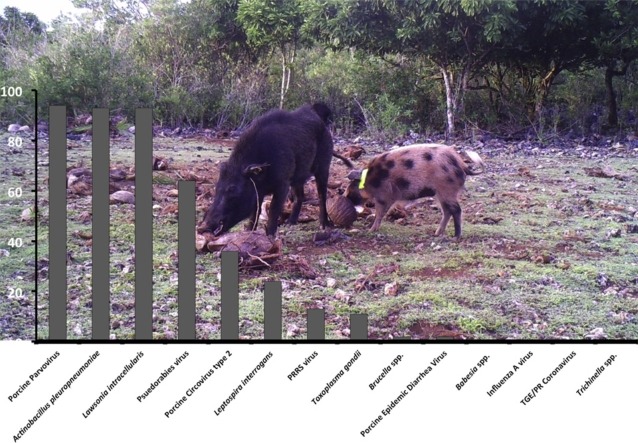
Pigs (Sus scrofa) were introduced to Guam in the 1600's and are now present in high densities throughout the island. Wild pigs are reservoirs for pathogens of concern to domestic animals and humans. Exposure to porcine parvovirus, transmissible gastroenteritis, and Leptospira interrogans has been documented in domestic swine but data from wild pigs are lacking. The close proximity of humans, domestic animals, and wild pigs, combined with the liberal hunting of wild pigs, results in frequent opportunities for pathogen transmission. From February-March 2015, blood, tissue and ectoparasite samples were collected from 47 wild pigs. Serologic testing found exposure to Brucella spp. (2%), Toxoplasma gondii (11%), porcine reproductive and respiratory syndrome (PRRS) virus (13%), porcine circovirus type 2 (36%), pseudorabies virus (64%), Actinobacillus pleuropneumoniae (93%), Lawsonia intracellularis (93%), and porcine parvovirus (94%). Eleven (24%) samples had low titers (1:100) to Leptospira interrogans serovars Bratislava (n=6), Icterohaemorrhagiae (n=6), Pomona (n=2), and Hardjo (n=1). Kidney samples from nine pigs with Leptospira antibodies were negative for Leptospira antigens. Numerous pigs had Metastrongylus lungworms and three had Stephanurus dentatus. Lice (Hematopinus suis) and ticks (Amblyomma breviscutatum) were also detected. No antibodies to Influenza A viruses were detected. In contrast to the previous domestic swine survey, we found evidence of numerous pathogens in wild pigs including new reports of pseudorabies virus, PRRS virus, Brucella, and Leptospira in pigs on Guam. These findings highlight that domestic swine-wild pig interactions should be prevented and precautions are needed when handling wild pigs to minimize the risk of pathogen transmission.
猪(野猪)于17世纪被引入关岛,如今全岛各地猪的密度都很高。野猪是家畜和人类所关注病原体的宿主。在家养猪中已记录到接触猪细小病毒、传染性胃肠炎和问号钩端螺旋体的情况,但野猪的数据尚缺。人类、家畜和野猪的近距离接触,再加上对野猪的大量捕猎,导致病原体传播的机会频繁出现。2015年2月至3月,从47头野猪身上采集了血液、组织和外寄生虫样本。血清学检测发现,这些野猪接触过布鲁氏菌属(2%)、弓形虫(11%)、猪繁殖与呼吸综合征(PRRS)病毒(13%)、2型猪圆环病毒(36%)、伪狂犬病病毒(64%)、胸膜肺炎放线杆菌(93%)、胞内劳森菌(93%)和猪细小病毒(94%)。11份(24%)样本对问号钩端螺旋体血清型布拉迪斯拉发(n = 6)、出血性黄疸型(n = 6)、波摩那型(n = 2)和哈德乔型(n = 1)有低滴度(1:百)反应。9头有钩端螺旋体抗体的猪的肾脏样本钩端螺旋体抗原检测为阴性。许多猪感染了后圆线虫,3头感染了有齿冠尾线虫。还检测到了猪虱(猪血虱)和蜱(短盾钝眼蜱)。未检测到甲型流感病毒抗体。与之前的家养猪调查不同,我们在野猪中发现了多种病原体的证据,包括关岛猪中伪狂犬病病毒、PRRS病毒、布鲁氏菌和钩端螺旋体的新报告。这些发现突出表明,应防止家养猪与野猪的相互接触,处理野猪时需要采取预防措施,以尽量降低病原体传播的风险。