Department of Clinical Sciences, Institute of Tropical Medicine, Nationalestraat 155, 2000, Antwerp, Belgium.
National Reference Centre for Campylobacter, CHU Saint-Pierre, Brussels, Belgium.
Eur J Clin Microbiol Infect Dis. 2017 Nov;36(11):2101-2107. doi: 10.1007/s10096-017-3032-6. Epub 2017 Jun 17.
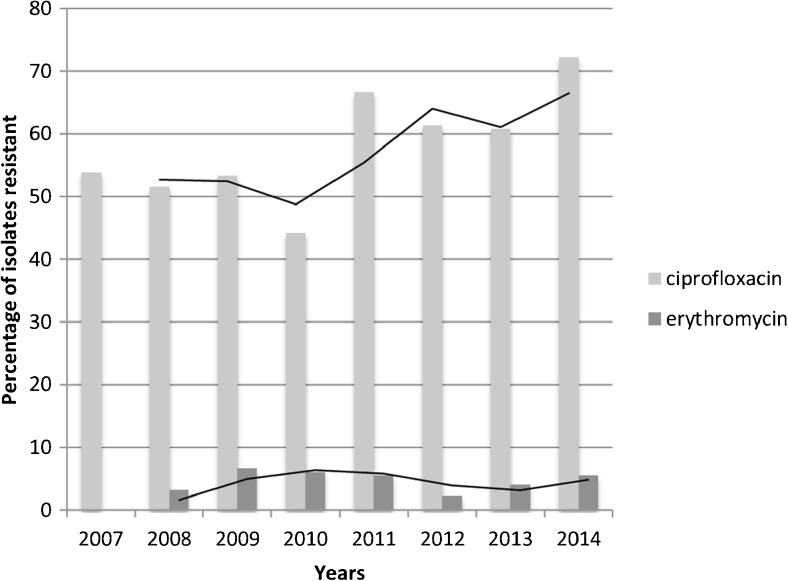
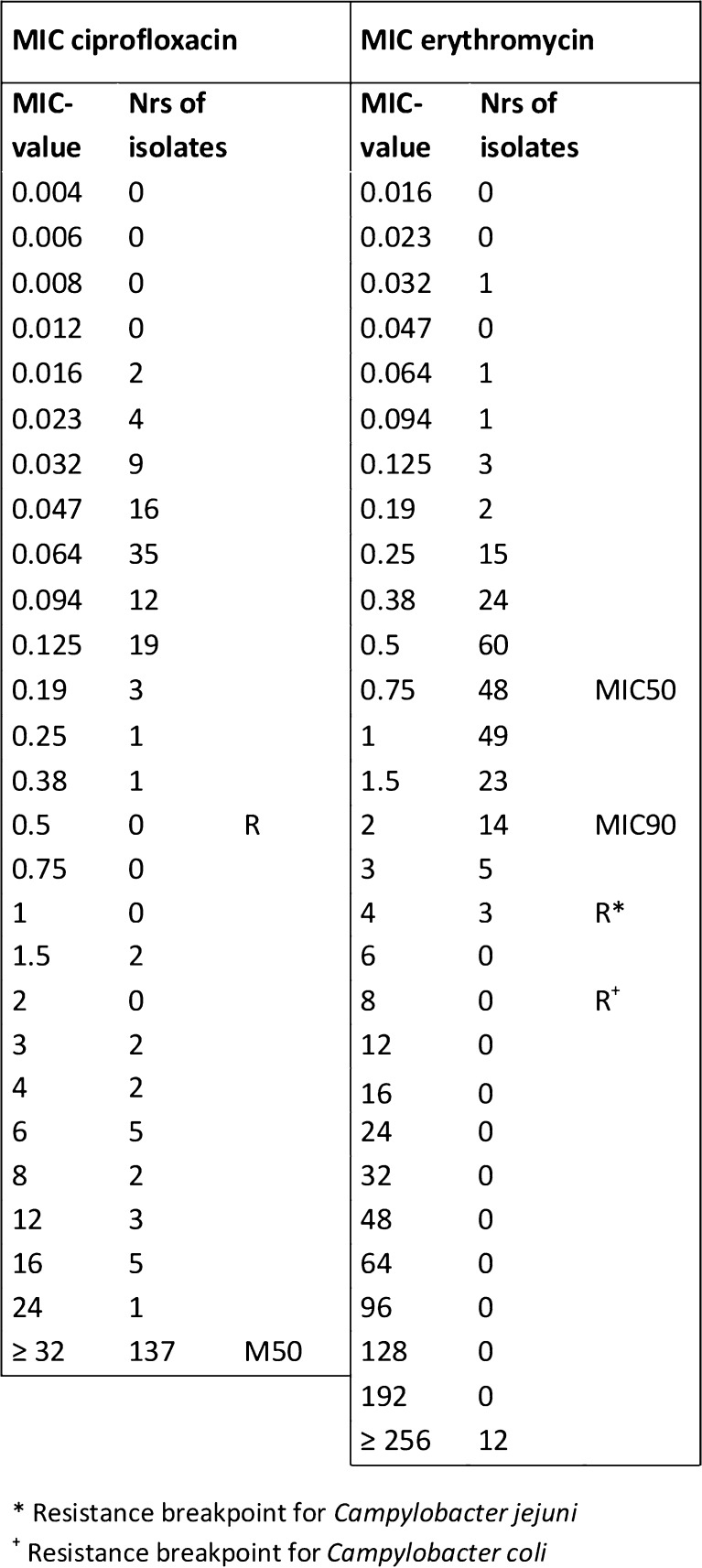
Campylobacter infection is a common cause of diarrhea among international travelers. We studied antibiotic resistance patterns among Campylobacter isolates obtained from international travelers according to travel destination. Three collections of isolates obtained from international travelers between 2007 and 2014 (Institute of Tropical Medicine, the "Laboratoire Hospitalier Universitaire de Bruxelles "and the Belgian National Reference Centre for Campylobacter) were used. Isolates were tested for minimal inhibitory concentration (MIC) values (E-test macromethod) for fluoroquinolones, macrolides, tetracyclines, amoxicillin-clavulanic acid, and meropenem. Single isolates from 261 travelers were available; median (IQR) age was 25.4 (4-42) years, 85.8% were symptomatic (information for 224 patients available). Overall resistance to ciprofloxacin was 60.9%, ranging from 50.8% in Africa to 75.0% in Asia. Resistance to erythromycin was 4.6%, with the highest rate observed for Southern Asia (15.2%, seven isolates, six of them recovered from patients returning from India). A total of 126 isolates (48.3%) were resistant to tetracycline. No resistance to amoxicillin-clavulanic acid or meropenem was detected. Ciprofloxacin resistance tended to increase over time (53.9% in 2007 versus 72.2% in 2014), erythromycin resistance remained stable (median annual resistance 4.2%). Most (86.2%) ciprofloxacin-resistant isolates had MIC values ≥32 mg/l, and all erythromycin-resistant isolates had MIC values ≥256 mg/l. Co-resistance to ciprofloxacin and erythromycin was observed in 11 (4.2%) isolates, seven of which came from Southern Asia. Among all regions of travel, more than half of Campylobacter isolates were resistant to ciprofloxacin. Overall resistance to erythromycin was below 5% but reached 15.2% in Southern Asia.
空肠弯曲菌感染是国际旅行者腹泻的常见原因。我们根据旅行者的旅行目的地研究了从国际旅行者中获得的空肠弯曲菌分离株的抗生素耐药模式。使用了 2007 年至 2014 年间从国际旅行者中获得的三批分离株(热带医学研究所、“布鲁塞尔大学医院实验室”和比利时国家空肠弯曲菌参考中心)。对分离株进行了最低抑菌浓度(MIC)值(E-测试宏观方法)的氟喹诺酮类、大环内酯类、四环素类、阿莫西林克拉维酸和美罗培南检测。从 261 名旅行者中获得了单株分离物;中位(IQR)年龄为 25.4(4-42)岁,85.8%有症状(可获得 224 名患者的信息)。环丙沙星总体耐药率为 60.9%,从非洲的 50.8%到亚洲的 75.0%不等。红霉素耐药率为 4.6%,南亚的耐药率最高(15.2%,7 株分离物,其中 6 株来自从印度返回的患者)。共有 126 株(48.3%)对四环素耐药。未检测到对阿莫西林克拉维酸或美罗培南的耐药性。环丙沙星耐药率呈上升趋势(2007 年为 53.9%,2014 年为 72.2%),红霉素耐药率保持稳定(中位年耐药率为 4.2%)。大多数(86.2%)环丙沙星耐药分离株的 MIC 值≥32mg/l,所有红霉素耐药分离株的 MIC 值≥256mg/l。11 株(4.2%)分离株同时对环丙沙星和红霉素耐药,其中 7 株来自南亚。在所有旅行地区,超过一半的空肠弯曲菌分离株对环丙沙星耐药。红霉素的总耐药率低于 5%,但在南亚达到 15.2%。