Wang Lixia, Li Renzhong, Xu Caihong, Zhang Hui, Ruan Yunzhou, Chen Mingting, Wang Dongmei, Dirlikov Emilio, Du Xin, Zhao Jin, Zhao Yanlin, Wang ShengFen, Liu Yuhong, Li Liang, Falzon Dennis, Sun Yanni, Wang Yu, Schwartländer Bernhard, Scano Fabio
National Center for TB Control and Prevention, Chinese Center for Disease Prevention and Control, Beijing, China.
Department of Anthropology, McGill University, Montréal, Québec, Canada.
PLoS One. 2017 Jun 19;12(6):e0177536. doi: 10.1371/journal.pone.0177536. eCollection 2017.
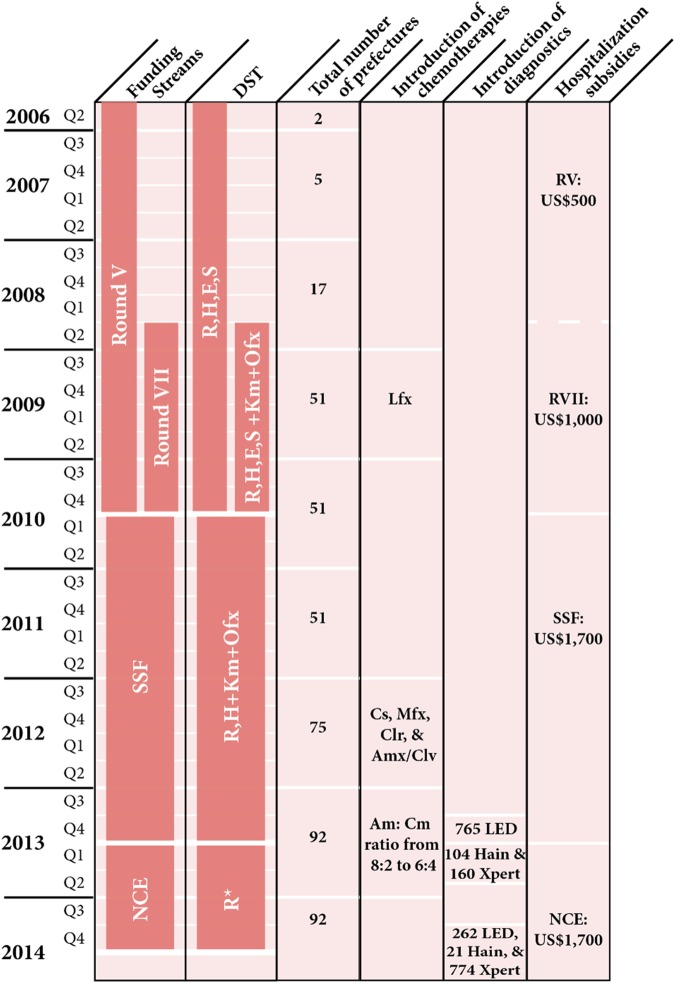
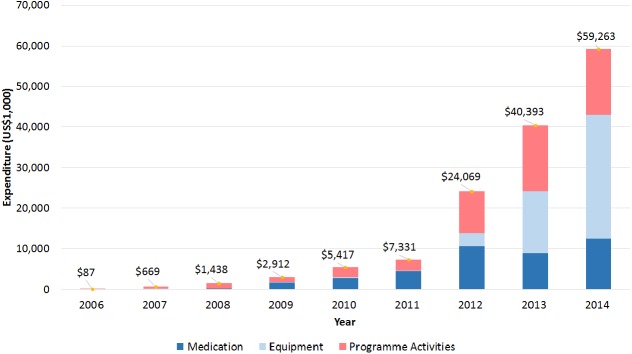
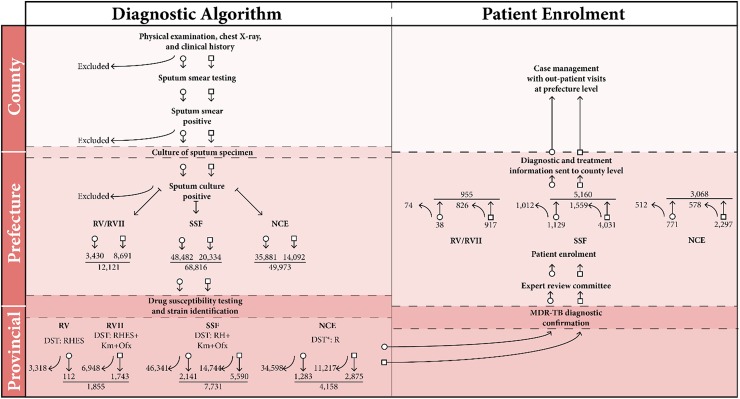
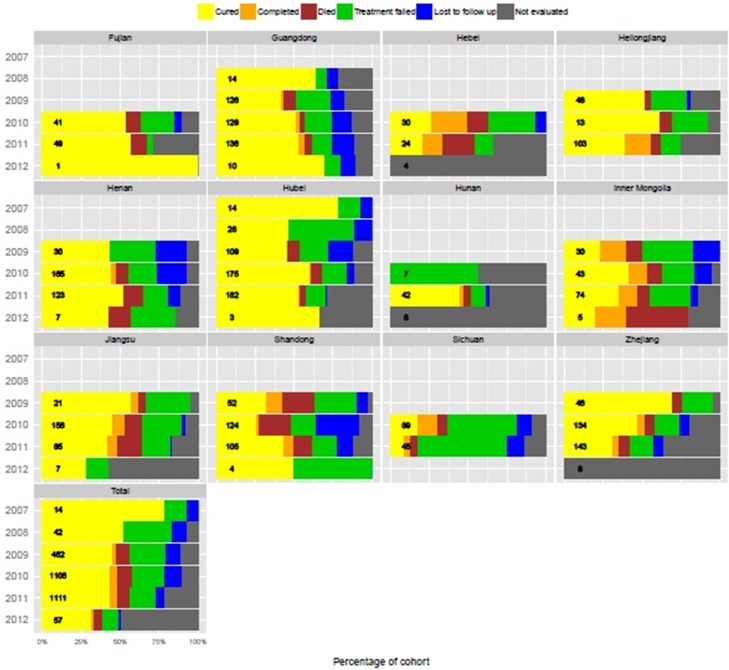
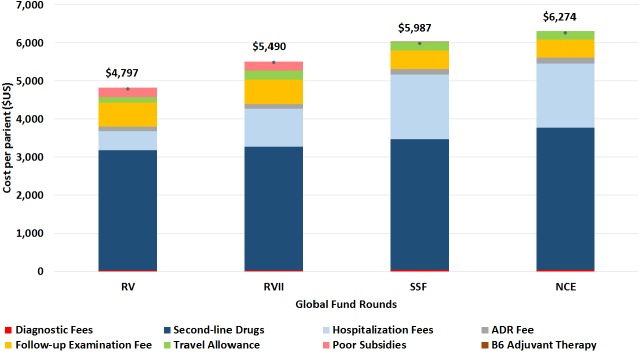
China has the world's second largest burden of multidrug-resistant tuberculosis (MDR-TB; resistance to at least isoniazid and rifampicin), with an estimated 57,000 cases (range, 48,000-67,000) among notified pulmonary TB patients in 2015. During October 1, 2006-June 30, 2014, China expanded MDR-TB care through a partnership with the Global Fund to Fight AIDS, Tuberculosis, and Malaria (Global Fund). We analyzed data on site expansion, patient enrolment, treatment outcomes, cost per patient, and overall programme expenditure. China expanded MDR-TB diagnostic and treatment services from 2 prefectures in 2006 to 92 prefectures, covering 921 of the country's 3,000 counties by June 2014. A total of 130,910 patients were tested for MDR-TB, resulting in 13,744 laboratory-confirmed cases, and 9,183 patients started on MDR-TB treatment. Treatment success was 48.4% (2011 cohort). The partnership between China and the Global Fund resulted in enormous gains. However, changes to health system TB delivery and financing coincided with the completion of the Global Fund Programme, and could potentially impact TB and MDR-TB control. Transition to full country financial ownership is proving difficult, with a decline in enrollment and insufficient financial coverage. Given needed improvement to the current treatment success rates, these factors jeopardise investments made for MDR-TB control and care. China now has a chance to cement its status in TB control by strengthening future financing and ensuring ongoing commitment to quality service delivery.
中国是耐多药结核病(MDR-TB,即对至少异烟肼和利福平耐药)负担第二重的国家,2015年报告的肺结核患者中估计有57000例(范围为48000 - 67000例)。在2006年10月1日至2014年6月30日期间,中国通过与全球抗击艾滋病、结核病和疟疾基金(全球基金)合作扩大了耐多药结核病防治工作。我们分析了关于服务点扩展、患者登记、治疗结果、每位患者成本以及项目总支出的数据。中国将耐多药结核病诊断和治疗服务从2006年的2个地区扩展到2014年6月的92个地区,覆盖了全国3000个县中的921个。共有130910名患者接受了耐多药结核病检测,其中13744例经实验室确诊,9183例患者开始接受耐多药结核病治疗。治疗成功率为48.4%(2011年队列)。中国与全球基金的合作取得了巨大成果。然而,卫生系统结核病服务和筹资的变化与全球基金项目的完成同时发生,可能会对结核病和耐多药结核病控制产生影响。向国家完全财政自主过渡面临困难,登记人数下降且财政覆盖不足。鉴于当前治疗成功率需要提高,这些因素危及为耐多药结核病控制和治疗所做的投资。中国现在有机会通过加强未来筹资并确保持续致力于提供高质量服务来巩固其在结核病控制方面的地位。