van Waateringe Robert P, Mook-Kanamori Marjonneke J, Slagter Sandra N, van der Klauw Melanie M, van Vliet-Ostaptchouk Jana V, Graaff Reindert, Lutgers Helen L, Suhre Karsten, El-Din Selim Mohammed M, Mook-Kanamori Dennis O, Wolffenbuttel Bruce H R
Department of Endocrinology, University of Groningen, University Medical Center Groningen, Groningen, The Netherlands.
Department of Biostatistics, Epidemiology and Scientific Computing, Epidemiology Section, King Faisal Specialist Hospital and Research Centre, Riyadh, Saudi Arabia.
PLoS One. 2017 Jun 20;12(6):e0179330. doi: 10.1371/journal.pone.0179330. eCollection 2017.
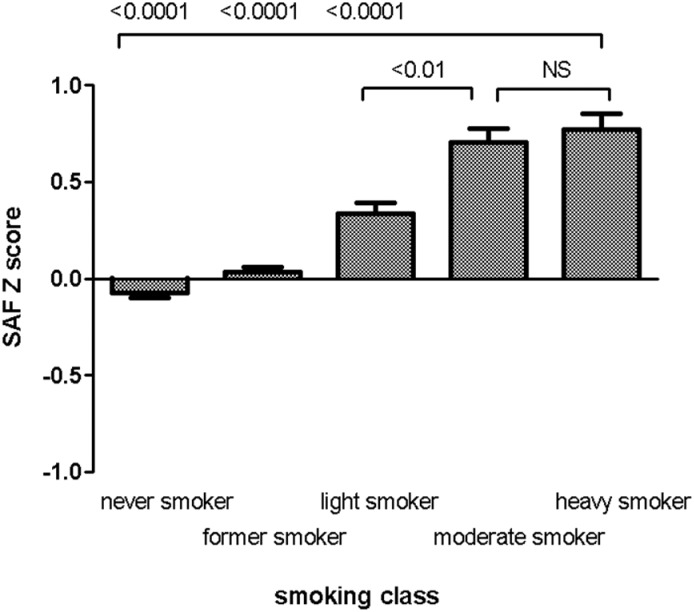
Skin autofluorescence, a biomarker for advanced glycation end products (AGEs) accumulation, has been shown to predict diabetes-related cardiovascular complications and is associated with several environmental and lifestyle factors. In the present study, we examined the association between various smoking behaviors and skin autofluorescence, as well as the association between several cotinine biomarkers and skin autofluorescence, using both epidemiological and metabolomics data.
In a cross-sectional study, we evaluated participants from the LifeLines Cohort Study and the Qatar Metabolomics Study on Diabetes (QMDiab). In the LifeLines Cohort Study smoking behavior and secondhand smoking were assessed in 8,905 individuals including 309 individuals (3.5%) with type 2 diabetes. In QMDiab, cotinine biomarkers were measured in saliva, plasma and urine in 364 individuals of whom 188 (51%) had type 2 diabetes. Skin autofluorescence was measured non-invasively in all participants using the AGE Reader.
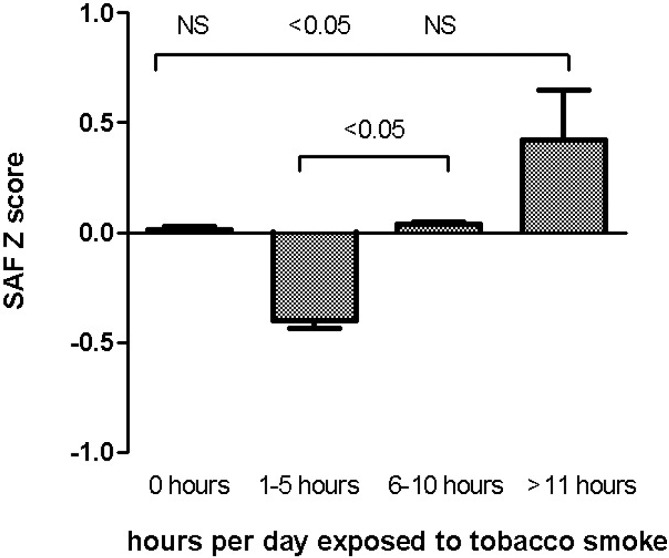
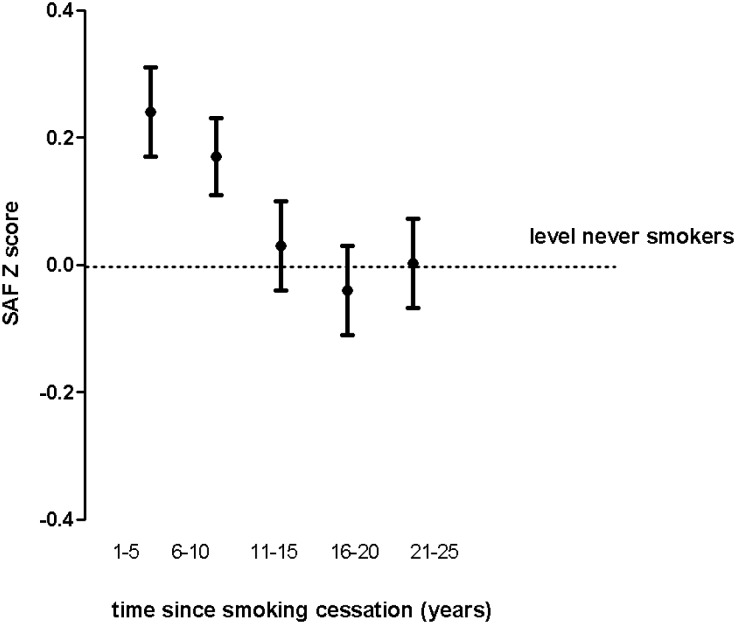
Skin autofluorescence levels increased with a higher number of hours being exposed to secondhand smoking. Skin autofluorescence levels of former smokers approached levels of never smokers after around 15 years of smoking cessation. Urinary cotinine N-oxide, a biomarker of nicotine exposure, was found to be positively associated with skin autofluorescence in the QMDiab study (p = 0.03).
In the present study, we have demonstrated that secondhand smoking is associated with higher skin autofluorescence levels whereas smoking cessation has a beneficial effect on skin autofluorescence. Finally, urinary cotinine N-oxide might be used as an alternative way for questionnaires to examine the effect of (environmental) tobacco smoking on skin autofluorescence.
皮肤自发荧光作为晚期糖基化终产物(AGEs)积累的生物标志物,已被证明可预测糖尿病相关的心血管并发症,且与多种环境和生活方式因素相关。在本研究中,我们利用流行病学和代谢组学数据,研究了各种吸烟行为与皮肤自发荧光之间的关联,以及几种可替宁生物标志物与皮肤自发荧光之间的关联。
在一项横断面研究中,我们评估了生命线队列研究和卡塔尔糖尿病代谢组学研究(QMDiab)的参与者。在生命线队列研究中,对8905名个体进行了吸烟行为和二手烟评估,其中包括309名2型糖尿病患者(3.5%)。在QMDiab研究中,对364名个体的唾液、血浆和尿液中的可替宁生物标志物进行了测量,其中188名(51%)患有2型糖尿病。使用AGE Reader对所有参与者进行无创皮肤自发荧光测量。
皮肤自发荧光水平随着接触二手烟时间的增加而升高。戒烟约15年后,既往吸烟者的皮肤自发荧光水平接近从不吸烟者。在QMDiab研究中,发现尿可替宁N-氧化物(一种尼古丁暴露生物标志物)与皮肤自发荧光呈正相关(p = 0.03)。
在本研究中,我们证明了二手烟与较高的皮肤自发荧光水平相关,而戒烟对皮肤自发荧光有有益影响。最后,尿可替宁N-氧化物可能作为问卷调查的替代方法,用于研究(环境)烟草烟雾对皮肤自发荧光的影响。