Bansal Savita, Burman Archana, Tripathi Asok Kumar
Department of Biochemistry, Institute of Home Sciences, University of Delhi, New Delhi 110016, India.
Department of Biochemistry, Institute of Home Economics, University of Delhi, New Delhi 110016, India.
World J Diabetes. 2023 Aug 15;14(8):1146-1162. doi: 10.4239/wjd.v14.i8.1146.
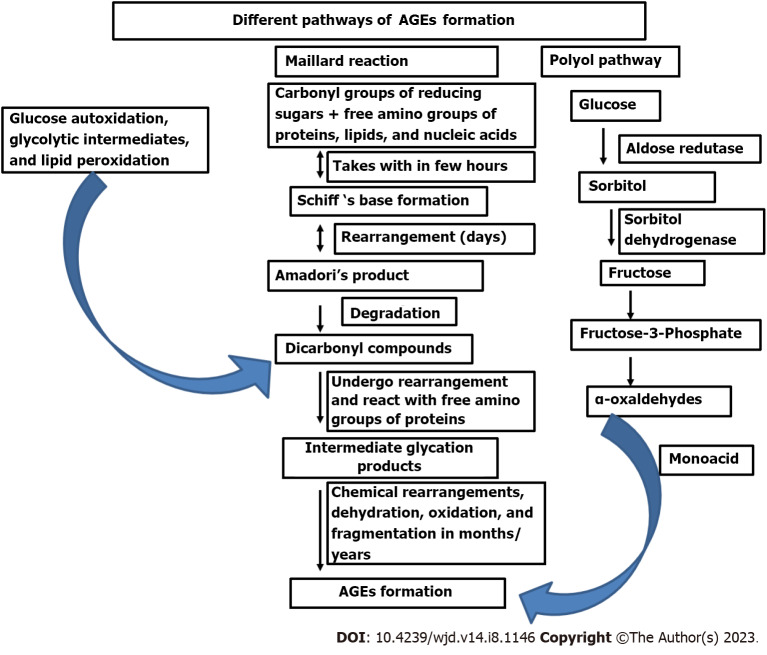
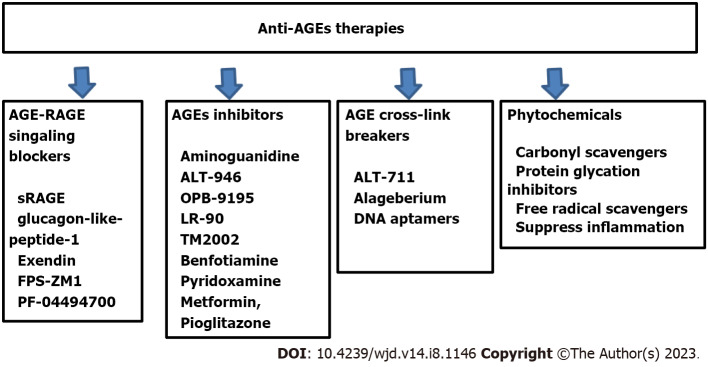
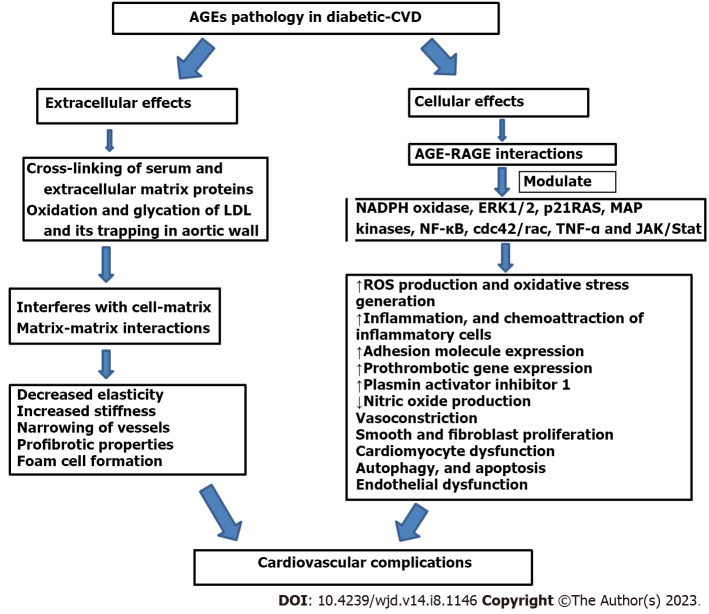
The incidence of type 2 diabetes mellitus is growing in epidemic proportions and has become one of the most critical public health concerns. Cardiovascular complications associated with diabetes are the leading cause of morbidity and mortality. The cardiovascular diseases that accompany diabetes include angina, myocardial infarction, stroke, peripheral artery disease, and congestive heart failure. Among the various risk factors generated secondary to hyperglycemic situations, advanced glycation end products (AGEs) are one of the important targets for future diagnosis and prevention of diabetes. In the last decade, AGEs have drawn a lot of attention due to their involvement in diabetic patho-physiology. AGEs can be derived exogenously and endogenously through various pathways. These are a non-homogeneous, chemically diverse group of compounds formed non-enzymatically by condensation between carbonyl groups of reducing sugars and free amino groups of protein, lipids, and nucleic acid. AGEs mediate their pathological effects at the cellular and extracellular levels by multiple pathways. At the cellular level, they activate signaling cascades the receptor for AGEs and initiate a complex series of intracellular signaling resulting in reactive oxygen species generation, inflammation, cellular proliferation, and fibrosis that may possibly exacerbate the damaging effects on cardiac functions in diabetics. AGEs also cause covalent modifications and cross-linking of serum and extracellular matrix proteins; altering their structure, stability, and functions. Early diagnosis of diabetes may prevent its progression to complications and decrease its associated comorbidities. In the present review, we recapitulate the role of AGEs as a crucial mediator of hyperglycemia-mediated detrimental effects in diabetes-associated complications. Furthermore, this review presents an overview of future perspectives for new therapeutic interventions to ameliorate cardiovascular complications in diabetes.
2型糖尿病的发病率正呈流行趋势增长,已成为最关键的公共卫生问题之一。与糖尿病相关的心血管并发症是发病和死亡的主要原因。糖尿病伴发的心血管疾病包括心绞痛、心肌梗死、中风、外周动脉疾病和充血性心力衰竭。在高血糖状态继发产生的各种危险因素中,晚期糖基化终产物(AGEs)是未来糖尿病诊断和预防的重要靶点之一。在过去十年中,AGEs因其参与糖尿病病理生理过程而备受关注。AGEs可通过多种途径外源性和内源性产生。它们是一组非均一的、化学性质多样的化合物,由还原糖的羰基与蛋白质、脂质和核酸的游离氨基非酶促缩合形成。AGEs通过多种途径在细胞和细胞外水平介导其病理作用。在细胞水平上,它们激活AGEs受体的信号级联反应,并引发一系列复杂的细胞内信号传导,导致活性氧生成、炎症、细胞增殖和纤维化,这可能会加剧对糖尿病患者心脏功能的损害作用。AGEs还会导致血清和细胞外基质蛋白的共价修饰和交联,改变其结构、稳定性和功能。糖尿病的早期诊断可能会阻止其进展为并发症并降低其相关合并症。在本综述中,我们概述了AGEs作为高血糖介导的糖尿病相关并发症有害作用的关键介质的作用。此外,本综述还概述了改善糖尿病心血管并发症的新治疗干预措施的未来前景。