Siebenaler Rebecca, Cameron Rochelle, Butt Craig M, Hoffman Kate, Higgins Christopher P, Stapleton Heather M
Nicholas School of the Environment, Duke University, Durham, NC, USA.
Colorado School of Mines, Department of Civil & Environmental Engineering, Golden, CO, USA.
Chemosphere. 2017 Oct;184:687-693. doi: 10.1016/j.chemosphere.2017.06.023. Epub 2017 Jun 9.
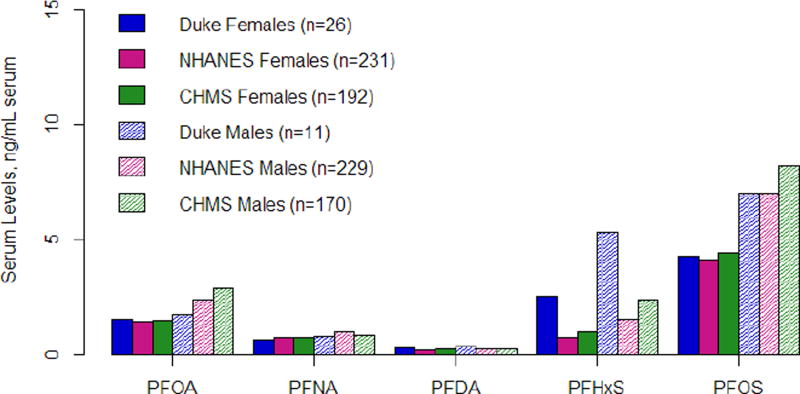
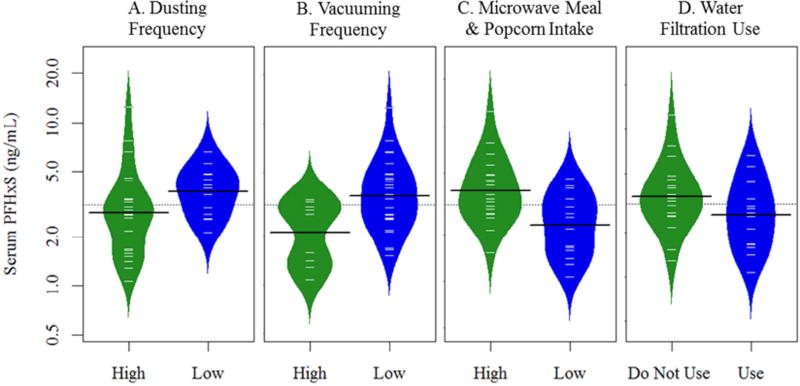
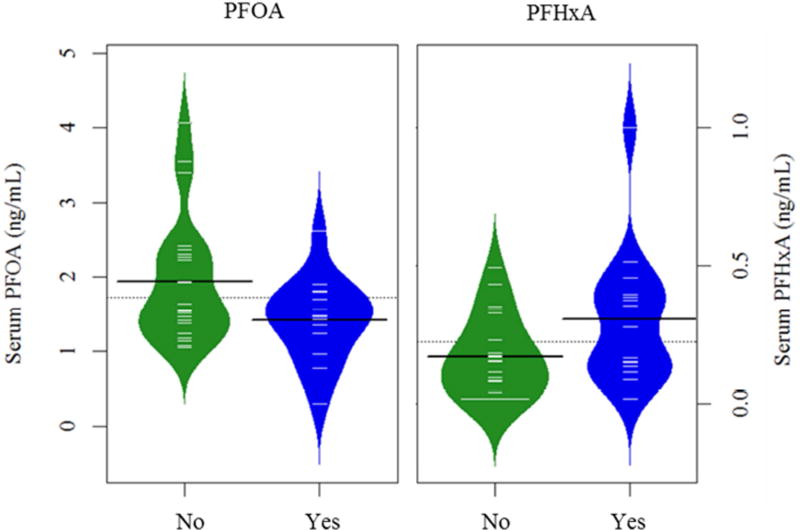
The ubiquitous use of poly- and perfluoroalkyl substances (PFASs) in a variety of industrial and consumer products has resulted in chronic exposure in most industrialized nations, and led to measurable concentrations in blood and other tissues in humans across all life stages; however, behavioral attributes that relate to exposure are not well studied. To further investigate how behavior may relate to PFAS exposure, 37 adults were recruited from central North Carolina. Participants provided blood samples and behavioral questionnaires were administered, asking questions about a variety of household, dietary, and behavioral outcomes. Six PFAAs, including PFHxA (geometric mean: 0.14 ng/mL), PFOA (1.57 ng/mL), PFNA (0.67 ng/mL), PFDA (0.28 ng/mL), PFHxS (3.17 ng/mL) and PFOS (4.96 ng/mL) were detected in >50% of the samples. Generally, males had higher serum levels than females across all chemicals, and levels were very similar to NHANES levels; however, PFHxS and PFDA levels were higher in our study population. Several personal characteristics and behaviors were associated with serum PFAS levels. Reported use of filtration devices was associated with lower levels of PFOA (28% lower, p = 0.03), but higher levels of PFHxA (122% higher, p = 0.04). Serum PFHxS levels were also elevated in individuals that vacuumed less often, and in individuals that reported consuming more microwavable foods. These results suggest that personal behaviors may be important determinants of PFAS exposures.
多氟烷基物质(PFASs)在各种工业和消费品中广泛使用,导致大多数工业化国家的人群长期接触该物质,并在所有生命阶段的人体血液和其他组织中检测到可测量的浓度;然而,与接触相关的行为属性尚未得到充分研究。为了进一步调查行为与PFAS接触之间的关系,从北卡罗来纳州中部招募了37名成年人。参与者提供了血液样本,并进行了行为问卷调查,询问了各种家庭、饮食和行为方面的问题。在超过50%的样本中检测到了六种全氟烷基酸,包括全氟己酸(几何平均值:0.14纳克/毫升)、全氟辛酸(1.57纳克/毫升)、全氟壬酸(0.67纳克/毫升)、全氟癸酸(0.28纳克/毫升)、全氟己基磺酸(3.17纳克/毫升)和全氟辛烷磺酸(4.96纳克/毫升)。总体而言,所有化学物质的血清水平男性均高于女性,且水平与美国国家健康与营养检查调查(NHANES)的水平非常相似;然而,在我们的研究人群中,全氟己基磺酸和全氟癸酸的水平更高。一些个人特征和行为与血清PFAS水平相关。报告使用过滤设备与较低的全氟辛酸水平相关(低28%,p = 0.03),但与较高的全氟己酸水平相关(高122%,p = 0.04)。不经常吸尘的个体以及报告食用更多微波食品的个体的血清全氟己基磺酸水平也有所升高。这些结果表明个人行为可能是PFAS接触的重要决定因素。