1Department of Laboratory Medicine,Ghent University Hospital,Ghent,Belgium.
2OneLIFE,Louvain-la-Neuve,Belgium.
Infect Control Hosp Epidemiol. 2017 Sep;38(9):1062-1069. doi: 10.1017/ice.2017.115. Epub 2017 Jun 21.
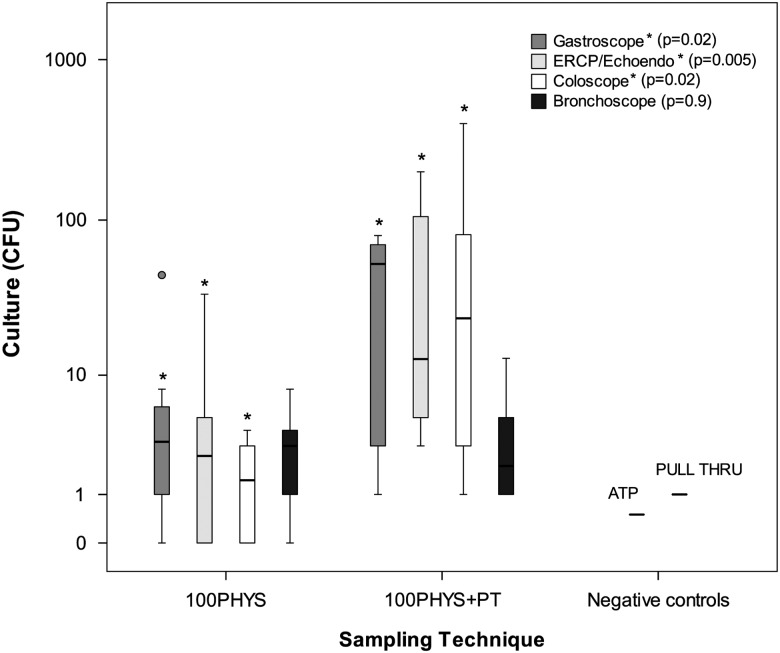
OBJECTIVE To compare different techniques of endoscope sampling to assess residual bacterial contamination. DESIGN Diagnostic study. SETTING The endoscopy unit of an 1,100-bed university hospital performing ~13,000 endoscopic procedures annually. METHODS In total, 4 sampling techniques, combining flushing fluid with or without a commercial endoscope brush, were compared in an endoscope model. Based on these results, sterile physiological saline flushing with or without PULL THRU brush was selected for evaluation on 40 flexible endoscopes by adenosine triphosphate (ATP) measurement and bacterial culture. Acceptance criteria from the French National guideline (<25 colony-forming units [CFU] per endoscope and absence of indicator microorganisms) were used as part of the evaluation. RESULTS On biofilm-coated PTFE tubes, physiological saline in combination with a PULL THRU brush generated higher mean ATP values (2,579 relative light units [RLU]) compared with saline alone (1,436 RLU; P=.047). In the endoscope samples, culture yield using saline plus the PULL THRU (mean, 43 CFU; range, 1-400 CFU) was significantly higher than that of saline alone (mean, 17 CFU; range, 0-500 CFU; P<.001). In samples obtained using the saline+PULL THRU brush method, ATP values of samples classified as unacceptable were significantly higher than those of samples classified as acceptable (P=.001). CONCLUSION Physiological saline flushing combined with PULL THRU brush to sample endoscopes generated higher ATP values and increased the yield of microbial surveillance culture. Consequently, the acceptance rate of endoscopes based on a defined CFU limit was significantly lower when the saline+PULL THRU method was used instead of saline alone. Infect Control Hosp Epidemiol 2017;38:1062-1069.
目的 比较不同的内镜采样技术,以评估残留细菌污染情况。
设计 诊断性研究。
设置 每年进行约 13000 例内镜检查的 1100 张病床的大学附属医院内镜科。
方法 共比较了 4 种采样技术,即冲洗液联合或不联合商用内镜刷。根据这些结果,选择无菌生理盐水冲洗联合或不联合 PULL THRU 刷,对 40 根软性内镜进行腺苷三磷酸(ATP)测量和细菌培养。采用法国国家指南(<25 个菌落形成单位[CFU]/内镜,且无指示微生物)作为评估的一部分,设定了验收标准。
结果 在涂有聚四氟乙烯(PTFE)管生物膜的情况下,生理盐水联合 PULL THRU 刷产生的平均 ATP 值(2579 相对光单位[RLU])显著高于生理盐水单独冲洗(1436 RLU;P=.047)。在内镜样本中,生理盐水联合 PULL THRU (平均 43 CFU;范围,1-400 CFU)的培养产率明显高于生理盐水单独冲洗(平均 17 CFU;范围,0-500 CFU;P<.001)。使用生理盐水+PULL THRU 刷法获取的样本中,被归类为不合格的样本的 ATP 值显著高于被归类为合格的样本(P=.001)。
结论 与生理盐水单独冲洗相比,用生理盐水冲洗联合 PULL THRU 刷采集内镜样本可产生更高的 ATP 值,并增加微生物监测培养的产量。因此,当使用生理盐水+PULL THRU 方法而不是生理盐水单独冲洗时,基于特定 CFU 限值的内镜合格率显著降低。感染控制与医院流行病学 2017;38:1062-1069.