Yao Kecheng, Zeng Linghai, He Qian, Wang Wei, Lei Jiao, Zou Xiulan
Department of Gerontology, Renmin Hospital of Three Gorges University and The First People's Hospital of Yichang, Yichang, Hubei, China (mainland).
Department of Endocrinology, Renmin Hospital of Three Gorges University and The First People's Hospital of Yichang, Yichang, Hubei, China (mainland).
Med Sci Monit. 2017 Jun 22;23:3044-3053. doi: 10.12659/msm.902600.
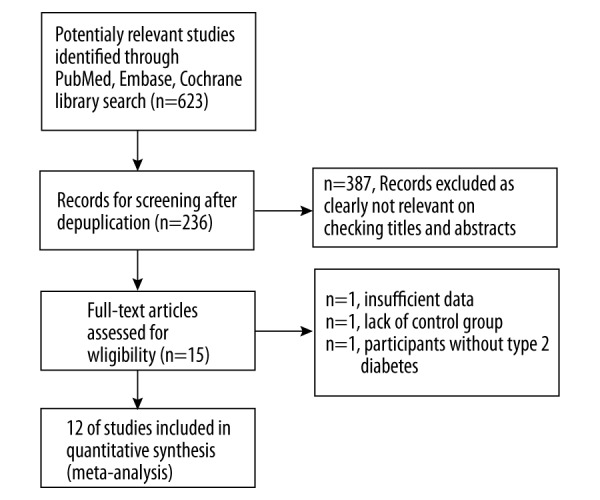
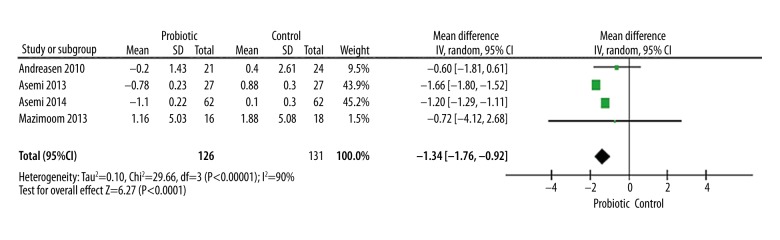
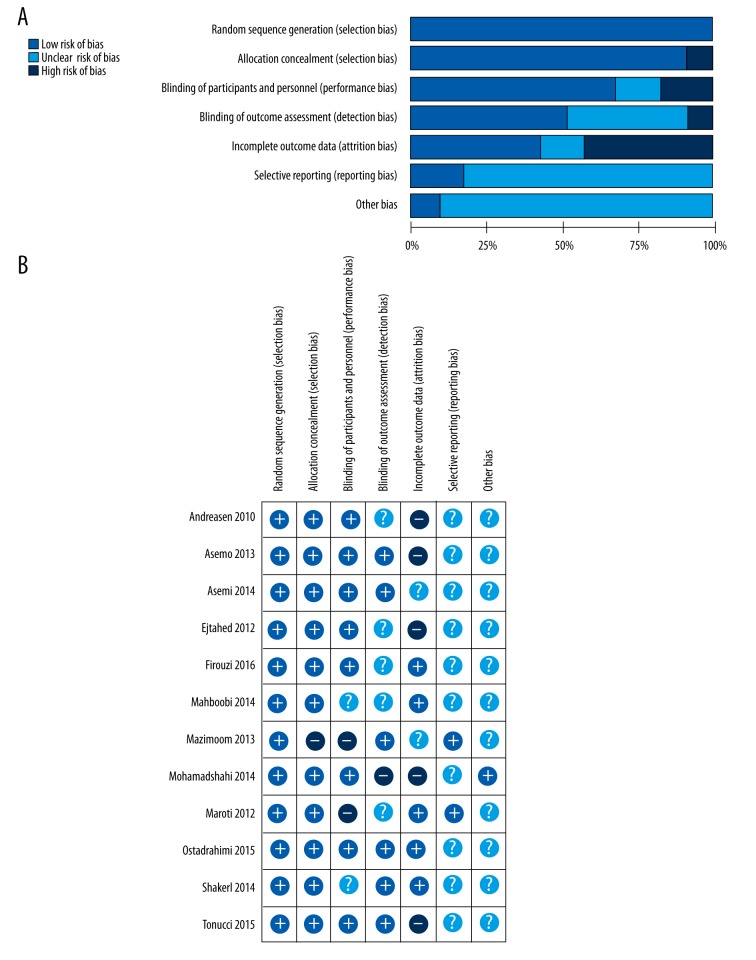
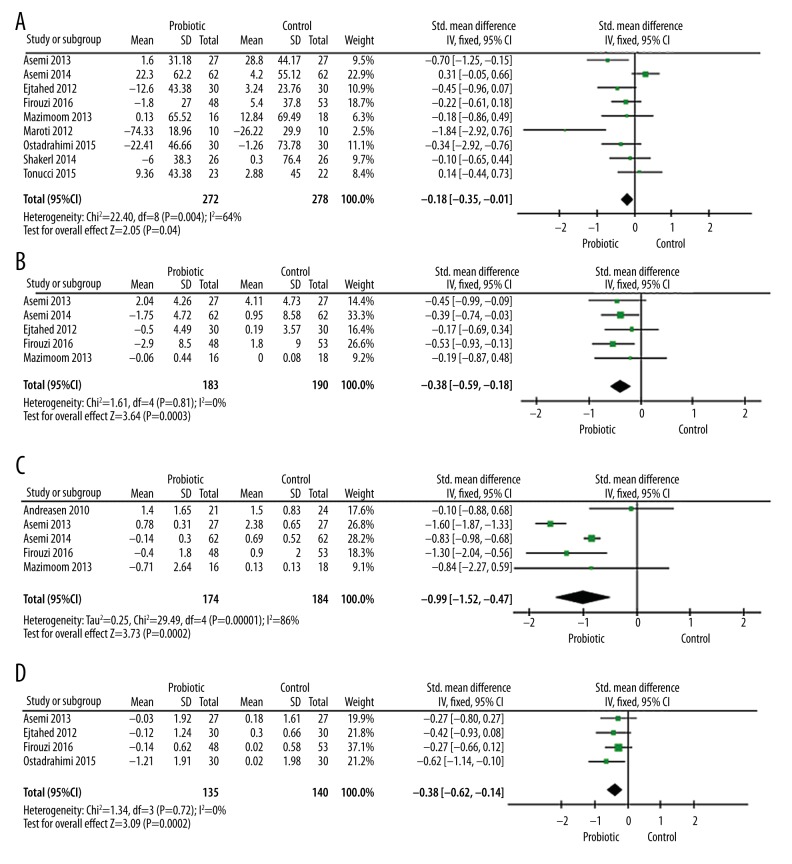
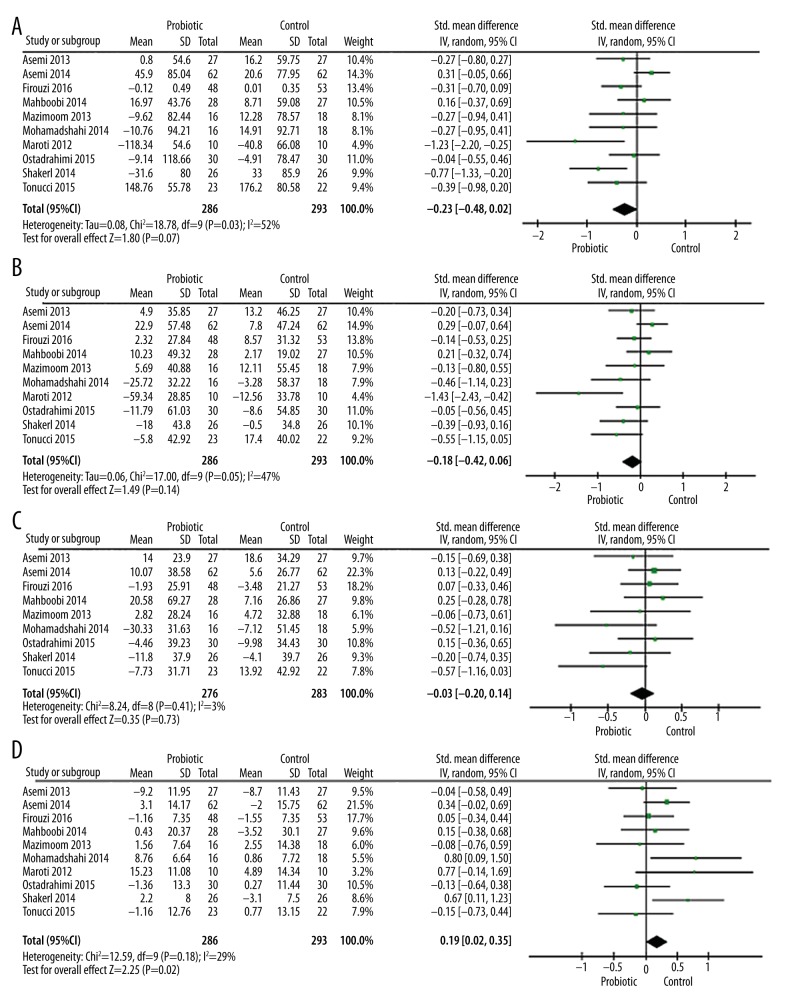
BACKGROUND It has been unclear whether supplemental probiotics therapy improves clinical outcomes in type 2 diabetic patients. This meta-analysis aimed to summarize the effect of probiotics on glucose and lipid metabolism and C-reactive protein (CRP) from 12 randomized controlled trials (RCTs). MATERIAL AND METHODS An up-to-date search was performed for all relevant RCTs up to April 2016 from PubMed, Embase, and Cochrane Library. Standardized mean difference (SMD) and weighted mean difference (WMD) were calculated for a fixed-effect and random-effect meta-analysis to assess the impact of supplemental probiotics on fasting plasma glucose (FPG), glycated hemoglobin (HbA1c), fasting insulin, homeostasis model assessment of insulin resistance (HOMA-IR), lipid profile, and CRP level. RESULTS A total of 12 studies (684 patients) were entered into the final analysis. The effect of probiotics was significant on reducing HbA1c level (standardized mean difference [SMD], -0.38; confidence interval [CI], -0.62 to -0.14, P=0.002; I²=0%, P=0.72 for heterogeneity), fasting insulin level (SMD, -0.38; CI -0.59 to -0.18, P=0.0003; I²=0%, P=0.81 for heterogeneity), and HOMA-IR (SMD, -0.99; CI -1.52 to -0.47, P=0.0002; I²=86%, P<0.00001 for heterogeneity). Pooled results on effects of probiotics on FPG, CRP, or lipid profile were either non-significant or highly heterogeneous. CONCLUSIONS This meta-analysis demonstrated that probiotics supplementation was associated with significant improvement in HbA1c and fasting insulin in type 2 diabetes patients. More randomized placebo-controlled trials with large sample sizes are warranted to confirm our conclusions.
补充益生菌疗法是否能改善2型糖尿病患者的临床结局尚不清楚。本荟萃分析旨在总结12项随机对照试验(RCT)中益生菌对血糖、脂质代谢和C反应蛋白(CRP)的影响。
截至2016年4月,通过对PubMed、Embase和Cochrane图书馆进行全面检索,获取所有相关的随机对照试验。计算标准化均数差(SMD)和加权均数差(WMD),用于固定效应和随机效应荟萃分析,以评估补充益生菌对空腹血糖(FPG)、糖化血红蛋白(HbA1c)、空腹胰岛素、胰岛素抵抗稳态模型评估(HOMA-IR)、血脂谱和CRP水平的影响。
共有12项研究(684例患者)纳入最终分析。益生菌在降低HbA1c水平(标准化均数差[SMD],-0.38;置信区间[CI],-0.62至-0.14,P = 0.002;I² = 0%,异质性P = 0.72)、空腹胰岛素水平(SMD,-0.38;CI -0.59至-0.18,P = 0.0003;I² = 0%,异质性P = 0.81)和HOMA-IR(SMD,-0.99;CI -1.52至-0.47,P = 0.0002;I² = 86%,异质性P < 0.00001)方面效果显著。益生菌对FPG、CRP或血脂谱影响的合并结果要么不显著,要么异质性很高。
本荟萃分析表明,补充益生菌与2型糖尿病患者HbA1c和空腹胰岛素的显著改善相关。需要更多大样本的随机安慰剂对照试验来证实我们的结论。