Ramadass Balamurugan, Rani B Sandya, Pugazhendhi Srinivasan, John K R, Ramakrishna Balakrishnan S
Department of Gastrointestinal Sciences, Christian Medical College, Vellore, India.
Department of Community Health, Christian Medical College, Vellore; Institute of Gastroenterology, SRM Institutes for Medical Science, Chennai, India.
Indian J Med Res. 2017 Feb;145(2):237-246. doi: 10.4103/ijmr.IJMR_639_14.
BACKGROUND & OBJECTIVES: The relevance of the gut microbiota to human health is increasingly appreciated. The objective of this study was to compare the gut microbiota of a group of adult tribals with that of healthy adult villagers in Tamil Nadu, India.
Faeces were collected from 10 healthy tribal adults (TAs) in the Jawadhi hills and from 10 healthy villagers [rural adults (RAs)] in Vellore district, Tamil Nadu. DNA was extracted, and 456 bp segments comprising hypervariable regions 3 and 4 of the 16S rRNA gene were amplified, barcoded and 454 sequenced.
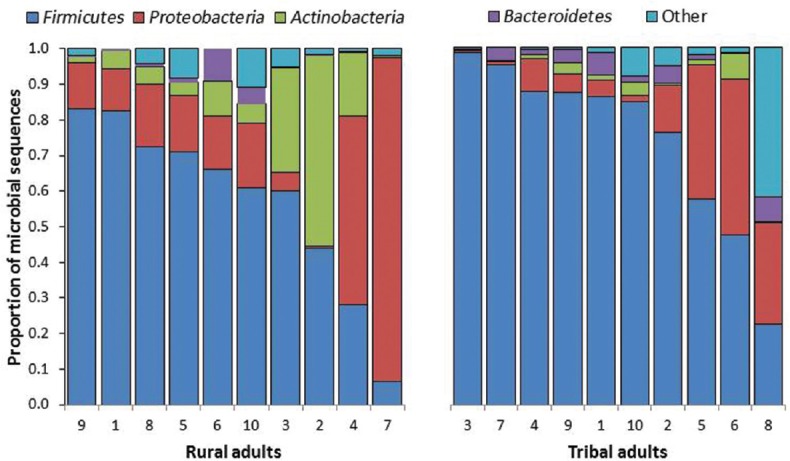
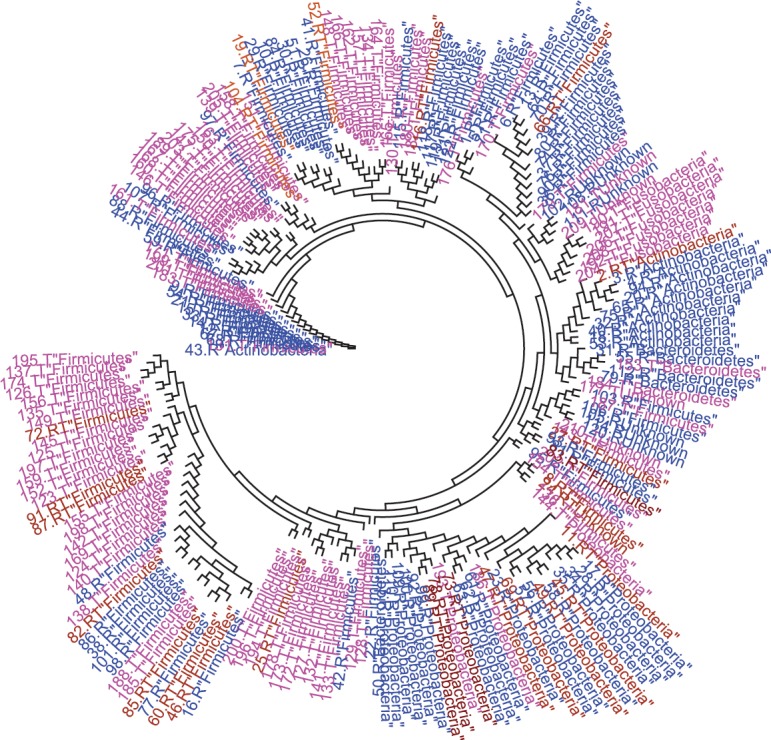
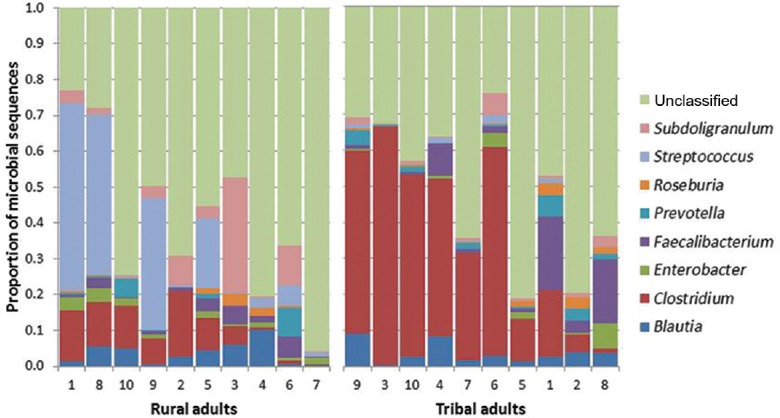
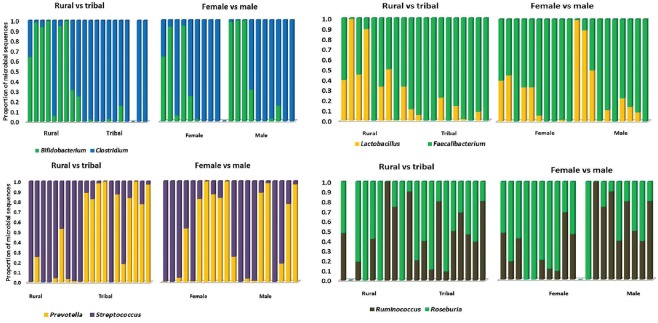
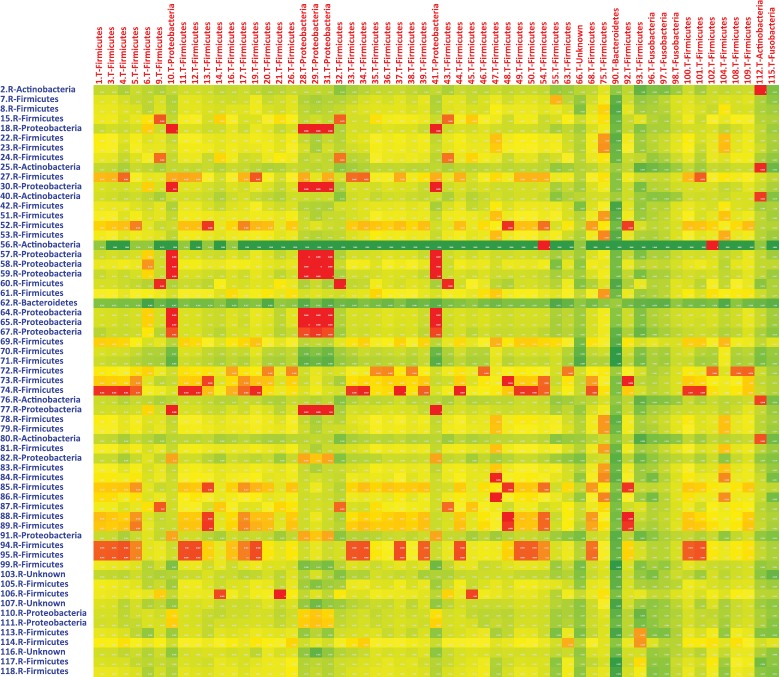
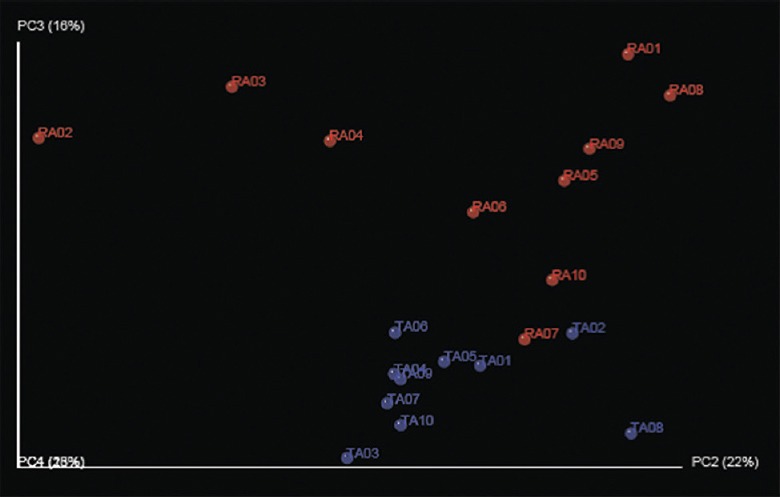
Totally 227,710 good-quality reads were analyzed. TAs consumed a millets-based diet, ate pork every day, and did not consume milk or milk products. RAs consumed a rice-based diet with meat intake once a week. In both groups, Firmicutes was the most abundant phylum, followed by Proteobacteria, Bacteroidetes and Actinobacteria. The median Firmicutes-to-Bacteroidetes ratio was 34.0 in TA and 92.9 in RA groups. Actinobacteria were significantly low in TA, possibly due to non-consumption of milk. Clostridium constituted the most abundant genus in both groups, but was significantly more abundant in TAs than RAs, while Streptococcus was significantly more abundant in RA (P<0.05). Analyses of genetic distance revealed that the microbiota were distinctly different between TA and RA, and principal component analysis using 550 distinct taxonomically identifiable sequences revealed a clear separation of microbiota composition in the two groups. Phylogenetic analysis of major microbiota indicated clustering of microbial groups at different major branch points for TAs and RAs.
INTERPRETATION & CONCLUSIONS: Phylum Firmicutes and genus Clostridium constituted the bulk of the faecal microbiota, while significant differences in composition between the groups were probably due to differences in diet and lifestyle.
肠道微生物群与人类健康的相关性日益受到重视。本研究的目的是比较印度泰米尔纳德邦一组成年部落居民与健康成年村民的肠道微生物群。
从贾瓦迪山的10名健康部落成年人(TA)和泰米尔纳德邦韦洛尔区的10名健康村民(农村成年人,RA)中收集粪便。提取DNA,扩增16S rRNA基因高变区3和4的456 bp片段,进行条形码标记并进行454测序。
共分析了227,710条高质量读数。TA食用以小米为主的饮食,每天吃猪肉,不食用牛奶或奶制品。RA食用以大米为主的饮食,每周摄入一次肉类。两组中,厚壁菌门是最丰富的菌门,其次是变形菌门、拟杆菌门和放线菌门。TA组厚壁菌门与拟杆菌门的中位数比值为34.0,RA组为92.9。TA组放线菌明显较低,可能是由于不食用牛奶。梭菌属在两组中都是最丰富的属,但在TA组中比RA组明显更丰富,而链球菌在RA组中明显更丰富(P<0.05)。遗传距离分析表明,TA和RA的微生物群明显不同,使用550个不同的可分类识别序列进行的主成分分析显示两组微生物群组成明显分离。主要微生物群的系统发育分析表明,TA和RA在不同主要分支点的微生物群聚类。
厚壁菌门和梭菌属构成了粪便微生物群的主体,而两组之间组成的显著差异可能是由于饮食和生活方式的不同。