Zhao Chunhua, Zhao Qiuwei, Li Yin, Zhang Yanping
CAS Key Laboratory of Microbial Physiological and Metabolic Engineering, Institute of Microbiology, Chinese Academy of Sciences, No. 1 West Beichen Road Chaoyang District, Beijing, 100101, China.
University of Chinese Academy of Sciences, Beijing, 100049, China.
Microb Cell Fact. 2017 Jun 24;16(1):115. doi: 10.1186/s12934-017-0728-3.
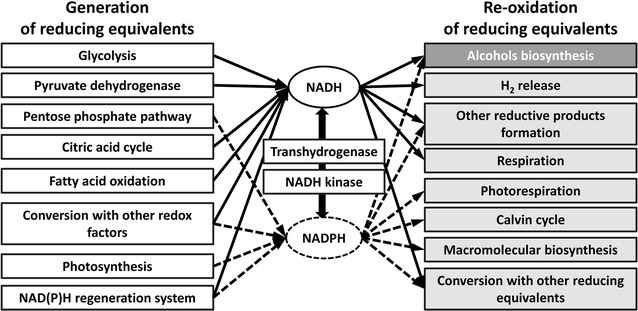
The biosynthetic pathways of most alcohols are linked to intracellular redox homeostasis, which is crucial for life. This crucial balance is primarily controlled by the generation of reducing equivalents, as well as the (reduction)-oxidation metabolic cycle and the thiol redox homeostasis system. As a main oxidation pathway of reducing equivalents, the biosynthesis of most alcohols includes redox reactions, which are dependent on cofactors such as NADH or NADPH. Thus, when engineering alcohol-producing strains, the availability of cofactors and redox homeostasis must be considered. In this review, recent advances on the engineering of cellular redox homeostasis systems to accelerate alcohol biosynthesis are summarized. Recent approaches include improving cofactor availability, manipulating the affinity of redox enzymes to specific cofactors, as well as globally controlling redox reactions, indicating the power of these approaches, and opening a path towards improving the production of a number of different industrially-relevant alcohols in the near future.
大多数醇类的生物合成途径与细胞内氧化还原稳态相关联,而氧化还原稳态对生命至关重要。这种关键的平衡主要由还原当量的产生以及(还原)-氧化代谢循环和硫醇氧化还原稳态系统控制。作为还原当量的主要氧化途径,大多数醇类的生物合成包括依赖于NADH或NADPH等辅因子的氧化还原反应。因此,在工程改造产醇菌株时,必须考虑辅因子的可用性和氧化还原稳态。在本综述中,总结了细胞氧化还原稳态系统工程改造以加速醇类生物合成的最新进展。近期的方法包括提高辅因子可用性、操纵氧化还原酶对特定辅因子的亲和力以及全局控制氧化还原反应,这些方法显示出强大的作用,并为在不久的将来提高多种不同工业相关醇类的产量开辟了一条道路。