Xi Yue, Liu Jinyi, Dong Chao, Cheng Zong-Ming Max
Fruit Crop Systems Biology Laboratory, College of Horticulture, Nanjing Agricultural UniversityNanjing, China.
Department of Plant Sciences, University of TennesseeKnoxville, TN, United States.
Front Plant Sci. 2017 Jun 9;8:978. doi: 10.3389/fpls.2017.00978. eCollection 2017.
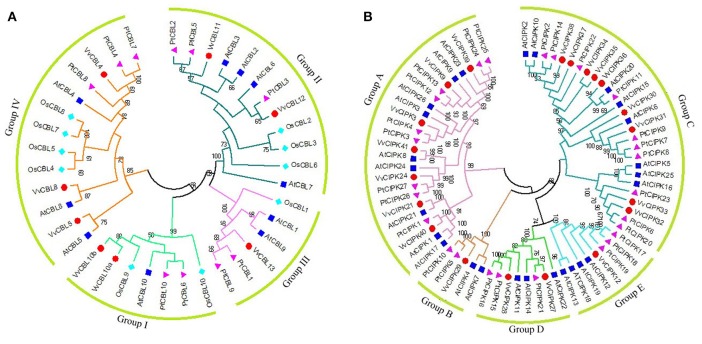
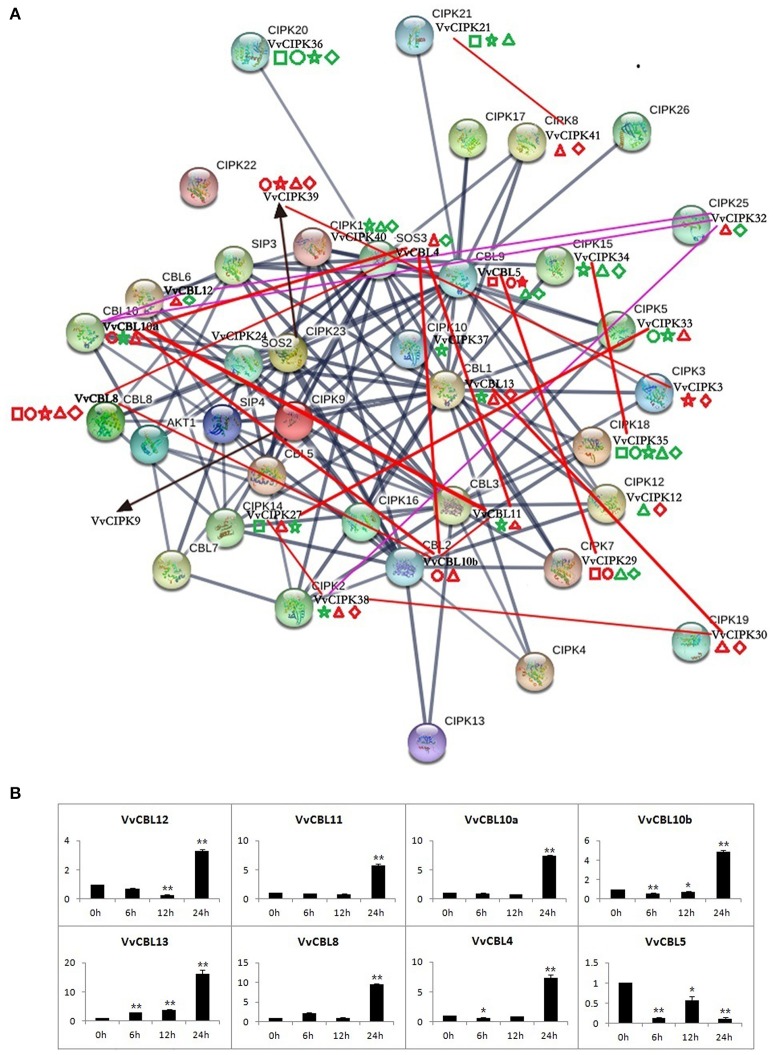
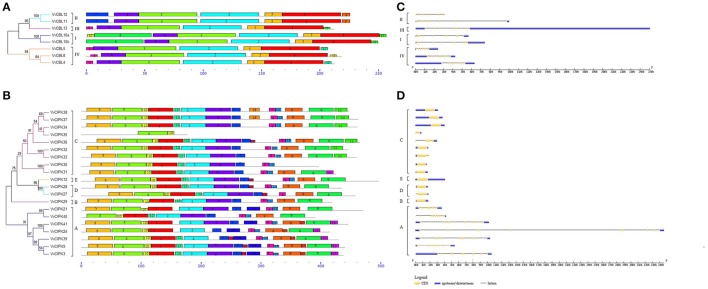
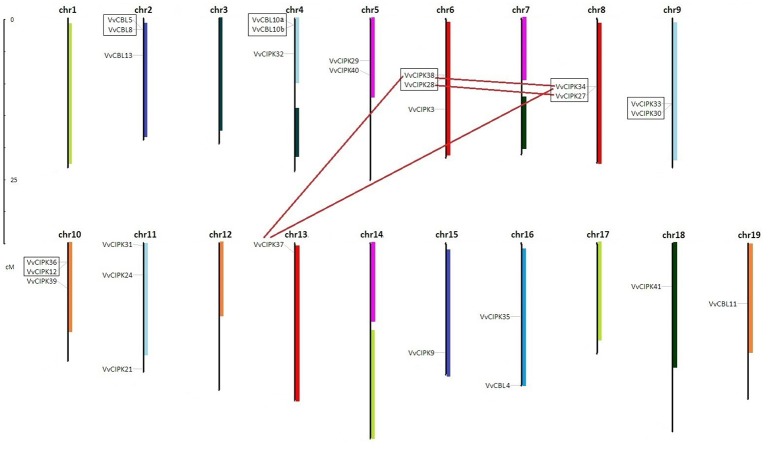
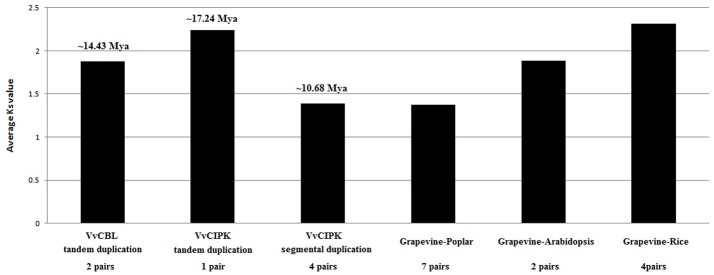
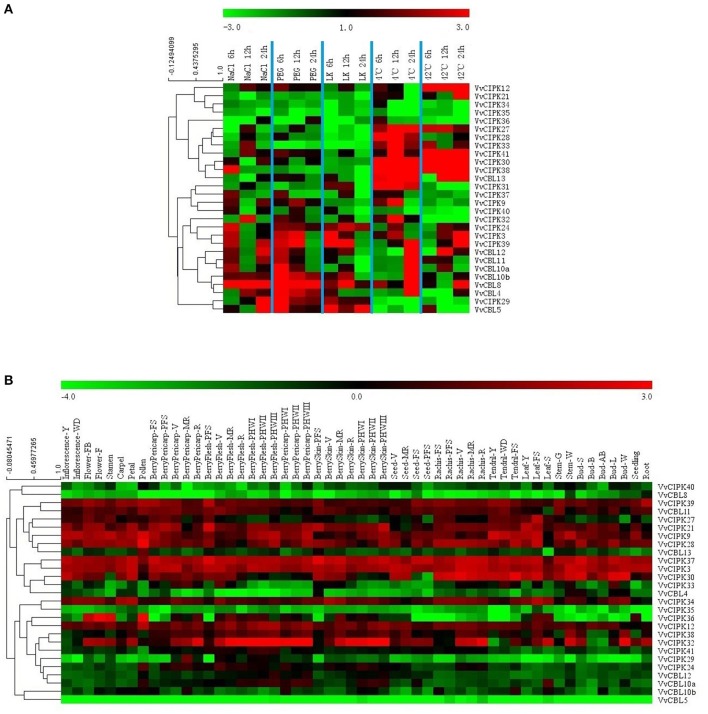
Calcium plays a central role in regulating signal transduction pathways. Calcineurin B-like proteins (CBLs), which harbor a crucial region consisting of EF hands that capture Ca, interact in a specific manner with CBL-interacting protein kinases (CIPKs). This two gene families or their interacting-complex widely respond to various environment stimuli and development processes. The genome-wide annotation and specific expression patterns of CBLs and CIPKs, however, in grapevine remain unclear. In the present study, eight and 20 genes were identified in grapevine genome, and divided into four and five subfamilies, respectively, based on phylogenetic analysis, and validated by gene structure and the distribution of conserved protein motifs. Four (50%) out of eight and eight (40%) out of 20 were found to be derived from tandem duplication, and five (25%) out of 20 were derived from segmental duplication, indicating that the expansion of grapevine CBL and CIPK gene families were mainly contributed by gene duplication, and all duplication events between genes only detected in intron poor clade. Estimating of synonymous and non-synonymous substitution rates of both gene families suggested that genes seems more conserved than genes, and were derived by positive selection pressure, whereas genes were mainly derived by purifying selection pressure. Expressional analyses of and genes based on microarray and qRT-PCR data performed diverse expression patterns of and in response to both various abiotic stimuli and at different development stages. Furthermore, the co-expression analysis of grapevine and suggested that CBL-CIPK complex seems to be more responsive to abiotic stimuli than during different development stages. may play an important and special role in regulating low temperature stress. The protein interaction analysis suggested divergent mechanisms might exist between Arabidopsis and grapevine. Our results will facilitate the future functional characterization of individual and .
钙在调节信号转导途径中起着核心作用。类钙调神经磷酸酶B蛋白(CBL)含有一个由能捕获钙的EF手结构组成的关键区域,它以特定方式与CBL相互作用蛋白激酶(CIPK)相互作用。这两个基因家族或它们的相互作用复合体广泛响应各种环境刺激和发育过程。然而,葡萄中CBL和CIPK的全基因组注释及特异性表达模式仍不清楚。在本研究中,在葡萄基因组中鉴定出8个CBL基因和20个CIPK基因,根据系统发育分析将它们分别分为4个和5个亚家族,并通过基因结构和保守蛋白基序的分布进行了验证。8个CBL基因中有4个(50%)和20个CIPK基因中有8个(40%)是串联重复产生的,20个CIPK基因中有5个(25%)是片段重复产生的,这表明葡萄CBL和CIPK基因家族的扩增主要由基因重复导致,并且所有CBL基因间的重复事件仅在低内含子分支中被检测到。对这两个基因家族的同义替换率和非同义替换率的估计表明,CBL基因似乎比CIPK基因更保守,且CIPK基因是由正选择压力产生的,而CBL基因主要是由纯化选择压力产生的。基于微阵列和qRT-PCR数据对CBL和CIPK基因的表达分析表明,CBL和CIPK在响应各种非生物刺激以及不同发育阶段时表现出不同的表达模式。此外,葡萄CBL和CIPK的共表达分析表明,CBL-CIPK复合体对非生物刺激的响应似乎比对不同发育阶段的响应更强。VviCIPK10可能在调节低温胁迫中发挥重要且特殊的作用。蛋白质相互作用分析表明拟南芥和葡萄之间可能存在不同的机制。我们的结果将有助于未来对单个CBL和CIPK的功能进行表征。