Geriatric Medicine Unit, University of Edinburgh, Edinburgh, UK.
Centre for Cognitive Ageing and Cognitive Epidemiology, University of Edinburgh, UK.
Age Ageing. 2017 Sep 1;46(5):722-728. doi: 10.1093/ageing/afx105.
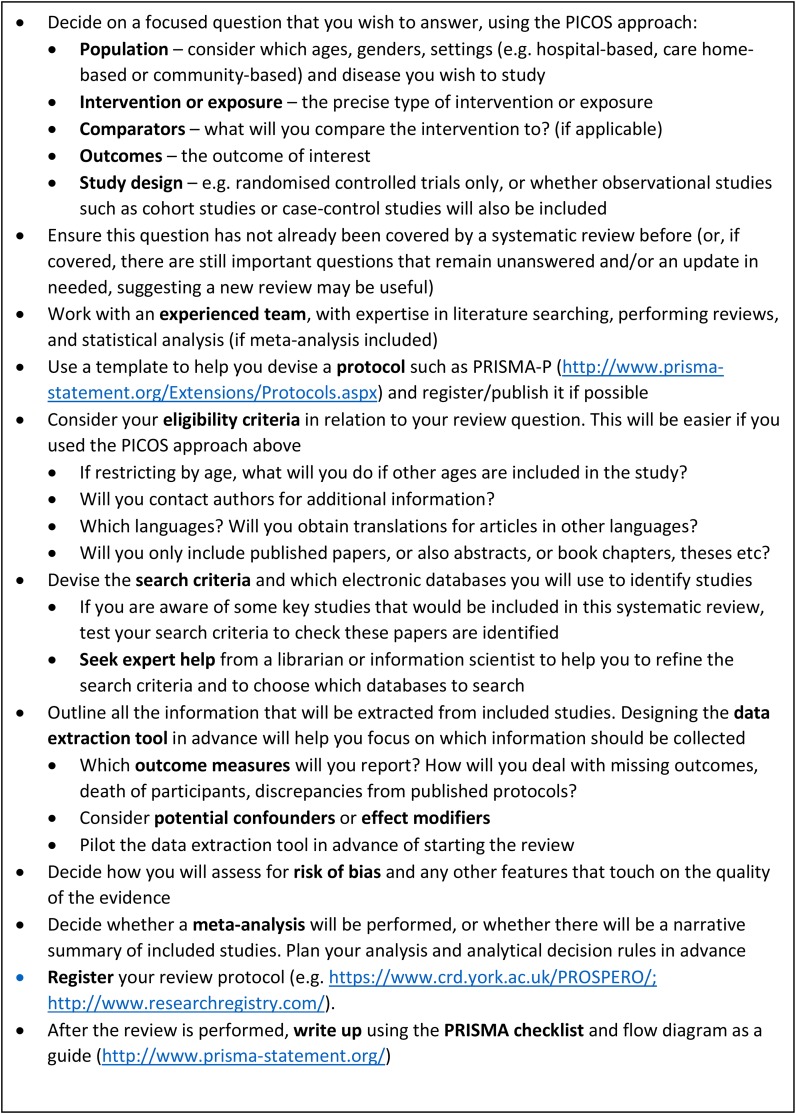
Systematic reviews and meta-analyses are increasingly common. This article aims to provide guidance for people conducting systematic reviews relevant to the healthcare of older people. An awareness of these issues will also help people reading systematic reviews to determine whether the results will influence their clinical practice. It is essential that systematic reviews are performed by a team which includes the required technical and clinical expertise. Those performing reviews for the first time should ensure they have appropriate training and support. They must be planned and performed in a transparent and methodologically robust way: guidelines are available. The protocol should be written-and if possible published-before starting the review. Geriatricians will be interested in a table of baseline characteristics, which will help to determine if the studied samples or populations are similar to their patients. Reviews of studies of older people should consider how they will manage issues such as different age cut-offs; non-specific presentations; multiple predictors and outcomes; potential biases and confounders. Systematic reviews and meta-analyses may provide evidence to improve older people's care, or determine where new evidence is required. Newer methodologies, such as meta-analyses of individual level data, network meta-analyses and umbrella reviews, and realist synthesis, may improve the reliability and clinical utility of systematic reviews.
系统评价和荟萃分析越来越常见。本文旨在为从事与老年人医疗保健相关的系统评价的人员提供指导。了解这些问题也将帮助阅读系统评价的人确定结果是否会影响他们的临床实践。至关重要的是,系统评价应由一个团队进行,其中包括所需的技术和临床专业知识。那些首次进行审查的人应确保他们接受了适当的培训和支持。他们必须以透明和方法稳健的方式进行计划和执行:有指南可供使用。在开始审查之前,应编写并尽可能发布方案。老年病医生将对基线特征表感兴趣,这将有助于确定研究样本或人群是否与他们的患者相似。对老年人研究的综述应考虑如何处理不同的年龄截止值、非特异性表现、多个预测因素和结果、潜在的偏差和混杂因素等问题。系统评价和荟萃分析可以提供证据,以改善老年人的护理,或确定需要新的证据。新的方法,如个体水平数据的荟萃分析、网络荟萃分析和伞式综述以及现实主义综合,可能会提高系统评价的可靠性和临床实用性。