Jiang Yuqing, Zhao Shujie, Ding Yin, Nong Luming, Li Haibo, Gao Gongming, Zhou Dong, Xu Nanwei
Department of Orthopedics, Nanjing Medical University Affiliated Changzhou No. 2 People's Hospital, Changzhou, Jiangsu 213000, P.R. China.
Mol Med Rep. 2017 Sep;16(3):2522-2528. doi: 10.3892/mmr.2017.6862. Epub 2017 Jun 27.
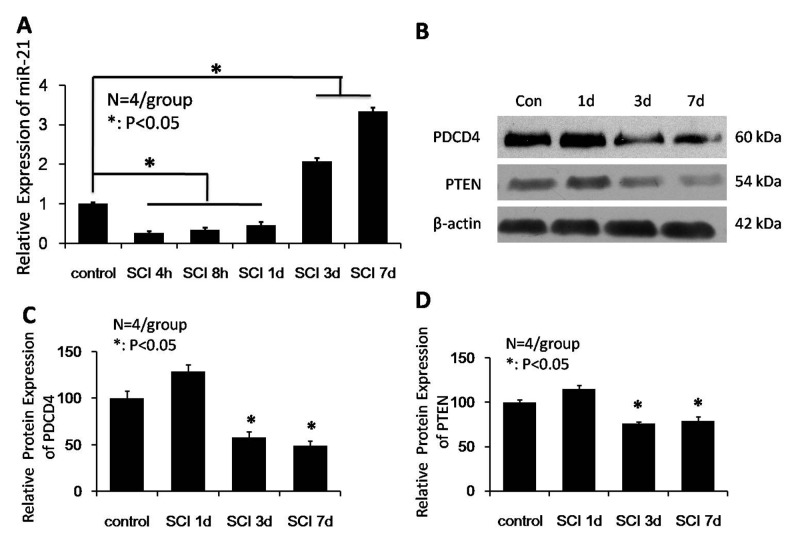
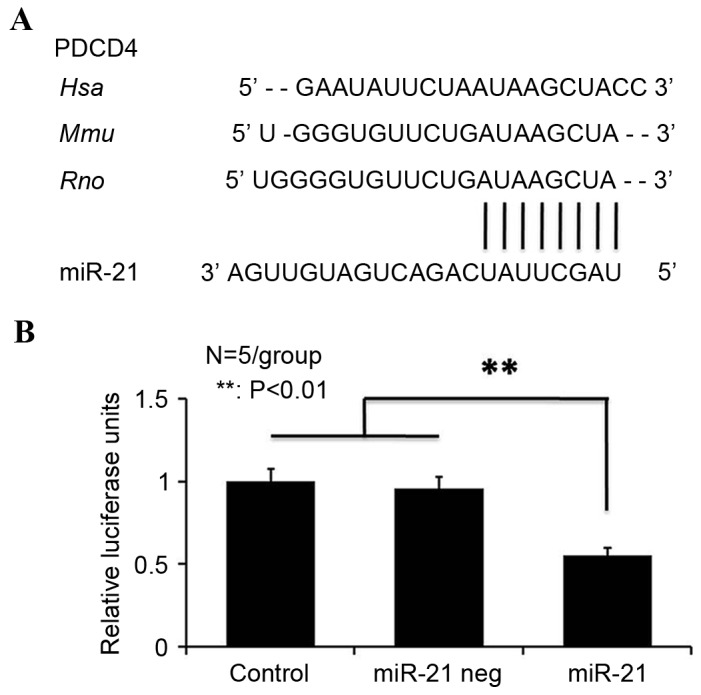
Altered expression levels of microRNA‑21 (miRNA‑21) have been observed in a series of pathological processes, including cancer and central nervous system injury; however, the involvement of miRNA‑21 in the molecular pathophysiology of spinal cord injury (SCI) has not been well documented. The present study examined the expression levels of miRNA‑21 and its predicted target genes, programmed cell death 4 (PDCD4) and phosphatase and tensin homolog (PTEN), in rats using quantitative polymerase chain reaction and western blotting to further understand the role of miRNA‑21 and the mechanisms underlying repair following SCI. The present study demonstrated that compared with uninjured spinal cords, miRNA‑21 expression levels were significantly downregulated in injured spinal cords 4 and 8 h, and 1 day post‑SCI, and were significantly upregulated after 3 and 7 days. Conversely, expression levels of PDCD4 and PTEN were significantly decreased at days 3 and 7 post‑SCI compared with the control group. miRNA‑21 overexpression in monolayer‑cultured postnatal rat spinal cord neurons promoted neurite outgrowth and downregulated protein expression levels of PDCD4; however, PTEN protein expression levels were unaltered. To confirm that miRNA‑21 directly targets PDCD4, a pRL‑CMV luciferase reporter construct was used to detect miRNA‑21 interactions with the PDCD4 3'‑untranslated region. The results demonstrated that miRNA‑21 decreased luciferase activity compared with a rat PDCD4 control reporter. The results of the present study suggested that increased miRNA‑21 expression levels following SCI may promote the repair of injured spinal cords by inhibiting the expression of its target gene PDCD4.
在一系列病理过程中,包括癌症和中枢神经系统损伤,均观察到了微小RNA-21(miRNA-21)表达水平的改变;然而,miRNA-21在脊髓损伤(SCI)分子病理生理学中的作用尚未得到充分记载。本研究采用定量聚合酶链反应和蛋白质印迹法检测大鼠中miRNA-21及其预测靶基因程序性细胞死亡4(PDCD4)和磷酸酶及张力蛋白同源物(PTEN)的表达水平,以进一步了解miRNA-21的作用及SCI后修复的潜在机制。本研究表明,与未损伤的脊髓相比,在SCI后4小时、8小时和1天时,损伤脊髓中miRNA-21的表达水平显著下调,而在3天和7天后显著上调。相反,与对照组相比,SCI后3天和7天时PDCD4和PTEN的表达水平显著降低。在原代培养的新生大鼠脊髓神经元中过表达miRNA-21可促进神经突生长并下调PDCD4的蛋白表达水平;然而,PTEN蛋白表达水平未改变。为了证实miRNA-21直接靶向PDCD4,使用pRL-CMV荧光素酶报告构建体检测miRNA-21与PDCD4 3'-非翻译区的相互作用。结果表明,与大鼠PDCD4对照报告基因相比,miRNA-21降低了荧光素酶活性。本研究结果提示,SCI后miRNA-21表达水平的升高可能通过抑制其靶基因PDCD4的表达促进损伤脊髓的修复。