Microelectronics-Photonics Graduate Program, 731 W. Dickson St., University of Arkansas, Fayetteville, Arkansas, AR 72701, USA.
Department of Physics, 825 W. Dickson St., University of Arkansas, Fayetteville, Arkansas, AR 72701, USA.
Sensors (Basel). 2017 Jun 30;17(7):1530. doi: 10.3390/s17071530.
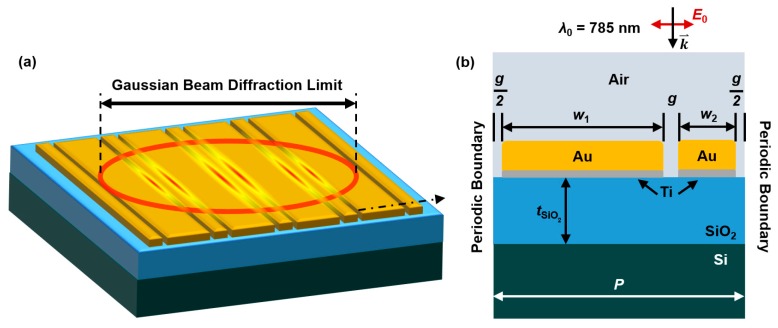
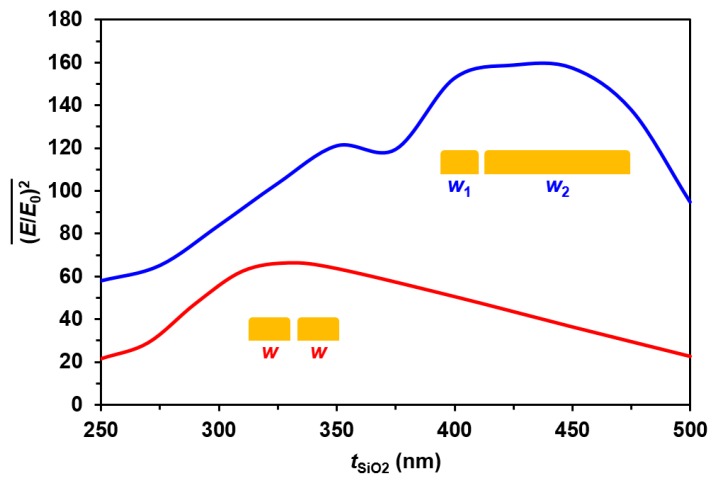
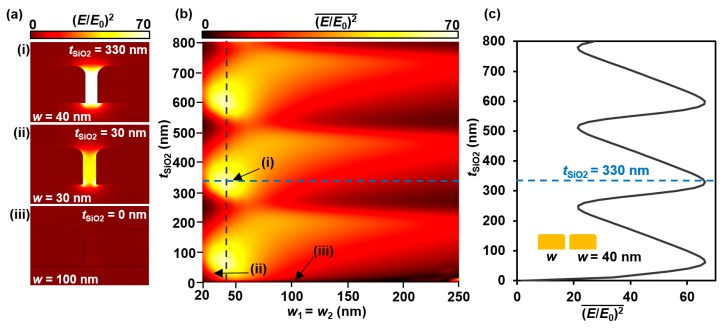
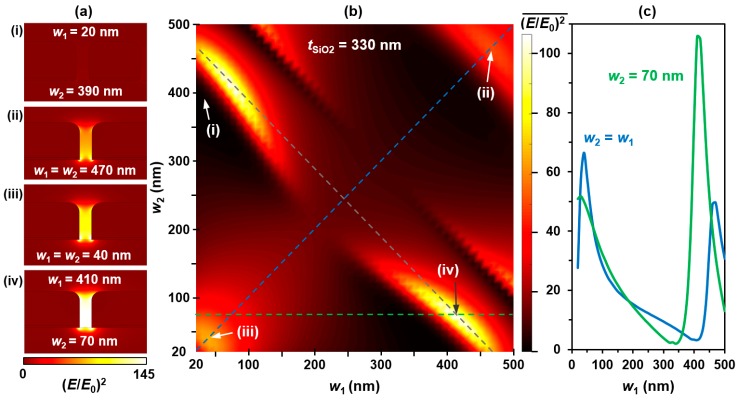
This work investigates a new design for a plasmonic SERS biosensor via computational electromagnetic models. It utilizes a dual-width plasmonic grating design, which has two different metallic widths per grating period. These types of plasmonic gratings have shown larger optical enhancement than standard single-width gratings. The new structures have additional increased enhancement when the spacing between the metal decreases to sub-10 nm dimensions. This work integrates an oxide layer to improve the enhancement even further by carefully studying the effects of the substrate oxide thickness on the enhancement and reports ideal substrate parameters. The combined effects of varying the substrate and the grating geometry are studied to fully optimize the device's enhancement for SERS biosensing and other plasmonic applications. The work reports the ideal widths and substrate thickness for both a standard and a dual-width plasmonic grating SERS biosensor. The ideal geometry, comprising a dual-width grating structure atop an optimal SiO₂ layer thickness, improves the enhancement by 800%, as compared to non-optimized structures with a single-width grating and a non-optimal oxide thickness.
本工作通过计算电磁模型研究了一种等离子体 SERS 生物传感器的新设计。它利用了双宽等离子体光栅设计,每个光栅周期具有两种不同的金属宽度。与标准单宽光栅相比,这些类型的等离子体光栅显示出更大的光学增强。当金属之间的间距减小到亚 10nm 尺寸时,新结构具有额外的增强。这项工作集成了一个氧化物层,通过仔细研究衬底氧化物厚度对增强的影响,进一步提高了增强效果,并报告了理想的衬底参数。研究了改变衬底和光栅几何形状的综合效应,以充分优化器件的增强,用于 SERS 生物传感和其他等离子体应用。报告了标准和双宽等离子体光栅 SERS 生物传感器的理想宽度和衬底厚度。理想的几何形状,包括在最佳 SiO₂层厚度上的双宽光栅结构,与具有单宽光栅和非最佳氧化物厚度的非优化结构相比,将增强提高了 800%。